
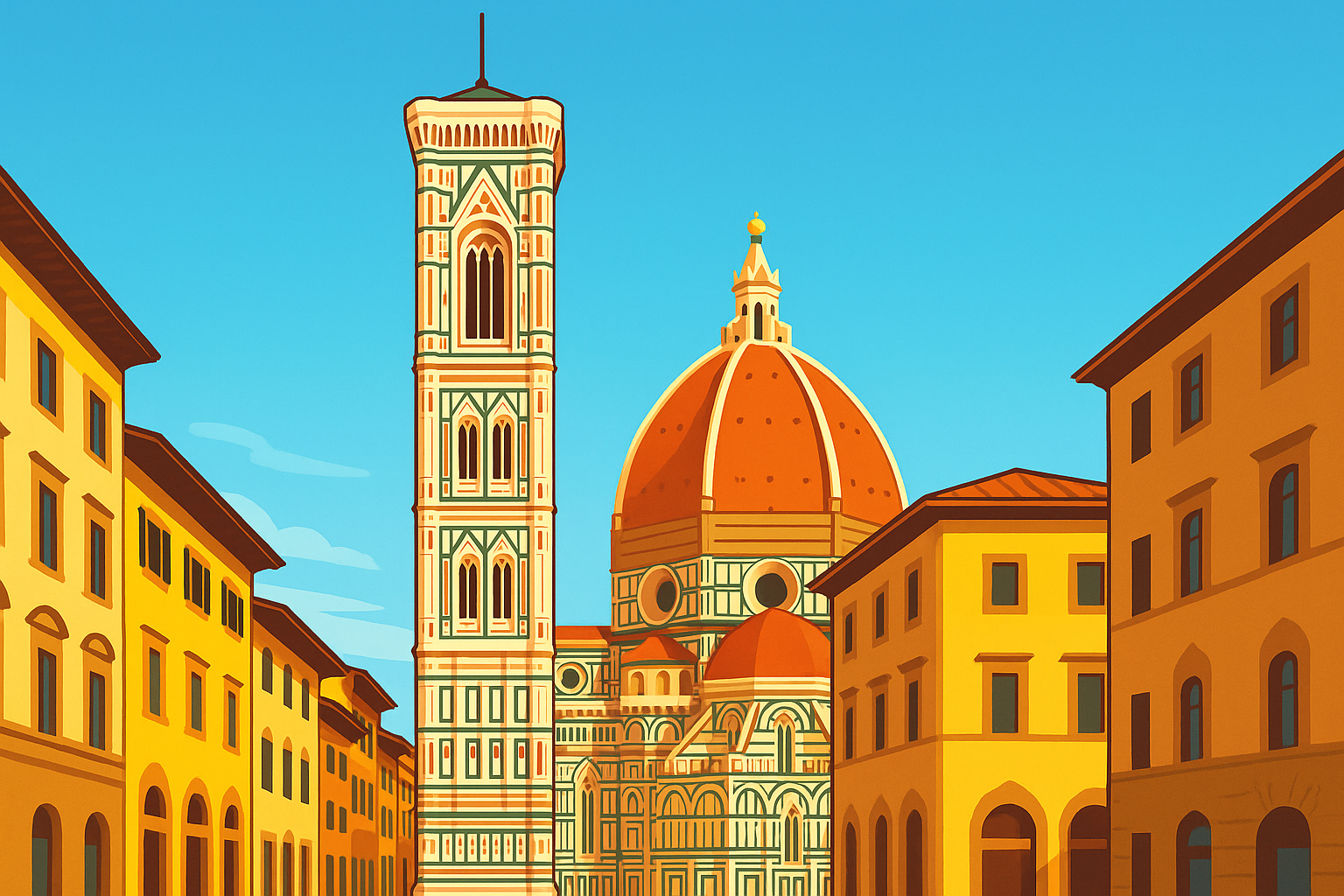
Giotto’s Campanile
Experience the magic of Tuscany
Imagine driving through the Chianti hills, discovering medieval villages, and stopping for an aperitivo at sunset. Renting a car is the secret to experiencing Tuscany with true freedom. Book now for the best choice.
🔍 Choose your car for TuscanyThe Polychrome Pillar: An Expert Guide to Climbing Giotto’s Bell Tower
To stand in Florence’s Piazza del Duomo is to face the traveler’s great dilemma. Before you, Brunelleschi’s colossal, world-changing Dome commands the skyline, a titan of terracotta and genius. Beside it, slender, elegant, and encased in a sublime geometry of colored marble, stands Giotto’s Campanile. The question is not if you should climb to see Florence from above, but which of these Renaissance giants you should ascend.
This guide makes the definitive case for the Campanile. While the Dome climb offers the singular experience of ascending Florence’s most recognized icon, Giotto’s Bell Tower provides, without question, the single greatest view of it. It is the photographer’s choice, the connoisseur’s viewpoint, and a slightly more manageable—though still formidable—physical journey.
This freestanding marvel of Florentine Gothic architecture soars 278 feet (84.7 meters) above the piazza, clad in its signature “dress” of white, green, and red marble. A climb to its summit is a journey of two parts. The first is a physical ascent of 414 steps, for which there is no elevator. The second is a symbolic ascent, a climb past a 14th-century “encyclopedia in stone” that tells the story of humanity’s redemption, encoded on its magnificent facade. This is both the practical “how” for a flawless visit and the profound “why” that makes the climb one of the most rewarding experiences in Italy.
An Encyclopedia in Stone: Reading the Tower’s Facade
Before taking a single step, stop. The climb begins at the base, with the story. The Campanile is not merely a belfry; it is a profound 14th-century philosophical statement, a “medieval encyclopedia” in marble designed to be read from the ground up.
The sculptural program, originally conceived by Giotto himself, presents a complete narrative of human existence. The first level, a series of 26 hexagonal panels, is a celebration of human activity. It begins with the Creation of Adam and Eve and moves through the Artes Mechanicae (Mechanical Arts)—a radical celebration of human labor. You will see panels dedicated to the art of building, medicine, weaving, and agriculture. In 1334, this was a breathtakingly humanist statement, honoring the very trades and guilds that had made Florence the most powerful and wealthy city in Europe.
Look higher, and you’ll find a second level of 28 diamond-shaped lozenges depicting the “celestial powers” that govern this human life. Here, you find the Artes Liberales (Liberal Arts) like Geometry and Astronomy, the Seven Planets, the Seven Christian Virtues, and the Seven Sacraments. The tower’s philosophy is embedded in its very structure. A visitor, and by extension society, ascends from the foundation of earthly Labor (the hexagons), through intellectual and moral Knowledge (the lozenges), to a divine, panoramic view of the city that human hands have built.
One crucial note: the magnificent, weathered sculptures you see on the tower today are exquisite copies. The priceless originals, carved by masters like Andrea Pisano and Luca della Robbia, are safely housed just steps away in the magnificent Opera del Duomo Museum. A visit to this museum is not optional; it is the essential second half of your climb.
A Drama in Three Acts: The History of the Campanile
The name “Giotto’s Bell Tower” is a romantic simplification. The tower’s creation is, in reality, a 25-year drama of genius, plague, and pragmatic brilliance, spanning three of Florence’s greatest masters.
Act I: Giotto di Bondone (1334–1337)
In 1334, the Opera del Duomo (the cathedral’s building committee) commissioned Giotto di Bondone, then 67 years old and the most celebrated artist in Italy, to oversee the project. Giotto laid the foundation and, more importantly, established the revolutionary design. He conceived of the tower not as a simple Gothic spire but as a painting in stone, dictating the rich polychrome marble facade and the complex philosophical program of the sculptures. He completed only the first level before his death just three years later.
Act II: Andrea Pisano (1337–1448)
The work passed to Giotto’s most gifted pupil, Andrea Pisano, who had just completed his masterpiece on the bronze doors of the adjacent Baptistery. Pisano faithfully continued Giotto’s vision, overseeing the creation of the hexagonal and lozenge-shaped panels. His work, however, was catastrophically halted in 1348 by the Black Death, which decimated Florence and stopped all major projects in their tracks.
Act III: Francesco Talenti (1348–1359)
When work resumed, Francesco Talenti was put in charge. He completed the tower, but with a history-altering change. Giotto’s original, ambitious design called for a massive, 400-foot (122-meter) pyramidal spire to crown the tower. Talenti, perhaps for reasons of stability, cost, or a shift in aesthetic, scrapped the spire entirely. Instead, he built the “large projecting terrace” that we find at the top today. In this single, pragmatic decision, Talenti sacrificed Giotto’s soaring Gothic finale for the magnificent, functional viewing platform that millions prize today. We do not stand where Giotto intended; we stand on Talenti’s brilliant solution.
The Architecture of a Masterpiece
The Campanile is the supreme example of Florentine Gothic architecture. This style is distinct from its French counterpart. Where French Gothic celebrates skeletal lightness and soaring voids, the Florentine style, rooted in its Roman past, emphasizes “sound solidity” and magnificent “polychrome marble encrustations.” It is, in essence, a monumental painting applied to architecture.
The vibrant, geometric “skin” of the tower is made from three specific marbles, sourced to create a precise palette: brilliant white marble from Carrara, deep green from Prato, and a soft red from Siena. The structure itself is a massive square, roughly 49.2 feet (15 meters) on each side, anchored by powerful corner buttresses that give it an air of unshakeable permanence.
Francesco Talenti’s genius is on full display in the upper levels. He employed a brilliant architectural trick to manage the viewer’s perception from the piazza below. The top three windowed levels were built progressively larger, extending further than the ones below them. This subtle expansion “exactly counters the effect of perspective,” making the tower appear perfectly, powerfully straight and uniform when viewed from the ground, rather than tapering away from the eye.
For the climber, the tower’s most welcome features are the “three superimposed loggias.” These large, open-air floors, defined by their elegant mullioned windows, are not just beautiful; they are the crucial, open-air rest stops that break up the 414-step ascent, offering shade, a place to catch your breath, and spectacular, framed previews of the view to come.
Planning Your Ascent: Tickets, Times, and Logistics
A smooth visit requires careful planning. Here is the essential information you need to know before you go.
Tickets and Reservations
It is no longer possible to buy a “tower-only” ticket. Entry is managed through the official Duomo complex pass system. The correct ticket is the “Giotto Pass,” which costs 20.00 EUR. This pass represents one of the best cultural values in Florence. It is valid for three consecutive calendar days from the date you select and also includes admission to the Baptistery of San Giovanni, the Opera del Duomo Museum, and the Santa Reparata crypt.
As of May 2023, all holders of the Giotto Pass must reserve a mandatory time slot for the Bell Tower climb. These slots fill up quickly. It is essential to book online from the official website weeks in advance, especially during high season.
Opening Hours & Duration
The Campanile is open to climbers seven days a week, from 8:15 AM to 7:30 PM (19:30). The most critical detail for planning is the last admission, which is 45 minutes before closing, at 6:45 PM (18:45). Plan for a total visit of 60 to 90 minutes. This provides a comfortable pace for the 414-step climb, allowing for 5-10 minute stops at the intermediate loggias and at least 20 minutes on the top terrace to savor the 360-degree view.
The No-Bag Policy & Luggage Storage
This is the most critical logistical detail. The Campanile is a 14th-century monument, and it is “forbidden to bring luggage, backpacks, parcels… and large and medium-sized bags” inside. You will be denied entry at the door, even with a timed ticket.
The solution is the official, free luggage storage (Deposito Bagagli) provided by the Opera del Duomo. Its location is Piazza Duomo n. 38/r. This is on the back side of the Cathedral, right next to the entrance of the Opera del Duomo Museum.
Insider Tip: You must check your bag at the official storage before your climb. Arrive at the storage location at least 15 minutes before your ticketed time slot, as there is often a line.
Facilities & Accessibility
There are no toilets inside the Bell Tower. You must use the public restrooms at the ticket office near the Baptistery or the free, clean facilities inside the Opera del Duomo Museum.
This climb is not accessible for visitors with mobility challenges. There are 414 steps and “No lift is available.” The climb is officially “not recommended for people with a heart condition or suffering from dizziness and claustrophobia.” While less claustrophobic than the Dome, the final stairwells are narrow.
Getting to the Heart of Florence
Giotto’s Bell Tower is located in the Piazza del Duomo, the undisputed geographic and spiritual heart of Florence. The entire historic center, or centro storico, is a ZTL (Restricted Traffic Zone). Driving here as a visitor is not possible and will result in heavy fines.
- By Foot (The Best Way): Florence is a city made for walking. From the main Santa Maria Novella (SMN) train station, the Campanile is a scenic and straightforward 10 to 15-minute walk.
- By Bus: If arriving from further out, the small, electric Autolinee Toscane buses are the best option. The C2 line stops at “Roma Duomo,” just moments from the piazza.
- By Tram: The T1 and T2 tram lines connect the Florence airport (Peretola) and outer suburbs to the city center. Both lines terminate at the “Santa Maria Novella” station, from which you can easily walk.
When to Climb for the Perfect View
Timing your climb is crucial for both comfort and photography.
- The Early Bird (Best Option): Book the very first time slot of the day at 8:15 AM. You will beat the summer heat, as the stone stairwell can become hot and stuffy. More importantly, you will avoid the largest crowds and be rewarded with crisp, beautiful morning light for your photos.
- The Golden Hour (Second Best): The light at sunset is equally spectacular, casting a warm, golden glow over the city and the Duomo. In spring or fall, this is around 6:00 PM to 7:00 PM. This is a very popular time, so expect it to be crowded. Remember, the last entry is at 6:45 PM.
- Worst Time to Visit: Midday (11:00 AM to 3:00 PM) in summer. This is when the crowds are at their peak and the climb is at its most strenuous due to the heat.
Beyond the Tower: Making the Most of Your Giotto Pass
Your Giotto Pass is a 3-day ticket to the entire complex (minus the Dome climb). Do not let it go to waste. These companion sites are essential for completing the story.
- Opera del Duomo Museum (A MUST-DO): This world-class museum is where the original 14th and 15th-century sculptures from the Campanile are preserved. After seeing the copies on the tower, you can stand face-to-face with the original hexagonal panels and the 16 life-sized statues of prophets and patriarchs (including masterpieces by Donatello) that once looked out over Florence.
- Baptistery of San Giovanni: Included in your pass, this is one of Florence’s oldest buildings. Step inside to witness the breathtaking 13th-century golden ceiling mosaics depicting the Last Judgment, a masterpiece of Byzantine-style art that directly inspired Dante.
- Santa Reparata: Also included, this is the fascinating archaeological crypt beneath the main Cathedral floor. Here, you can walk among the ruins of the original 4th-century Roman and early Christian basilica that once stood on this spot.
- The “Other” Climbs: For a complete perspective, consider the Torre di Arnolfo at the Palazzo Vecchio. This climb is highly recommended, as it is the only high viewpoint from which you can photograph both the Campanile and the Duomo together in the city skyline.
Capturing the Moment: The Best Photo Spots
You are climbing the Campanile for the view, so capturing it is paramount.
The Signature Shot (From the Top): The best photograph is not from the final, open-air terrace, which is enclosed by a high fence. Instead, the most iconic shot is from the highest loggia just below the top. The large three-mullioned windows on this level perfectly frame Brunelleschi’s Dome, creating a stunning, “up-close and very personal” composition that is impossible from anywhere else.
The “Framed” Shot (On the Way Up): Use the open-air loggias on the intermediate floors as you ascend. They are less crowded, and the Gothic arches of the windows create beautiful, artistic frames for the city streets and the Dome below.
The “Of the Tower” Shot: The Campanile itself is notoriously difficult to photograph from the piazza. The best photos of the tower are taken from the top of Brunelleschi’s Dome or, for the full skyline context, from the top of the Torre di Arnolfo.
The Final Verdict
The great Florentine debate is easily solved. If your primary goal is the experience of climbing within an architectural marvel and seeing Vasari’s frescoes up close, you should climb the Dome. But if you want the better view, the better photograph, and a climb that is significantly less claustrophobic thanks to its open-air rest stops, you must climb Giotto’s Bell Tower.
Here is the final tip to transform your visit: complete the narrative. After you have descended all 414 steps, your legs aching, walk directly across the piazza to the Opera del Duomo Museum. Find the Sala del Campanile (Hall of the Bell Tower) and stand before the original 14th-century sculptures. Seeing the profound, weathered faces of the prophets and patriarchs that Giotto, Pisano, and Donatello carved for that very tower connects your physical, panoramic journey to its deep, historical, and human soul.