
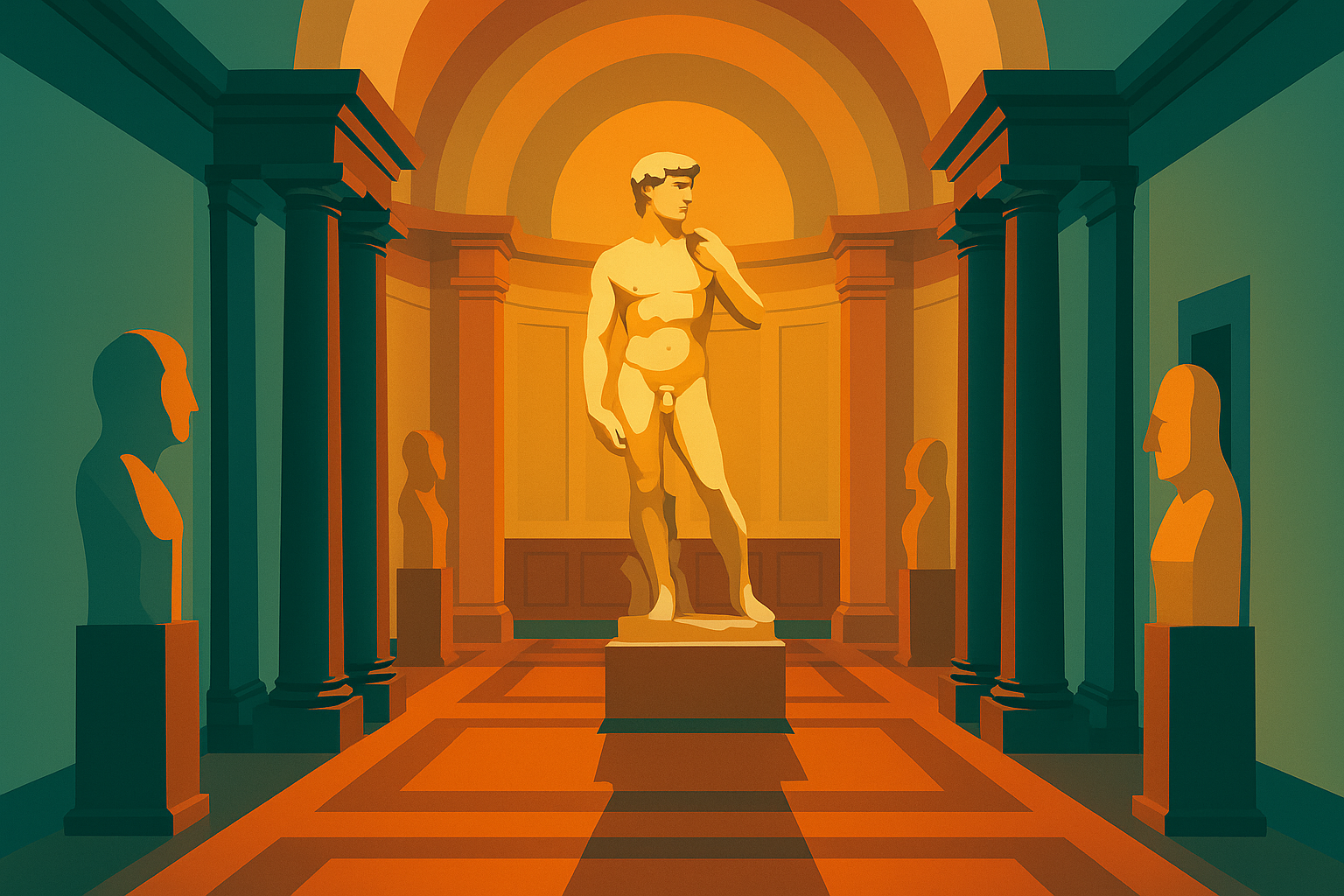
Accademia Gallery of Florence
Experience the magic of Tuscany
Imagine driving through the Chianti hills, discovering medieval villages, and stopping for an aperitivo at sunset. Renting a car is the secret to experiencing Tuscany with true freedom. Book now for the best choice.
🔍 Choose your car for TuscanyThe Man in Marble: A Definitive Insider’s Guide to Florence’s Accademia Gallery
The experience of Florence’s Galleria dell’Accademia is one of magnetic, inexorable pull. From the moment you step inside, every sense, every instinct, feels the gravity of a single point at the far end of a long hall: David. It is, without question, the focal point of human genius, and most visitors rush toward it, camera phones raised, anxious to stand in the presence of perfection.
This is a mistake.
To truly understand David, to feel the full weight of his creation, one must first walk the path of his “brothers”—the colossal, unfinished Prigioni, or Slaves, that line the corridor. These figures, writhing and trapped in their marble prisons, are the necessary prologue. They tell the story of the struggle, the raw effort, and the divine battle against stone. David is not just a statue; he is the triumphant result of that battle, and his victory is only understood by first witnessing the fight.
The Galleria dell’Accademia is not merely a shrine for a single masterpiece, though it is the second-most-visited art museum in Italy largely for that reason. It is a profound, focused journey into the mind of Michelangelo, who is represented here more than anywhere else in the world. It is a story that begins with its 1784 founding as a humble teaching academy, continues with the raw philosophy of unfinished stone, and ends, unexpectedly, with the serene, polished wood of the world’s first pianos.
The Journey Before the Destination: Why the Accademia is More Than Just David
The true genius of the Accademia’s layout is that it forces you into a narrative. The main artery of the museum, the Hall of the Prisoners, is not just a passageway; it is an emotional and philosophical education. This long, vaulted corridor leading to the Tribune is lined with four of Michelangelo’s most enigmatic works: the Awakening Slave, the Young Slave, the Bearded Slave, and Atlas.
These four colossal, unfinished figures were never intended for this hall. They were part of a project that haunted Michelangelo for 40 years: the “tragedy of the tomb.” This was to be a monumental, 40-figure mausoleum for Pope Julius II, a project that was repeatedly downsized, defunded, and ultimately abandoned after decades of political turmoil.
Their unfinished state, known as non-finito, is the physical embodiment of a philosophy. Michelangelo was a devout Neoplatonist, believing that the sculptor was not a creator, but a liberator. The form, the “soul,” was already imprisoned within the marble; his job was simply to remove the excess stone to set it free. These figures are that divine struggle, caught in the act. We see the Bearded Slave almost free, his torso finely modeled, while Atlas remains a raw mass of stone, his head bowed, forever bearing the weight of the marble from which he fails to emerge. They are the most powerful expression of the human soul’s battle against its physical constraints. Walking past them, feeling their struggle, makes the arrival at the “perfect,” fully liberated David a moment of profound catharsis.
A Tale of Two Davids: Symbolism and Atmosphere
The heart of the Accademia is the Tribune, the purpose-built “chapel” for David. Designed in the 19th century by architect Emilio de Fabris, the space was conceived as a secular sanctuary, and the atmosphere is one of pure reverence. The key feature is not a dramatic spotlight, but the magnificent central skylight.
This architectural choice was brilliant. The skylight bathes the 17-foot marble hero in a living, shifting, celestial light that animates his form. Depending on the time of day or the passing of a cloud, David’s expression seems to shift, his muscles tense, his gaze—fixed defiantly toward Rome—intensifies. You are not just looking at a statue; you are witnessing a living presence.
This 19th-century atmosphere of aesthetic worship, however, is a stark contrast to the statue’s original 16th-century meaning. When the David was first unveiled in 1504, it was not placed in a museum. It was placed at the very entrance of the Palazzo Vecchio, Florence’s town hall, as a purely political statement. This was not just a biblical hero; it was a civic metaphor. This young, defiant, and unnervingly confident figure represented the Florentine Republic: strong, independent, and ready to take on any “Goliath,” be it the powerful Medici family or the Pope himself. The statue’s electric gaze and coiled tension were a warning, a symbol of liberty that every citizen understood.
From Humble Hospital to Hallowed Hall: The Accademia’s Story
The first impression of the Accademia’s exterior is one of surprise. It is functional, even modest, lacking the palatial grandeur of the nearby Uffizi or Palazzo Pitti. This humble facade is the key to its identity. The building’s story is one of layers, beginning in the 14th century not as a palace, but as a public hospital, the Hospital of Saint Matthew.
Its true birth as a cultural institution came in 1784. Grand Duke Peter Leopold of Lorraine, an enlightened monarch, founded the Accademia di Belle Arti (Academy of Fine Arts) here. Its primary purpose was not to be a museum for the public, but a teaching facility for young artists. The collection of Gothic altarpieces, Renaissance paintings, and plaster casts was gathered from suppressed convents and monasteries to serve as “didactic models” for students to study and copy. This original purpose explains the eclectic, and at times seemingly random, layout of the collections.
For nearly 100 years, it served this noble but quiet purpose. Then, in 1873, everything changed. Michelangelo’s David was moved indoors from the Piazza della Signoria to protect it from centuries of weathering and vandalism. This single act fundamentally shifted the building’s destiny. It was no longer just a functional school; it was now a public shrine. The transformation was completed in 1882 with the opening of de Fabris’s custom-built Tribune. The Accademia had a new, monumental purpose: to be the permanent, hallowed home for the most famous sculpture on Earth.
Planning Your Visit: Essential Practical Advice
A visit to the Accademia is a highlight of any trip to Florence, but its popularity requires careful planning to ensure a meaningful experience rather than a battle with crowds. Here’s everything you need to know.
Opening Hours and Tickets
The Galleria dell’Accademia is open from Tuesday to Sunday, from 8:15 am to 6:50 pm. The last admission is strictly at 6:20 pm, and museum closing procedures begin at 6:40 pm. The museum is always closed on Mondays, January 1, and December 25.
A regular admission ticket costs €16, with a reduced price of €2 for European Union citizens between the ages of 18 and 25. Now for the most important piece of advice we can give you:
You must book your ticket in advance. The mandatory €4 reservation fee is the best money you will spend in Florence, allowing you to secure a timed entry slot and bypass a general admission line that can stretch for hours.
Book only through the official B-Ticket portal, which is the sole channel authorized by the Ministry of Culture. All other websites are third-party resellers that add significant and unnecessary markups.
For a focused visit centered on Michelangelo, plan for 60 to 90 minutes. For a more complete experience, including the art-historical context of the Gipsoteca and the unique Musical Instruments collection, a 2-hour visit is ideal.
Facilities and a Critical Warning
This section contains the single most important piece of logistical advice for planning your visit. The Galleria dell’Accademia, due to its origins as a 14th-century hospital and not a modern museum, has extremely limited visitor services.
The Galleria dell’Accademia has NO CLOAKROOM or luggage storage.
Unlike the Uffizi, you cannot check your bags, backpacks, or luggage. Furthermore, you will be denied entry if you have luggage, large backpacks, helmets, or any bag larger than 40x30x18 cm (approximately 15.7 x 11.8 x 7 inches). Plan accordingly. Do not schedule your visit for your arrival or departure day unless you have secured luggage storage elsewhere, such as at the Santa Maria Novella train station.
Only small water bottles (not exceeding 0.5 liters) are permitted inside. On a positive note, the museum provides excellent accessibility for visitors with disabilities, with all halls being fully wheelchair accessible via a lift. Excellent audio guides are available for rent at the bookshop for €6.
The Best and Worst Times to Visit
The Accademia is one of the most popular museums in the world, and its small size means it can feel overwhelmingly crowded. Beating the crowds is essential. There are two “golden windows” for visiting:
- At 8:15 am: Book the very first entry slot of the day. You will get 30 to 45 minutes of relative peace to experience David and the Prigioni before the large, guided tour groups arrive en masse around 9:00 am.
- After 4:30 pm: The crowds thin out significantly in the late afternoon. The light in the Tribune can be magical, and the atmosphere is far more contemplative.
For the best experience, aim for a Wednesday or Thursday. Avoid Tuesdays, which are notoriously busy as the museum is packed with visitors who found it closed on Monday. Finally, avoid the first Sunday of the month. While admission is free, the lines are famously hours long, and the museum becomes so overcrowded that it is difficult to truly see the art.
How to Get to the Accademia
The Accademia is wonderfully central and is best reached on foot, allowing you to absorb the Renaissance atmosphere of the city center. Its location on Via Ricasoli is just a short walk north of the Duomo complex.
- From Santa Maria Novella (SMN) Train Station: It is a brisk and straightforward 15-minute walk. Simply follow the flow of travelers east toward the Duomo, and then head north from the cathedral’s main square.
- From the Duomo: The museum is an effortless 5 to 8-minute stroll. Walk north along Via Ricasoli, and the museum entrance will be on your right.
For those with mobility concerns, several ‘Autolinee Toscane’ buses stop at the nearby Piazza San Marco, just a one-minute walk from the museum. Key bus lines include 6, 14, 17, 23, or the electric minibus C1.
A strong word of caution: do not attempt to drive to the Accademia. The museum is deep inside Florence’s Zona a Traffico Limitato (ZTL), a limited traffic zone. Non-permitted vehicles will be photographed and automatically fined.
Beyond the Accademia: The San Marco Art Nexus
Do not make the mistake of seeing David and immediately leaving the neighborhood. The Accademia is the anchor of a “San Marco Art Nexus,” a cluster of world-class, uncrowded sites within a two-minute walk.
First, visit the Museo di San Marco. This former Dominican convent is the serene, spiritual antidote to the Accademia’s crowds. It houses a breathtaking collection of frescoes by the early Renaissance master Fra Angelico, many preserved in the very monks’ cells where they were painted.
Next, discover the Opificio delle Pietre Dure. This “hidden gem” museum is dedicated to the mind-bending Florentine craft of pietra dura—creating intricate images from inlaid semi-precious stones. It is a fascinating study of artistic technique that pairs perfectly with Michelangelo’s mastery of stone.
Finally, after your visit, walk 10 minutes south to the Piazza della Signoria. Here, standing in front of the Palazzo Vecchio, you will find the full-size replica of David. Seeing the copy in its original 1504 location provides the “Aha!” moment—it connects all the dots, allowing you to finally understand the statue’s immense political power and historical context.
Capturing the Moment: Best Photo Spots
Photography is permitted inside the Accademia, but the rules are strict and enforced: no flash, no selfie sticks, and no tripods. This is to protect the art and ensure a good experience for all visitors.
The most iconic shot is, of course, David. For a more professional composition, stand at the entrance to the Hall of the Prisoners and use the Prigioni in the foreground to create a powerful sense of depth and narrative, framing David under the Tribune’s arch.
For the best undisturbed photo, head to the Gipsoteca Bartolini. This luminous, 19th-century hall is filled with hundreds of white plaster casts and models from the original academy. It is bright, photogenic, and often completely empty, offering a beautiful, crowd-free memory of the museum’s true origins.
A Final Word of Advice
The Accademia is a small museum that tells a very big story. Too many visitors treat it as a drive-by, a “selfie-stop” on the way to the Uffizi. Give it the one or two hours it deserves. See the “other” collections first. The Gipsoteca, with its ghost-like plaster casts, and the Museum of Musical Instruments, with the very first pianos ever made, are not afterthoughts. They are the heart of the museum’s original purpose as a teaching academy. See them, and you will understand the David not as an isolated icon, but as the graduation of an entire culture of genius.