
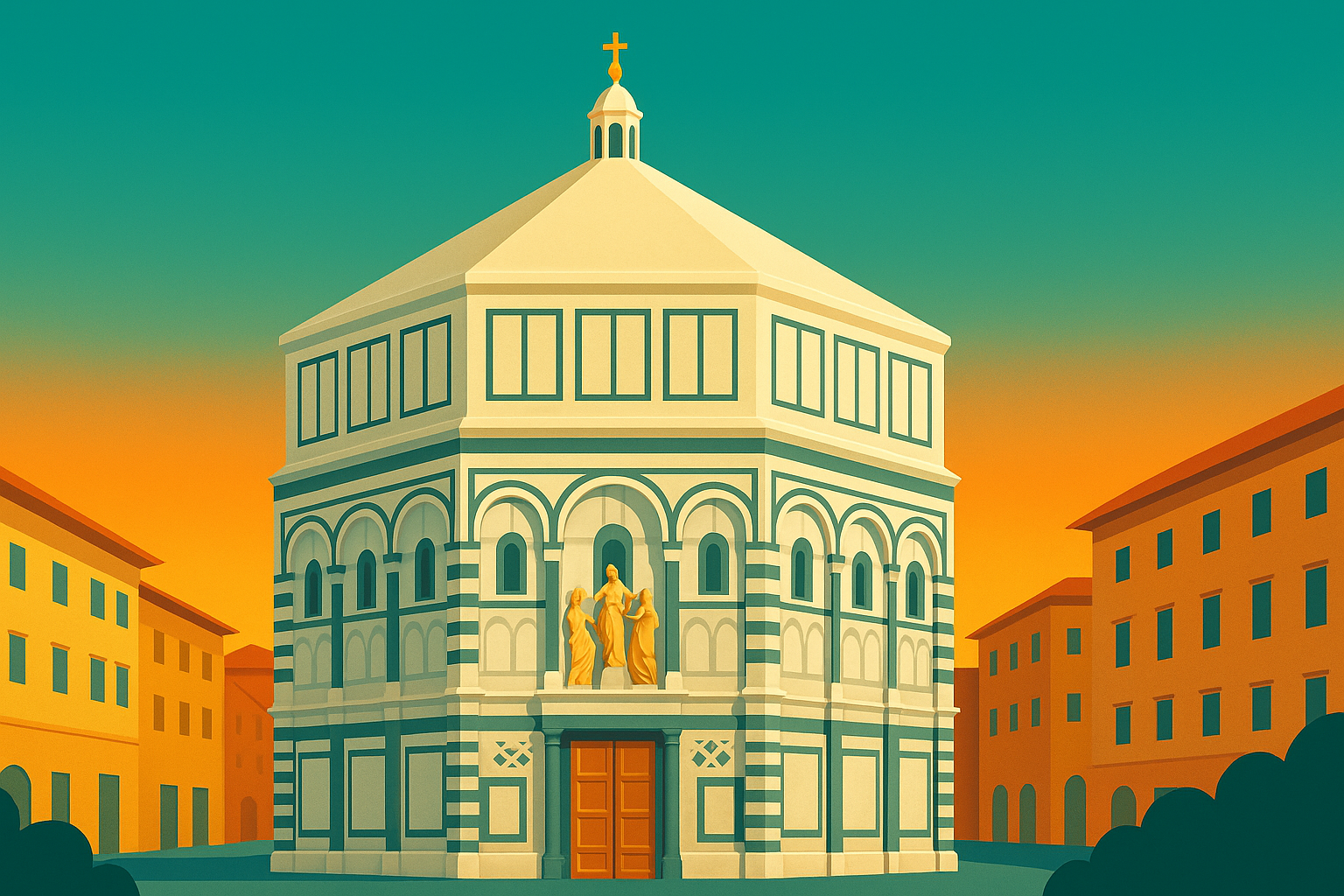
Baptistery of Saint John
Experience the magic of Tuscany
Imagine driving through the Chianti hills, discovering medieval villages, and stopping for an aperitivo at sunset. Renting a car is the secret to experiencing Tuscany with true freedom. Book now for the best choice.
🔍 Choose your car for TuscanyThe Eighth Day: A Guide to Florence’s Baptistery of San Giovanni
When you stand in Piazza del Duomo, your gaze is inevitably drawn upward. It climbs the magnificent polychrome marble of the Cathedral, follows the breathtaking curve of Brunelleschi’s Dome, and scales the heights of Giotto’s Bell Tower. In the shadow of these titans, the Battistero di San Giovanni—the Baptistery of St. John—can feel like a beautiful but secondary feature, a modest octagonal prelude to the main event.
This is the great, beautiful mistake most travelers make. The Baptistery is not the prelude. It is the source.
This is the ancient religious and civic heart of Florence, the “bel San Giovanni” (my beautiful St. John) that a baptized Dante Alighieri would remember with a deep longing from his exile. It is the building whose mythical Roman origins inspired the very soul of the Renaissance. It is the stage upon which a legendary artistic duel in 1401 lit the fuse for the modern world. The magnificent structures that surround it were all built later, in deference to it. To truly understand Florence, you must first understand this building. To visit it correctly is to appreciate its three distinct lives: the mythical Roman temple it was believed to be, the golden Byzantine shrine it is, and the modern museum showcase that now protects its most priceless treasures.
Why the Baptistery is the True Heart of Florence
To step inside the Baptistery is to cross a threshold in time. As you push through the heavy bronze doors (note: these are replicas of the originals), the noise of the piazza—the chatter of tour groups, the endless camera clicks, the city’s heat—is instantly muffled. It’s replaced by the cool, hushed air of a sacred space consecrated in 1059. The atmosphere is one of profound, ancient reverence. And then, you look up.
A Symbol of Eternity: The Eighth Day
The interior is a golden firmament, a celestial map of salvation that glitters far above. The entire 25.6-meter (84-foot) octagonal dome is a staggering masterpiece of 13th and 14th-century Byzantine mosaics. But before you even process the art, the building’s very shape communicates its powerful purpose.
The Baptistery is an octagon for a profound theological reason: it represents the Octava Dies, the Eighth Day. In Christian symbolism, the seven-day week of Genesis represents earthly, cyclical time—the world as we know it. The “Eighth Day” is the new day after the Sabbath, the day of Christ’s resurrection. It is the day that breaks the cycle, symbolizing a new creation and the beginning of eternity. Baptism is the sacrament of this spiritual rebirth. For centuries, by being baptized within this eight-sided structure, generations of Florentines were physically placed inside a powerful symbol of their own resurrection.
The Myth That Forged the Renaissance
For centuries, every Florentine—including the great Renaissance artists themselves—believed a powerful and inspiring myth: that their beloved Baptistery was, in fact, an original, perfectly preserved Roman temple dedicated to the god Mars. Twentieth-century excavations disproved this, revealing the foundations of a 3rd-century Roman house and an earlier Christian church, but no temple.
Yet, the reality is less important than the belief. This “productive misunderstanding” became a catalyst for the Renaissance. Architects like Filippo Brunelleschi and Leon Battista Alberti, obsessed with reviving the classical forms of ancient Rome, had few local models to study. They looked to the Baptistery, believing it to be a pure example of antiquity, and meticulously studied its clear, geometric Romanesque style. The Florentine Renaissance, in its infancy, was born from a revival of its own 11th-century past, which it had mistaken for the glory of Rome.
The Duel That Defined an Era
This building was the undisputed center of Florentine civic life, a fact not lost on its powerful patrons, the Arte di Calimala (the Cloth-Merchants’ Guild). In 1401, they launched a competition that would change the course of art history forever: a “creative duel” to design and cast the building’s second set of magnificent bronze doors. The chosen theme was “The Sacrifice of Isaac.”
The contest ultimately came down to two brilliant young goldsmiths: Lorenzo Ghiberti and Filippo Brunelleschi. Their trial panels, now displayed side-by-side in the Bargello Museum, reveal two competing visions for a new age. Brunelleschi’s version is raw, dramatic, and intensely violent. Ghiberti’s is technically superior, cast with greater efficiency, and, above all, defined by a graceful, harmonious, and classical poise.
Ghiberti won. Brunelleschi, famously, stormed off to Rome to study architecture, only to return decades later to build the “impossible” dome on the cathedral next door. The 1401 competition was the “Big Bang” of the Renaissance, a public declaration of a new world defined by individual genius, fierce competition, and artistic innovation.
What to See: A Journey Through Art and History
The Baptistery is a masterwork of art and architecture, a palimpsest where Romanesque structure, Gothic storytelling, and Renaissance genius converge.
The Exterior: A Story in Three Doors
The building’s iconic face is its geometric skin of white Carrara marble and green serpentinite from Prato, a signature of the Tuscan Romanesque style. Its three portals tell a story of artistic evolution spanning 120 years.
- South Door (c. 1330–36): Created by Andrea Pisano, this is the oldest door. It is a Gothic masterpiece depicting the life of the Baptistery’s patron, St. John the Baptist, in 28 severe yet elegant quatrefoil (four-leaf clover) panels.
- North Door (c. 1403–24): This is the very door by Lorenzo Ghiberti that won him the 1401 competition. It shows scenes from the New Testament, still set within the traditional Gothic quatrefoil frames, but the figures within are fully Renaissance—poised, classical, and dynamic.
- East Door, “The Gates of Paradise” (c. 1425–52): Ghiberti’s first door was such a triumph that he was commissioned for the final set without a competition. He labored on it for 27 years. Here, he shattered the old format, creating ten large, square panels with scenes from the Old Testament. These panels are the perfection of linear perspective in sculpture. Using a technique called rilievo schiacciato (flattened relief), he created a revolutionary illusion of deep, pictorial space. When Michelangelo saw them, he declared them “truly worthy to be the Gates of Paradise.”
The Interior: A Golden Heaven and a Terrifying Hell
Inside, two key features dominate the space. The first is the magnificent Tomb of Antipope John XXIII. This is not just a tomb; it’s a bold political statement. Baldassarre Coscia (John XXIII) was a deposed Antipope and a close ally of the Medici bank. When he died in Florence, his executors, the Medici, paid his ransom and commissioned the most radical artists of the day—Donatello and Michelozzo—to build his tomb. The result (c. 1422–28) is considered the first great Renaissance wall tomb. Its gilded bronze effigy, lying in state under a marble canopy, was an unprecedented display of artistry and a powerful statement of Medici power and loyalty.
The second, and most overwhelming, feature is the dome’s glittering mosaic ceiling. Begun in 1225, it took over a century to complete. Venetian masters were hired for their expertise in the Byzantine technique, but they worked from cartoons (designs) by the first great Tuscan artists, including Cimabue, Giotto’s master. The ceiling is a visual encyclopedia of biblical stories, but it is dominated by the terrifying Last Judgment positioned over the altar. A gigantic, 8-meter (26-foot) Christ sits in judgment. To his right, the blessed rise peacefully from their tombs; to his left, a grotesque and vivid Hell (attributed to Coppo di Marcovaldo) unfolds in graphic detail. It was under this very image that Dante Alighieri was baptized. This specific, terrifying vision of blue-horned demons and tortured souls is widely considered a primary visual inspiration for his Inferno.
Planning Your Visit: Tickets, Times, and Insider Tips
Navigating the Duomo complex requires a bit of planning, but it’s straightforward once you understand the ticketing system.
Opening Hours and Ticket Passes
The Baptistery is open daily from 08:30 to 19:30 (8:30 AM to 7:30 PM). A standard visit to the main ground floor takes approximately 30 to 45 minutes.
A critical point to understand is that you cannot buy a standalone ticket for the Baptistery. Entry is included in one of the three cumulative passes for the Duomo complex, all of which are valid for 3 consecutive calendar days from your chosen start date.
- Ghiberti Pass (€15): This is the best-value “art historian” pass. It includes the Baptistery, the essential Opera del Duomo Museum, and the Santa Reparata crypt (beneath the Cathedral). It does not include any climbs.
- Giotto Pass (€20): This includes everything in the Ghiberti Pass, plus the climb up Giotto’s Bell Tower for panoramic views.
- Brunelleschi Pass (€30): This is the all-inclusive pass. It includes all five monuments: the Baptistery, Museum, Crypt, Bell Tower, and the Dome Climb. This is the only pass that includes the Dome, which requires a mandatory pre-booked time slot.
For visitors focused primarily on the art and history of the Baptistery and its treasures, the €15 Ghiberti Pass is the most logical and economical choice.
The Best Time to Visit (And a Once-in-a-Generation Opportunity)
To experience the Baptistery in relative peace, the best time to arrive is immediately at opening (08:30 AM). At this hour, the morning light streams in, illuminating the golden mosaics to spectacular effect, and the large tour groups have not yet descended upon the piazza.
However, the “best” time to visit is currently defined by an extraordinary, temporary opportunity. The mosaics of the main vault are undergoing a massive, multi-year restoration. While this means that much of the ceiling is obscured by scaffolding from the ground floor, it has created one of the most exclusive experiences in Florence.
Insider Tip: The single most extraordinary experience in Florence right now is the “Guided tour of the Restoration site.” Book this special ticket (€65) on the official website to climb the scaffolding and come face-to-face with the 800-year-old mosaics that inspired Dante.
Essential Visitor Information
- Dress Code: A strict dress code is enforced, as this is an active place of worship. Visitors must cover both their shoulders and knees. This rule is not flexible, and you will be denied entry if you don’t comply.
- Facilities: As an 11th-century monument, the Baptistery has no internal facilities like restrooms or gift shops. These are located in the adjacent Opera del Duomo Museum.
- Accessibility: The Baptistery’s main floor is accessible via a ramp for visitors with mobility difficulties. The Opera del Duomo organization provides excellent services for visitors with disabilities, often including free admission for the individual and one companion. However, this is not automatic. It is essential to email the accessibility office in advance at accessibilita@duomo.firenze.it to make arrangements.
How to Get to the Baptistery
The Baptistery is located in Piazza San Giovanni, the absolute epicenter of Florence. It is impossible to miss, standing directly opposite the main facade of the Cathedral.
The entire Duomo complex is deep within the city’s Zona a Traffico Limitato (ZTL), a limited traffic zone. Driving here is not recommended or practical for visitors. The best way to arrive is on foot. From the main Santa Maria Novella (SMN) train station, it is a pleasant and well-signed 10 to 15-minute walk through the heart of the historic center.
For those with mobility challenges, the small electric city bus (Autolinee Toscane) line C2 has a stop (“Roma Duomo”) very close to the piazza.
Beyond the Baptistery: Essential Companion Visits
A visit to the Baptistery is only half the story. The building is, in essence, a jewel box whose most precious gems have been moved to a high-security vault for their own protection. That “vault” is the Museo dell’Opera del Duomo (Cathedral Museum), located just behind the Duomo.
This visit is non-negotiable and is included in all pass types. A visit to the Baptistery without the museum is an incomplete experience. The museum’s “Sala del Paradiso” (Hall of Paradise) is where the building’s true treasures are displayed in a breathtaking setting. Here, you will find:
- The Original “Gates of Paradise”: Ghiberti’s 8-ton, gilded bronze masterpieces, restored to their full glory and displayed at eye level where you can appreciate every detail.
- The Original North and South Doors: The other two sets of original bronze doors by Ghiberti and Pisano are also here.
- Donatello’s “Penitent Magdalene”: The haunting, emotionally raw wooden statue that once stood inside the Baptistery.
To complete the 1401 “duel” story, take a short walk to the Bargello Museum, which holds the two original competition panels from Ghiberti and Brunelleschi, displayed side-by-side for direct comparison.
Capturing the Moment: Best Photo Spots
The Baptistery is notoriously difficult to photograph well, caught as it is between the shadow of the Duomo and the throngs of the piazza.
- The Classic Exterior: The best-known shot is from the steps of the Cathedral, looking back to frame the “Gates of Paradise” (the replicas) with the bustling piazza behind them.
- The Contemplative Interior: The most compelling ground-floor shot is looking straight down, capturing the intricate 12th-century geometric marble pavement and its fascinating zodiac inlay.
- The Insider Shot: The best photo is not in the Baptistery at all. It is in the Museo dell’Opera del Duomo, where you can take a glare-free, museum-lit, close-up shot of a single, breathtaking panel from Ghiberti’s original Gates of Paradise. This is the photo that proves you understand the site’s true history.
A Final Word: Choose Your Heaven
The Baptistery offers one of the most profound travel experiences in Italy, but for the next few years, it requires a choice. The magnificent 13th-century ceiling mosaics are undergoing a historic restoration and are largely hidden from the ground floor. This is not a disappointment—it is an opportunity.
You have two options. The first is a 30-minute ground-floor visit (with the €15 Ghiberti Pass) to absorb the incredible architecture, the marvelous floor, and the revolutionary Donatello tomb. The second is to book the “Guided tour of the Restoration site.” This is a once-in-a-generation chance to ascend into that golden heaven, to stand just feet away from the 800-year-old mosaics, and to be eye-to-eye with the very angels and demons that shaped the imagination of Dante and the world that followed. Choose wisely.