
Bardini Gardens
Experience the magic of Tuscany
Imagine driving through the Chianti hills, discovering medieval villages, and stopping for an aperitivo at sunset. Renting a car is the secret to experiencing Tuscany with true freedom. Book now for the best choice.
🔍 Choose your car for TuscanyIn a city defined by magnificent, monumental, and often overwhelming landmarks, the Giardino Bardini is an elegant whisper. Tucked away in the Oltrarno, the “other side” of the Arno river, this four-hectare park is Florence’s great “secret balcony.” It offers a profound sense of tranquility that its famous neighbours—the sprawling Boboli Gardens and the perpetually mobbed Piazzale Michelangelo—can no longer provide.
Visiting Bardini is not a single experience; it is a journey through three distinct gardens, each with its own soul. You will ascend a dramatic Italian Baroque staircase, wander through a romantic 19th-century English wood, and delight in a rustic agricultural park that is home to the city’s most photographed floral display—the Wisteria Tunnel. This entire complex is the legacy of a single, extraordinary man, Stefano Bardini, the “Prince of Antiquarians,” who transformed this hillside into a theatrical showroom designed to enchant the world’s wealthiest art collectors.
Today, after decades of neglect and a masterful restoration, the Villa and Garden serve as a dynamic cultural center and a verdant refuge from the city’s beautiful chaos. This is not just another garden. This is a curated view, a lesson in history, and, for those in the know, the smartest way to see the Oltrarno’s greatest treasures.
Why You Must Visit Giardino Bardini
The feeling at Bardini is one of intimate discovery. Unlike the royal, sprawling expanse of Boboli, which was designed to project the immense power of the Medici dynasty, Bardini feels like a private estate you have stumbled upon. Because it remains relatively “lesser-known,” you often share its winding paths with only a handful of others. This creates a sense of peace that has become Florence’s rarest and most sought-after luxury.
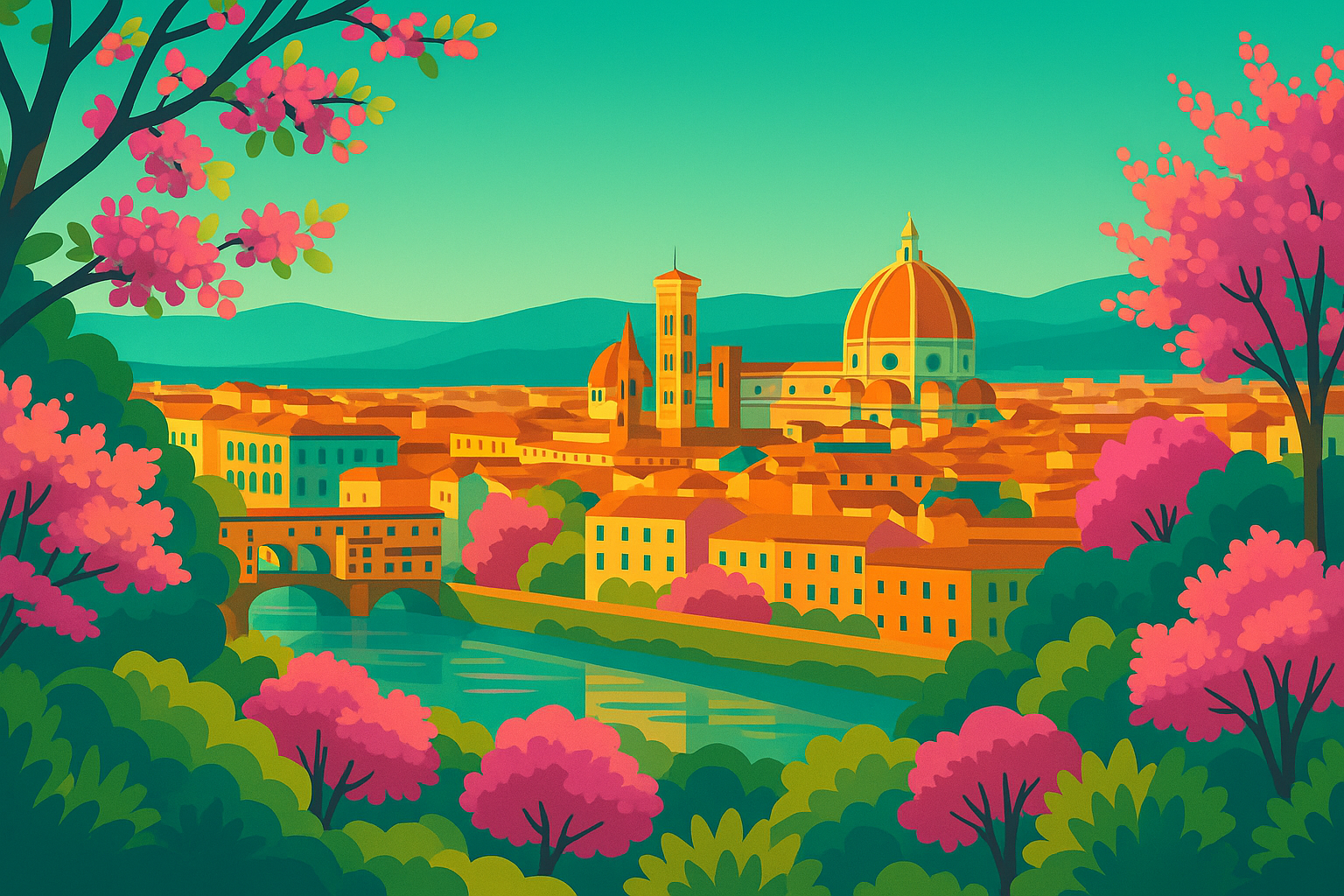
The garden’s very essence is its relationship with the city it overlooks. It is a “scenic machine.” Every path, terrace, and stone archway is meticulously designed to create a living painting of Florence. You are guided to view the Duomo and the Palazzo Vecchio not as simple landmarks on a skyline, but as composed elements within a breathtaking landscape of cypress, olive, and stone.
The atmosphere shifts with each of the three garden “acts.” The Baroque staircase is all drama, symmetry, and theatricality, a grand stage for the city. The English wood is a place of quiet, romantic wandering, cool and shaded even on a warm day. The Agricultural park, with its famous wisteria pergola, is a place of pure, photogenic joy. This deliberate progression—from drama to contemplation to delight—is the garden’s true genius.
A Hillside with a History
The land on Montecuccoli hill has been cultivated for centuries, but its story as we know it begins in 1641. The architect Gherardo Silvani built a simple but elegant villa here named Villa Manadora, perched above the medieval Mozzi family estate. For the next 200 years, it passed through various hands. In the 19th century, a key layer was added when Luigi Le Blanc transformed a section into an English-style wood, a rare and fashionable “Anglo-Chinese” garden that introduced a sense of wild romance to the structured hillside.
But the man who gave the complex its name and soul was Stefano Bardini (1836-1922). Bardini was not an aristocrat; he was a visionary tastemaker and one of the most astute businessmen of his era. Trained as a painter and copyist, he served with Garibaldi during the unification of Italy before returning to Florence. He astutely recognized that as the city modernized, its Renaissance past was being sold off piece by piece. He became a restorer, then a dealer, and ultimately the “Prince of Antiquarians.” He supplied the world’s great new museums, including the Bode in Berlin, the Musée Jacquemart-André in Paris, and the Isabella Stewart Gardner Museum in Boston.
In 1913, he purchased the Villa Manadora complex. For Bardini, this was not a home; it was the ultimate “showroom.” He radically reorganized the landscape, building the grand staircase to connect the disparate parts and create a single, dramatic experience. He then studded the grounds with his eclectic collection of statues, fountains, and architectural fragments. The garden became a theatrical set, a fantasy of the Renaissance designed to enchant his wealthy clients and frame his priceless wares against the ultimate backdrop: Florence itself.
After the death of his son Ugo in 1965, a long legal battle saw the property fall into ruin. For decades, it was an overgrown, inaccessible wood, its treasures hidden from view. The rescue began in 1998 when the Fondazione CR Firenze took charge, launching a painstaking, five-year restoration. The garden reopened in 2005 and the Villa in 2007, reborn as the multi-layered cultural complex we see today.
What to See and Do: The Three Gardens and the Villa
The complex’s genius lies in its “three-in-one” design, which Bardini himself called “the three gardens.” Each offers a unique experience, making a visit feel like three distinct discoveries.
The Italian Garden & Baroque Staircase
This is the dramatic centerpiece and the garden’s most recognizable feature. A magnificent Baroque staircase acts as the vertical spine of the entire property, connecting the Arno riverbank below with the Villa at the summit. As you ascend (or descend), the view of Florence is revealed in stages, each more breathtaking than the last. The staircase is flanked by six mosaic fountains, weathered stone statues, and vibrant plantings of Bourbon roses and irises—Florence’s signature flower. The symmetry and grandeur are pure theatre, designed to make you feel like the guest of honour at a spectacular performance.
The English & Anglo-Chinese Wood
To the side of the main staircase lies the older, 19th-century Anglo-Chinese wood. Stepping into this section is a complete change of pace. The formal structure gives way to a romantic, shady forest designed for wandering. A meandering stream trickles through the undergrowth, and paths curve around exotic plants and the whimsical “Dragon Fountain.” This is also where you will find the garden’s impressive collections of azaleas and camellias, which provide bursts of colour in the spring. It’s a cool, contemplative space that offers a welcome respite from the sun.
The Agricultural Park & Wisteria Tunnel
This lower section honours the land’s original purpose as a “hortus conclusus,” or walled orchard. It includes a productive olive grove whose trees shimmer silver in the breeze and an orchard of traditional Tuscan fruit trees. But its main feature, and the complex’s biggest draw, is the wisteria pergola. This long, arched tunnel, in bloom from mid-April to early May, creates a fragrant, purple-framed view of the Duomo that has become a global icon of Florentine spring. It is an unforgettable sensory experience.
The Villa Bardini
At the top of the hill sits the 17th-century Villa. Its ground floor has been transformed into a modern kunsthalle, or exhibition hall, hosting high-profile temporary shows of photography and modern art. This is the Villa’s primary cultural function today, and the exhibitions are often a prime reason for repeat visits. Always check the official website for the current major exhibition.
The Villa also houses the permanent Museo Pietro Annigoni. This collection is dedicated to the 20th-century “painter of queens,” known for his dramatic and psychologically intense portraits. Visitors should note that the Villa was also home to the Roberto Capucci Museum; however, the permanent foundation and its collection of “sculpture-clothing” have since relocated.
Planning Your Visit: Tickets, Transport, and Tips
A little planning goes a long way in making your visit to Bardini seamless and magical. Your arrival strategy, in particular, is the most critical decision you’ll make.
How to Get There
There are two entrances that create two totally different experiences.
- Entrance 1: Via dei Bardi 1 rosso (The “Bottom-Up” Pilgrimage)
This lower entrance is just a 15-minute walk from the Ponte Vecchio. You will enter through the agricultural park and must climb the entire complex. This is a very steep and strenuous ascent, not for the faint of heart. The reward is that the panoramic view is revealed slowly as you earn it, culminating at the top.
- Entrance 2: Costa San Giorgio 2 (The “Top-Down” Unveiling)
This upper entrance is near the Forte di Belvedere. This is the universally recommended route. It allows you to start at the top, see the Villa and the famous panorama immediately, and then enjoy a pleasant downhill walk through the Baroque staircase and gardens. This is also the entrance to use for accessibility.
Getting to the Entrance:
- By Taxi: This is the easiest and most recommended option. Ask the driver to take you to “Villa Bardini, Costa San Giorgio 2”. From the city center, this is a quick 7-10 minute ride.
- By Bus: Several city buses get you close. Bus C4 stops at “Torrigiani Chiesa Luterana,” and Bus 23 stops at “Serristori Demidoff”. Both stops are about a 7-minute walk from one of the entrances but will still involve some uphill walking.
- By Foot: Walking is only recommended to the lower entrance (Via dei Bardi 1 rosso) from the Ponte Vecchio area.
Opening Hours and Tickets
The Giardino Bardini’s garden gates are part of the Uffizi-Pitti-Boboli circuit and follow its hours, opening daily at 8:15 a.m.
Closing times are seasonal:
- 4:30 p.m. (November – February)
- 5:30 p.m. (March)
- 6:30 p.m. (April, May, September, October)
- 7:10 p.m. (June, July, August)
The complex is closed on the first and last Monday of each month, as well as on January 1, May 1, and December 25.
A standard “Garden” ticket costs €10.00. A combined ticket including the temporary exhibitions in the Villa is also available for €15.00.
The €10.00 garden ticket is cumulative. It grants same-day access to Bardini, the Boboli Gardens, and the Porcelain Museum. Start at Bardini to buy this pass and use it to walk right into Boboli, completely bypassing the main queue at the Pitti Palace.
Plan for 90 to 120 minutes to fully explore the Bardini complex itself—the three gardens, the Villa’s belvedere, and a quick look at the Annigoni museum. If you plan to use the cumulative ticket to also see the Boboli Gardens, set aside a minimum of a half-day for the combined visit.
Facilities and Accessibility
The Bardini complex is well-equipped for a comfortable visit. Public restrooms are available for ticket holders. For refreshments, you have two excellent choices right on the property:
- La Loggetta: This is the panoramic café/bar located on the belvedere terrace. It is the perfect spot to stop for a cappuccino or a light lunch while soaking in the best view of the city.
- La Leggenda dei Frati: This is a high-end, Michelin-starred destination restaurant, also located within the complex. It offers a refined sensory experience, making the Villa a complete evening destination for a special occasion.
For visitors with mobility challenges, wheelchair access is provided via a ramp at the vehicular entrance at Costa San Giorgio n°4. It is required to call the ticket office upon arrival (+39 055 2638599) to have this gate opened. Be aware that while the Villa and main terrace are accessible, the garden paths themselves are steep, uneven, and made of gravel and earth.
The Best Time to Visit
To see the garden’s star attraction, timing is everything. The absolute best time to visit is from mid-April to early May. This is when the famous wisteria pergola is in full, fragrant bloom, creating the iconic purple tunnel. A live webcam on the official website even tracks its progress so you can time your visit perfectly.
This period is closely followed by the rest of May, when the Baroque staircase is lined with blooming irises and roses. Later in the summer, the garden is famous for its large collection of over 60 varieties of hydrangeas.
On a daily basis, the best time is first thing in the morning. Arriving when the gates open at 8:15 a.m. means you will have the paths and the views almost entirely to yourself, enjoying the soft morning light before the city fully wakes.
Capturing the Moment: Best Photo Spots
For photographers, Bardini offers three world-class shots, each capturing a different facet of Florence’s beauty.
- The Wisteria Tunnel: The quintessential shot. During peak bloom, frame the Duomo and Palazzo Vecchio through the cascade of purple flowers. Arrive early to get the shot without crowds.
- The Belvedere Terrace: From the café (La Loggetta) or the balustrade just outside the Villa, this is the single best, unobstructed “postcard” panorama of the entire city skyline. The morning light is particularly beautiful here.
- The Baroque Staircase (from above): Stand at the top of the grand staircase and shoot down. The sweeping stairs, stone statues, and symmetrical plantings create powerful leading lines that draw the eye directly to the city below.
Beyond the Garden: Exploring the Oltrarno Hills
The Giardino Bardini is the perfect anchor for a full day exploring the Oltrarno hills. It is part of a “Florence Greenway” of interconnected parks and viewpoints.
- Boboli Gardens: The most logical pairing. Your €10 Bardini ticket includes entry. From the top of the Bardini Garden (near the Costa San Giorgio entrance), a “back exit” leads you across the street and, after a short walk, to a side entrance of the Boboli Gardens.
- Forte di Belvedere: This 16th-century fortress sits on the hill between Bardini and Boboli, offering another spectacular (and often uncrowded) panoramic viewpoint.
- Museo Stefano Bardini: Do not confuse this with the Villa. This is Stefano Bardini’s other museum, located down the hill in Piazza dè Mozzi. It houses the bulk of his staggering collection and is a must-see for antique lovers.
- Ponte Vecchio: If you end your (downhill) journey at the Via dei Bardi exit, you are just a few minutes’ walk from Florence’s most famous bridge.
- Piazzale Michelangelo: If you are dedicated to seeing all the views, the city’s most famous free viewpoint is a 15-20 minute uphill walk from the Bardini complex.
The Giardino Bardini is the smarter, more intimate alternative for the discerning traveler. It offers what its more famous neighbors cannot: a world-class view without the crowds, a rich, layered history, and a sense of personal discovery.
So here is your perfect plan: Take a taxi to the upper entrance at Costa San Giorgio 2. Buy the €10 cumulative ticket. See the Villa, then walk downhill through the gardens, enjoying the staggering views without the grueling climb. Use that same ticket to bypass the lines at Boboli. You will have just experienced the Oltrarno’s two greatest gardens like an insider, not a tourist.