
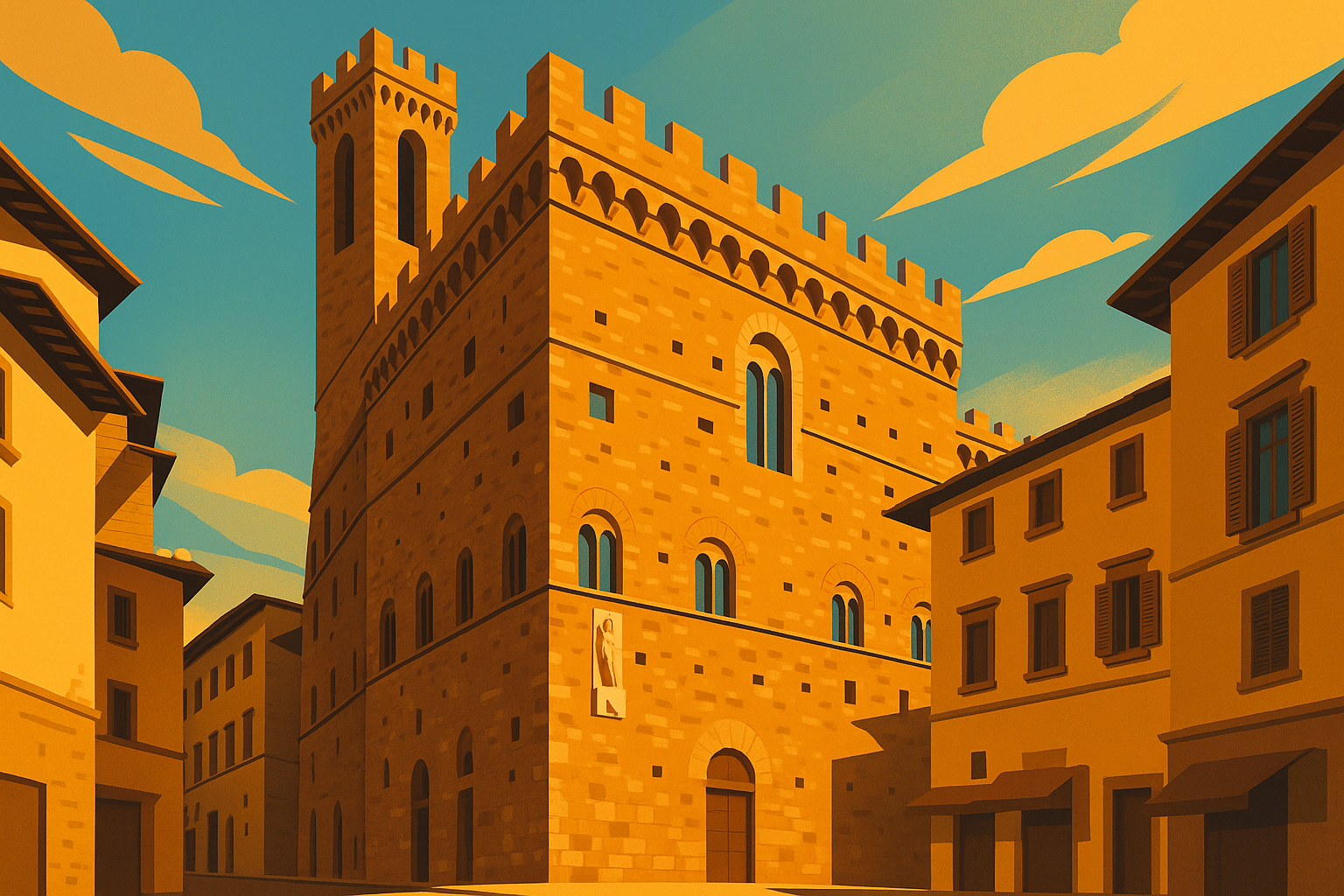
Bargello National Museum
Experience the magic of Tuscany
Imagine driving through the Chianti hills, discovering medieval villages, and stopping for an aperitivo at sunset. Renting a car is the secret to experiencing Tuscany with true freedom. Book now for the best choice.
🔍 Choose your car for TuscanyFlorence’s Fortress of Sculpture: An Insider’s Guide to the Bargello Museum
In a city defined by its art, the Uffizi and the Accademia galleries dominate the conversation, drawing millions into a cultural vortex of skip-the-line anxiety and timed-entry tickets. But just a five-minute walk from the Duomo, a different experience awaits. When you step from the narrow, sun-baked Via del Proconsolo through the massive wooden doors of the Museo Nazionale del Bargello, the change is immediate. The noise of the city vanishes, replaced by the monastic silence of a vast medieval courtyard.
This is the connoisseur’s choice, the essential “third” museum of Florence and arguably its most profound. While the Uffizi has the paintings and the Accademia has the icon, the Bargello has the story. It holds the most important collection of Italian Renaissance sculpture on earth. This is not a sterile “white cube” gallery. It is a 13th-century fortress, a former prison, and a place of execution that was transformed into Italy’s very first national museum. Here, you don’t just see the finished masterpieces; you witness the birth of the Renaissance itself. You can stand before the dueling panels of Ghiberti and Brunelleschi, the very “Big Bang” of the movement. You can trace the evolution of genius in the early, pagan experiments of Michelangelo and come face-to-face with Donatello’s revolutionary bronze David.
The Bargello offers what is so rare in modern travel: A-list masterpieces without the crowds. It trades mass-market popularity for breathing room and intellectual depth. This is a guide to appreciating that trade—to experiencing the Renaissance not as a series of isolated icons, but as an intimate, complex, and often brutal conversation among artists, all housed within the most symbolically charged building in Florence.
A Palace of Contradictions: Atmosphere and History
The power of the Bargello comes from its layered, contradictory identity. The building is a palimpsest of Florentine history, and its atmosphere is a constant tension between a grim past and a serene present. The 800-year arc of this building’s life is a metaphor for the story of Florence itself, moving from republican pride to autocratic rule and, finally, to cultural redemption.
Its story begins in 1255. Before the Palazzo Vecchio, there was this. The Palazzo del Popolo (“Palace of the People”) was Florence’s first public building, a crenellated fortress built to house the Capitano del Popolo and later the Podestà. This magistrate was, by law, a foreigner, hired to ensure impartiality in the city’s fractious political climate. The building was the ultimate symbol of the medieval city-state’s fierce independence.
Today, visitors describe the courtyard as an “oasis” of calm, but for over 300 years, this was one of the most feared places in Florence. The second phase of its life began in 1574. As the Medici family consolidated their power, they repurposed the palace. It became the headquarters of the Bargello (police chief), and its name and function changed forever. It was converted into a notorious prison, its grand halls subdivided, its frescoes whitewashed. For three centuries, its identity was one of repression, control, and public execution, which took place in this very courtyard.
The final act is one of rebirth. In the 19th century, during the Risorgimento, the building’s symbolic power was reclaimed. In 1840, the whitewash in the chapel was removed, revealing lost frescoes from Giotto’s workshop and, with them, the oldest known portrait of Dante Alighieri. This discovery sparked a national fervor. The prison was relocated, and in 1865, the new Kingdom of Italy declared the Bargello its very first national museum. It was a profoundly symbolic act: a former place of tyranny was transformed into a sanctuary celebrating the nation’s greatest cultural treasures.
To visit the Bargello is to walk through a “haunted” gallery. The austere, fortress-like appearance is not an aesthetic choice; it is a literal expression of its past. This grim history makes the art inside feel all the more fragile and transcendent. The humanistic beauty of a Donatello sculpture takes on a new, profound meaning when you realize you are viewing it within the stone walls of a former prison.
A Journey Through the Masterpieces: What to See
A visit to the Bargello is a “tour” in the truest sense, a journey up through the floors and through the centuries. The architecture itself is the first masterpiece you will encounter.
The Courtyard: A Somber Welcome
Your visit begins in the magnificent and somber medieval courtyard. The walls are papered with history, decorated with the colorful terracotta and stone stemmi (coats of arms) of the long line of Podestà who ruled from this palace. The space is dominated by an octagonal well and, opposite the entrance, the grand, covered stone staircase (the scalone) designed by Neri di Fioravante in the 14th century. Take a moment here. This tranquil space, now a place for orientation, was the site of countless executions, a stark reminder of the building’s brutal past that sets the stage for the redemptive beauty you are about to witness.
The Ground Floor: Michelangelo Before the Legend
Beyond the courtyard, the ground-floor hall is dedicated to the 16th century and, most notably, the works of Michelangelo. But this is not the icon of the Accademia. This is the ambitious, revolutionary artist before he was a living legend.
Here you’ll find his Bacchus (1496), one of his earliest large-scale sculptures and a rare pagan subject. Commissioned by a cardinal who then famously rejected it—perhaps finding the sensual, drunken, and staggering god too provocative for his collection—it reveals a young artist testing the boundaries of classical form and Christian sensibility.
Nearby, the Tondo Pitti (1503) is a masterclass in Michelangelo’s non-finito (unfinished) technique. This marble bas-relief of the Virgin and Child allows you to see the raw marks of the chisel, offering a thrilling, intimate window into his creative process. Finally, don’t miss the politically charged bust of Brutus (1538). A celebration of a tyrannicide (the assassin of Julius Caesar), it was commissioned by an anti-Medici republican to commemorate the assassination of Duke Alessandro de’ Medici, making it a profoundly subversive object to be housed, eventually, in a building synonymous with state justice.
The First Floor: The Heart of the Renaissance in One Room
Ascending the grand staircase brings you to the Salone del Consiglio, the vast 14th-century council hall that now serves as the Donatello Hall. This single room is arguably the most important space for understanding Renaissance sculpture in the world. It is a room of direct, stunning comparisons.
First is the “David” masterclass. Here you can trace the hero’s evolution across generations, side-by-side:
- Donatello’s Marble David (1408): An early, almost Gothic work by a 21-year-old Donatello. The figure is clothed, heroic, but still bound by tradition.
- Donatello’s Bronze David (c. 1440): The revolution. This is the iconic masterpiece of the Bargello: the first freestanding bronze nude made since antiquity. Created for a private Medici courtyard, it is profoundly different from Michelangelo’s later public monument. This David is small, sensual, androgynous, and deeply enigmatic. His foot rests on Goliath’s head, but his gaze is introverted, a picture of philosophy rather than just action.
- Verrocchio’s Bronze David (1475): The “next generation.” Verrocchio (Leonardo da Vinci’s teacher) responds to Donatello with his own bronze. This David is a confident, handsome adolescent, dressed as a page, exuding a proud, youthful swagger.
This room also holds the “Big Bang” of the Renaissance. In 1401, a competition was held to design the new bronze doors for the Florence Baptistery. Here, displayed side-by-side, are the two finalist panels depicting the Sacrifice of Isaac. Filippo Brunelleschi’s panel (the “loser”) is raw, dramatic, and full of jagged, emotional energy. Lorenzo Ghiberti’s panel (the “winner”) is more elegant, classical, and technically superior in its casting. To stand before these two panels is to stand at the exact moment the Renaissance began, able to literally judge the competition that would launch Ghiberti’s career and push a bitter Brunelleschi to abandon sculpture for architecture, eventually leading him to design the Duomo’s dome.
Beyond the Titans: The “Hidden” Collections
While most visitors focus on the main sculpture halls, the Bargello’s upper floors hold “museums-within-a-museum” that are just as significant. The Carrand Collection is a world-class bequest of over 3,000 “minor arts,” including exquisite medieval ivories, Limoges enamels, jewelry, and metalwork. It provides an essential look at the objects of daily life and devotion that a wealthy Renaissance patron would have collected.
Even more surprising is the Islamic Collection. This stunning collection of Mamluk carpets, Persian manuscripts, and ceramics is not here by accident. The museum’s curators intentionally placed these works in “dialogue” with Donatello’s. The Renaissance was not a purely European phenomenon; it was funded by global trade. These objects prove that Florentine patrons like the Medici admired, collected, and were deeply influenced by the master craftsmanship of the Islamic world.
The Chapel of the Condemned and the Poet’s Ghost
Finally, do not miss the Cappella della Maddalena. This was the prisoners’ 14th-century chapel, where the condemned would stop for their final prayers. Its damaged but powerful frescoes are attributed to the workshop of Giotto. On the wall, among the chosen in the “Paradise” fresco, you can spot the oldest known portrait of Dante Alighieri, shown in profile in his red robes—a poignant discovery in the very building that condemned him to exile in 1302.
Planning Your Visit: Practical Tips and Insider Advice
The Bargello’s greatest virtue, aside from its collection, is its atmosphere. It is one of the few major Florentine museums that is almost always uncrowded. Here’s how to make the most of your visit.
Opening Hours, Tickets, and the Best Deal in Florence
The Museo Nazionale del Bargello is generally open daily from 8:15 AM to 6:50 PM (Monday, Wednesday through Saturday) and from 8:15 AM to 1:50 PM on Sundays. It is closed on Tuesdays. The ticket office closes 50 minutes before the museum’s closing time.
A full-price ticket is €10.00. A reduced ticket of €2.00 is available for EU citizens between 18 and 25, and admission is free for all visitors under 18. While you can see the main sculpture highlights in 60 to 90 minutes, a proper visit that includes the remarkable applied arts collections on the upper floors requires a more leisurely 2 to 2.5 hours.
For the discerning traveler, the single best value is the €25.00 cumulative ticket. This ticket is valid for 72 hours and grants one-time access to all five museums in the Bargello circuit: the Museo Nazionale del Bargello, the Medici Chapels, the Palazzo Davanzati, the Orsanmichele complex, and Casa Martelli. This is the key to a perfectly curated, crowd-free 3-day itinerary.
Getting to the Bargello
The Bargello is located at Via del Proconsolo, 4, in the absolute heart of medieval Florence. Walking is the best option. It is approximately a 5-minute walk from both Piazza della Signoria and the Duomo, and a 10-minute walk from the Ponte Vecchio.
If you need public transport, the small, electric Autolinee Toscane buses are most useful. The C1 and C2 lines both have stops very close to the museum; the “Ghibellina Bargello” stop is steps away. Taxis can also drop visitors directly at the entrance.
Facilities and Accessibility
Despite its medieval origins, the Bargello is well-equipped. The museum is accessible for visitors with disabilities, with a ramp for the ground floor and an elevator (with staff assistance) for the upper floors. Small lockers are available for a €1.00 deposit. Audioguides in English and Italian are available to rent for a €6.00 fee. One key practical note: there is no café inside the museum, so plan accordingly.
The Best (and Worst) Time to Visit
Almost any time is a good time to visit the Bargello. For the most serene experience, plan your visit on a weekday morning right at the 8:15 AM opening, when you may have the Donatello Hall almost to yourself. Weekday afternoons after 3:00 PM are also reliably tranquil.
The most important tip for visiting the Bargello: avoid the “Free First Sunday.” The €10.00 admission fee is a small price to pay to preserve the unique, quiet experience that makes this museum so special.
Like all Italian state museums, the Bargello offers free admission on the first Sunday of every month. While this sounds like a great deal, it is the only day the museum becomes incredibly crowded with long lines, shattering the peaceful atmosphere that is its greatest asset.
Beyond the Bargello: Creating the Perfect Itinerary
The Bargello is the perfect anchor for a day themed around sculpture and the Medici. The €25 cumulative ticket provides the ideal itinerary. A 10-minute walk away, the Medici Chapels are the essential follow-up, where you can witness Michelangelo’s mature genius in the New Sacristy. The Palazzo Davanzati shows the domestic context for which many of the Bargello’s artworks were created, while Orsanmichele is where Donatello’s St. George originally stood.
Beyond the cumulative ticket, you are a 5-minute walk from the Basilica di Santa Croce, with the tombs of Michelangelo and Galileo, and the Museo dell’Opera del Duomo, the other great sculpture museum, where you can see Ghiberti’s original Baptistery doors—the final product of the competition you just judged.
The Best Photo Spots
While art photography is secondary to the experience, the Bargello’s architecture offers stunning opportunities.
- The Courtyard: The classic shot is from the ground floor, pointing up at the grand scalone. The layers of the loggia and the dense tapestry of colorful coats of arms create a perfect medieval frame.
- The Loggia: From the top of the staircase on the first-floor loggia, look down into the courtyard. This “inside-out” perspective captures the building’s imposing fortress-like scale.
- The Donatello Hall: This vast room is filled with light from enormous 14th-century windows. A powerful shot is to capture Donatello’s Bronze David in profile, using the natural light to highlight its revolutionary form.
A Final Word: The Soul of the Renaissance
The Bargello is not just a museum; it is a conversation with history. It’s the rare public space that doesn’t just show you the art, but also gives you the quiet, the context, and the breathing room to actually understand it. It is, quite simply, where the savvy traveler goes to experience the soul of the Renaissance, far from the crowds. For the traveler who has more than one day in Florence, the €25, 72-hour Cumulative Ticket is the single best value in the city, unlocking a more profound, less-crowded Florence.