
Basilica di San Lorenzo e complesso Mediceo Laurenziano
Experience the magic of Tuscany
Imagine driving through the Chianti hills, discovering medieval villages, and stopping for an aperitivo at sunset. Renting a car is the secret to experiencing Tuscany with true freedom. Book now for the best choice.
🔍 Choose your car for TuscanyThe Medici Cradle: Why San Lorenzo’s Unfinished Story is the True Heart of Florence
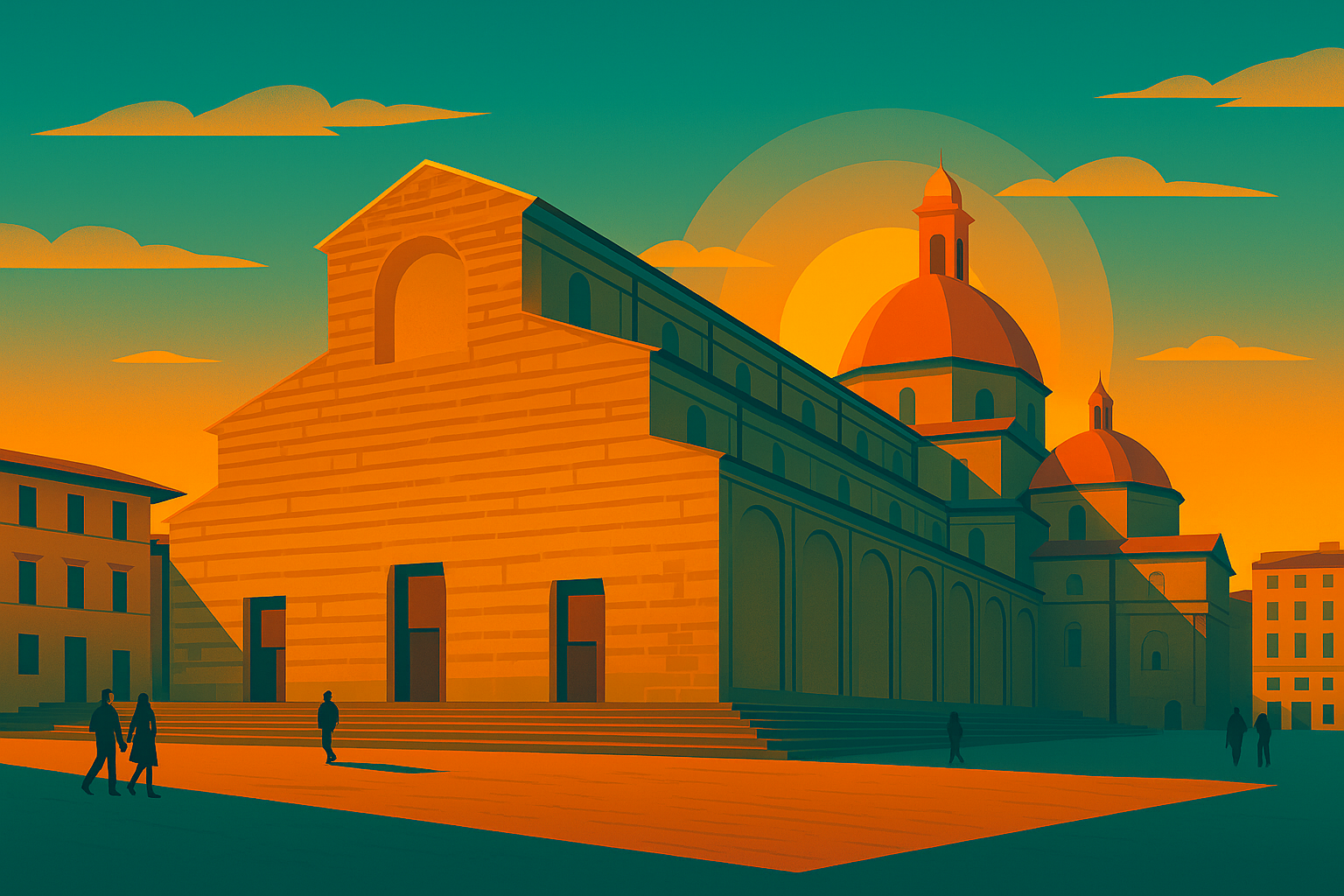
The first encounter with the Basilica di San Lorenzo is, by design, an anticlimax. You emerge from the glorious cacophony of the Mercato di San Lorenzo—a vibrant, chaotic sea of leather stalls, shouting vendors, and tourist throngs—to stand in a piazza before… a wall. This is the great paradox of San Lorenzo. Its façade is a vast, rustic expanse of raw brownstone, pockmarked, irregular, and jarringly plain. It feels less like a church than a fortress that has surrendered to the city around it.
Then, you step inside. The contrast is immediate and absolute. The noise of the city vanishes, replaced by a profound, intellectual silence. The interior is a world of calm beauty, a perfectly rational, airy space defined by soaring arches and the cool, rhythmic gray-and-white geometry of the Early Renaissance.
This transition is your first clue. This is not just a church; it is arguably the most important church for understanding the power, ambition, and creative soul of Florence. It is the official parish church of the Medici family, the dynasty that financed the Renaissance. It is their spiritual home, their generational stage, and their final necropolis, holding the tombs of every principal family member from the founder, Cosimo il Vecchio, to the last heir, Anna Maria Luisa. It is a 300-year biography of a family written in stone, marble, and bronze.
But visiting San Lorenzo is notoriously confusing. The name itself refers not to one building, but to a complex of three separate institutions, each with its own entrance, hours, and ticket. This guide is your map to navigating this puzzle. The three parts are:
- The Basilica di San Lorenzo: The main church.
- The Medici Chapels (Cappelle Medicee): A state museum containing the grand tombs.
- The Laurentian Library (Biblioteca Laurenziana): A state library, also run separately.
This administrative split is not a modern bureaucratic headache; it is a historical clue. It perfectly reflects the way the complex was built: in distinct, ambitious layers over centuries, as successive generations of Medici patrons—from bankers to Popes to Grand Dukes—added their own legacy projects. The separate tickets are not an inconvenience; they are a lesson, forcing you to experience the complex just as it was created: one masterpiece at a time.
The Soul of the Renaissance: Atmosphere and Symbolism
The feeling of San Lorenzo is one of deliberate, intellectual order imposed on worldly chaos. The sensory overload of the surrounding market makes the church’s interior atmosphere all the more powerful. This is the essence of Renaissance Humanism captured in architecture.
Unlike the mystical, vertical darkness of a Gothic cathedral, Brunelleschi’s nave is bright, analytical, and built to a human scale. The atmosphere is defined by its minimalist visual language: the stark, elegant contrast of dark gray pietra serena (serene stone) outlining the architectural skeleton against pure white stucco walls. This rhythmic repetition of columns, arches, and squares is Brunelleschi’s “modular system,” a groundbreaking use of mathematics and geometry to create a space that is both harmonious and divinely rational.
After purchasing a ticket, your entry is often through the enchanting green space of the Cannon’s Cloister. This tranquil, two-tiered courtyard, designed by Brunelleschi’s disciple, acts as an architectural “pause button.” It is a sanctuary of monastic calm that separates the sacred space from the commerce of the street. From within its walls, you can catch glimpses of the Florentine skyline, reminding you that you are at the city’s heart, yet profoundly removed from it.
The complex’s true genius, however, is how its atmosphere changes as you move through its parts, forcing you to walk through time. You begin with the confident, intellectual optimism of Brunelleschi’s Early Renaissance nave (c. 1420s). You then enter the claustrophobic, emotionally turbulent space of Michelangelo’s New Sacristy (c. 1520s), a masterpiece of High Renaissance and Mannerist drama. Finally, you are overwhelmed by the dazzling, opulent, and monumental propaganda of the Grand Dukes’ Baroque-era Chapel of the Princes (c. 1600s). The building is not one statement, but a conversation across centuries.
A Dynasty’s Declaration: The History of San Lorenzo
The Basilica di San Lorenzo is built on ancient foundations. It claims to be the oldest church in Florence, originally consecrated in 393 AD by St. Ambrose of Milan, and it stood outside the original city walls. For three hundred years, it served as the city’s official cathedral, long before that title was transferred to Santa Reparata, the site of the current Duomo.
Its true story, however, begins in 1419. This is the pivotal moment when Giovanni di Bicci de’ Medici, founder of the formidable Medici bank, offered to finance a new church to replace the crumbling 11th-century Romanesque structure. He commissioned the leading architect of the day, Filippo Brunelleschi, for the design. This was more than an act of piety; it was a declaration of power. It transformed San Lorenzo into the Medici family’s personal parish, forever linking their name to the greatest artists of the new age.
The entire complex is a “Who’s Who” of Medici patronage:
- Giovanni di Bicci (d. 1429): The Founder. He commissioned the Old Sacristy as his personal burial chapel, a perfect cube of Renaissance theory.
- Cosimo il Vecchio (d. 1464): The Patriarch. Giovanni’s son, he oversaw the main church’s construction and is buried in a humble tomb in the crypt. He was the patron of Donatello, who created the bronze pulpits.
- Pope Leo X (d. 1521): The Ambitious Pope. A Medici, he launched the grand, ill-fated competition for the church’s façade.
- Pope Clement VII (d. 1534): The Embattled Pope. Also a Medici, he canceled the façade, diverted funds, and commissioned Michelangelo to create the New Sacristy and the Laurentian Library.
- The Grand Dukes (from Cosimo I): The Dynastic Rulers. In the 17th century, they began the bombastic, jaw-dropping Cappella dei Principi (Chapel of the Princes) as their grand ducal mausoleum.
- Anna Maria Luisa (d. 1743): The Last of the Line. The final Medici heir, she is buried in the crypt. Her final act was the “Family Pact,” bequeathing the entire, priceless Medici art collection to the city of Florence, ensuring it could never be removed.
The relationship between the Medici and their artists was not always simple. It was personal, political, and passionate. The most dramatic evidence is “Michelangelo’s secret room,” rediscovered in 1975. In 1530, Florence was recaptured by Medici forces, and Michelangelo—who had actively supported the revolt against them—was sentenced to death by his own patron, Pope Clement VII. The artist hid for two months in a tiny, windowless cell beneath the New Sacristy, covering the walls in brilliant charcoal sketches. He was eventually pardoned; the Pope needed his genius to complete the tombs. This room, now an absolute bucket-list spot, is the ultimate testament to the complex bond that fueled the Renaissance.
Navigating the Masterpiece: A Guide to the Three San Lorenzos
To visit San Lorenzo properly, you must approach it as three distinct sites. Here is a definitive guide to what you will see for each of the three tickets.
Part 1: The Basilica di San Lorenzo (€9.00)
This ticket, purchased from the office on Piazza San Lorenzo, grants access to the main church, the cloisters, and the Old Sacristy.
The Unfinished Façade: The first work of “architecture” to see is the one that isn’t there. In 1515, Pope Leo X launched a competition to finally face the church in marble. Michelangelo won the prestigious commission. He spent years creating designs (a wooden model still exists at Casa Buonarroti) and personally overseeing the quarrying of the finest Carrara marble. But in 1520, the project was abruptly canceled. The Pope, his cousin, likely diverted the funds to the New Sacristy. The rustic brick façade remains a permanent, public scar of this political decision and one of art history’s greatest “what ifs.”
Brunelleschi’s Nave: The interior is a groundbreaking triumph of Early Renaissance design. Brunelleschi’s “modular system” is on full display—the repeating geometry, the classical columns, and the signature pietra serena and stucco create an atmosphere of unparalleled rational harmony.
The Old Sacristy (Sagrestia Vecchia): This is the must-see of the Basilica ticket. It is “ground zero” for the Renaissance. Begun in 1421, it is the only part of the entire complex that Brunelleschi completed in his lifetime. It is a perfect cube (symbolizing the human world) topped by a sphere (the heavens). Inside, it contains the tombs of Giovanni di Bicci and his wife, and is richly decorated with sculptural details and magnificent bronze doors by Donatello. Look up at the small dome over the altar to see the astrological depictions of constellations, a fascinating blend of science and faith.
Donatello’s Bronze Pulpits: In the nave, you will find the last, fiery masterpieces of Donatello, completed in his old age. These two pulpits—the “Resurrection Pulpit” (north) and the “Passion Pulpit” (south)—are works of incredible, raw emotion, shocking for their time. Look for the dramatic panel of the Martyrdom of St. Lawrence, where the saint’s body seems to melt into the gridiron, a display of brutal realism.
Part 2: The Medici Chapels (€9.00)
Insider Tip: This is a separate state museum. The entrance is not on the main piazza. You must walk around the back of the church to Piazza di Madonna degli Aldobrandini, 6.
The Crypt: The visit begins here, in the burial place of 49 later Medici family members, from the Grand Duke Cosimo I to the last heir, Anna Maria Luisa.
The Chapel of the Princes (Cappella dei Principi): From the Crypt, you ascend into one of the most overwhelming rooms in Europe. This dazzling, lavish octagonal mausoleum is the embodiment of Baroque power. Begun in the 17th century, it is covered floor-to-ceiling in commesso, an intricate Florentine mosaic technique using precisely cut pieces of polychrome marble and semi-precious stones to create stunning patterns.
The New Sacristy (Sagrestia Nuova): This is the main event. Designed and sculpted by Michelangelo between 1520 and 1534, it is his direct architectural and sculptural “answer” to Brunelleschi’s Old Sacristy. The room is intentionally different: it is taller, more claustrophobic, and uses architectural elements in an expressive, almost sculptural way that breaks classical rules. The room is a theater for its four famous tombs, a complex allegory of human life:
- Tomb of Giuliano, Duke of Nemours: He is portrayed as the “Active Life,” a Roman general. On his sarcophagus recline the powerful allegories of Night (a woman, identified by her owl and mask) and Day (a powerful, unfinished man).
- Tomb of Lorenzo, Duke of Urbino: He is the “Contemplative Life,” a pensive philosopher. On his tomb are Dusk (a weary, reclining man) and Dawn (a pained woman, twisting as if waking in anguish).
- The third wall holds Michelangelo’s Madonna and Child, which was intended for the tombs of the two most famous Medici: Lorenzo the Magnificent and his brother Giuliano.
Part 3: The Laurentian Library (€5.00)
This is the third and most-overlooked jewel of the complex, with a separate ticket and very limited hours. The entrance is via the Basilica’s cloister. It was also commissioned by Pope Clement VII and designed by Michelangelo. The highlight is the Vestibule and Staircase. The staircase is a revolutionary work of architecture, defying all classical convention. It “flows” downward from the library like a wave of lava, a dynamic, sculptural form that seems to flood the small, tall room. It leads to the long, serene Reading Room, where Michelangelo also designed the plutei (desks).
Practical Guide: Planning Your Visit
The most common mistake visitors make is arriving at San Lorenzo and asking for “one ticket.” You must decide which of the three independent sites you wish to see. Planning is essential, as their hours and closed days do not align.
Opening Hours, Tickets, and Durations
Here is a simple breakdown of the complex:
| Site | Official Name | Ticket Price | Official Hours | What You See |
|---|---|---|---|---|
| The Church | Basilica di San Lorenzo | €9.00 | Mon-Sat: 10:00–17:30 (Closed Sun) | Main Nave, Old Sacristy, Donatello’s Pulpits, Cloisters |
| The Tombs | Medici Chapels | €9.00 | Wed-Mon: 8:15–18:50 (Closed Tue) | Chapel of the Princes, New Sacristy, Medici Crypt |
| The Library | Laurentian Library | €5.00 | Mon-Fri: 10:00–13:30 (Closed Sat/Sun) | Michelangelo’s Staircase, Reading Room |
| Secret Room | Michelangelo’s hidden room | €32.00 (Combined) | By Reservation Only (Extremely limited) | Cell with Michelangelo’s hidden sketches |
Recommended Visit Duration:
- Basilica Only: Allow a solid 60–90 minutes to explore the nave, cloisters, and fully absorb the Old Sacristy.
- Medici Chapels Only: Plan for 1.5 to 2 hours. The symbolism of the New Sacristy and the sheer detail of the Chapel of the Princes demand time.
- The “Grand Tour” (All Three): To see all three ticketed areas, allow a minimum of 3 to 4 hours. This accounts for walking between the separate entrances and the time needed to appreciate each distinct space.
How to Get There and Find the Entrances
The Basilica di San Lorenzo is perfectly situated in the heart of Florence’s market district, making it extremely easy to reach on foot.
- From Santa Maria Novella (SMN) Station: A simple 5 to 10-minute walk east.
- From the Duomo: A very short 3 to 5-minute walk northwest.
- From the Pitti Palace: A pleasant 15-minute walk, crossing the Ponte Vecchio and heading north.
The historic center is best explored on foot, but the small electric ATAF C1 bus line has a “San Lorenzo” stop nearby.
Navigating the Entrances: This is the most critical logistical challenge. The visitor’s path, walking around the building from the Basilica to the Chapels, physically mirrors the way the Medici built outward from their parish, generation after generation.
- Basilica Entrance: On the main square, Piazza San Lorenzo.
- Medici Chapels Entrance: Around the back of the church, on Piazza di Madonna degli Aldobrandini, 6.
- Laurentian Library Entrance: Accessed from within the Basilica’s cloister.
Facilities and Visitor Information
The Dress Code (Non-Negotiable): This is the most important rule. The Basilica di San Lorenzo is an active, consecrated sacred site, and the dress code is strictly enforced. Entry will be denied if you are not dressed appropriately. Knees and shoulders must be covered. This means no sleeveless tops, tank tops, short shorts, miniskirts, or low-cut tops for men or women.
Insider Tip: Always carry a light scarf or shawl in your bag when exploring Florence. It is the easiest way to ensure entry to all of the city’s magnificent churches without a second thought.
Accessibility (A Mixed Bag): The complex is a mix of ancient and modern infrastructure. The Medici Chapels, as a state museum, are well-equipped with ramps, an elevator, and a platform lift. The Basilica, as an ancient church, is less accommodating, with uneven stone floors and steps. The “Secret Room” is inaccessible for those with mobility issues, as it’s reached only by a narrow staircase.
When to Go and Where to Look: Timing and Photography
The Best Time to Visit
For the Basilica, visit either early in the morning (right at 10:00 AM) or in the last hour before closing (after 16:30) to experience its tranquil atmosphere. Remember, it is closed to tourists on Sundays.
For the Medici Chapels, queues can form, especially in high season. It is highly advisable to book a timed-entry ticket online in advance to bypass the line. Remember, the Chapels are closed on Tuesdays.
For the Laurentian Library, you must plan your day around its very limited hours, typically open only on weekday mornings from 10:00 to 13:30.
Expert Strategy: The best approach is a “split-day” plan. Start your day at the Laurentian Library (10:00–10:30), then move to the Basilica (10:30–11:30). Explore the market and have lunch. Book a timed ticket for the Medici Chapels for the early afternoon (e.g., 14:00) to bypass the main queues.
Best Photo Spots
- The Façade: Capture the classic contrast shot: the rough, pockmarked brownstone of the unfinished wall juxtaposed against the bright, chaotic stalls of the market.
- The Nave: Stand at the main entrance and shoot down the perfect, rhythmic, linear perspective of Brunelleschi’s pietra serena columns.
- The Cloister: Use the arches of the Cannon’s Cloister as a frame for the central green garden or for Giotto’s Bell Tower peeking over the walls.
- New Sacristy: The “money shot.” A low-angle shot of Michelangelo’s Night or Dawn to capture the tension in the marble and the way they seem to slide off the sarcophagi.
- Laurentian Library: The “flowing” staircase, shot from either the top (looking down) or the bottom (looking up) to emphasize its radical, liquid-like form.
Beyond the Basilica: The San Lorenzo Neighborhood
The San Lorenzo Market
The market is San Lorenzo’s most obvious neighbor. The Outdoor Market is a characteristic sprawl of stalls surrounding the church, the place for leather goods, souvenirs, and clothing. The Mercato Centrale is the essential culinary stop. The ground floor is an authentic, bustling local food market (best in the morning), while the first floor is a vibrant, modern food hall open until midnight, perfect for a casual lunch or dinner.
Following the “Medici Trail”
San Lorenzo is “Chapter 1” of the Medici story. To complete it, visit:
- Palazzo Medici Riccardi: Just a 2-minute walk away. This was the Medici family’s private home. You have seen their church; now see their palace.
- The Duomo Complex: A 5-minute walk. This was the public center of Florentine religious life, a fascinating contrast to San Lorenzo as the private dynastic center of the Medici.
- Palazzo Vecchio: The center of Florence’s political power, to contrast with San Lorenzo as the center of the Medici’s cultural and spiritual power.
Conclusion: The Key to Unlocking San Lorenzo
Many visitors make the mistake of running directly to the Medici Chapels, taking a quick photo of Michelangelo’s tombs, and leaving. They “see” the masterpiece but fail to understand it.
The definitive insider move, the key to unlocking the entire complex, is to visit the Old Sacristy (Brunelleschi) before you visit the New Sacristy (Michelangelo).
You must first stand inside Brunelleschi’s perfect, calm, rational, and optimistic cube—the “question”—to fully appreciate the tense, emotional, and dramatic architectural space that Michelangelo created as his “answer” a century later. This simple, 30-minute detour provides the entire context for one of the world’s greatest artistic dialogues. It is the difference between simply sightseeing and truly understanding.