
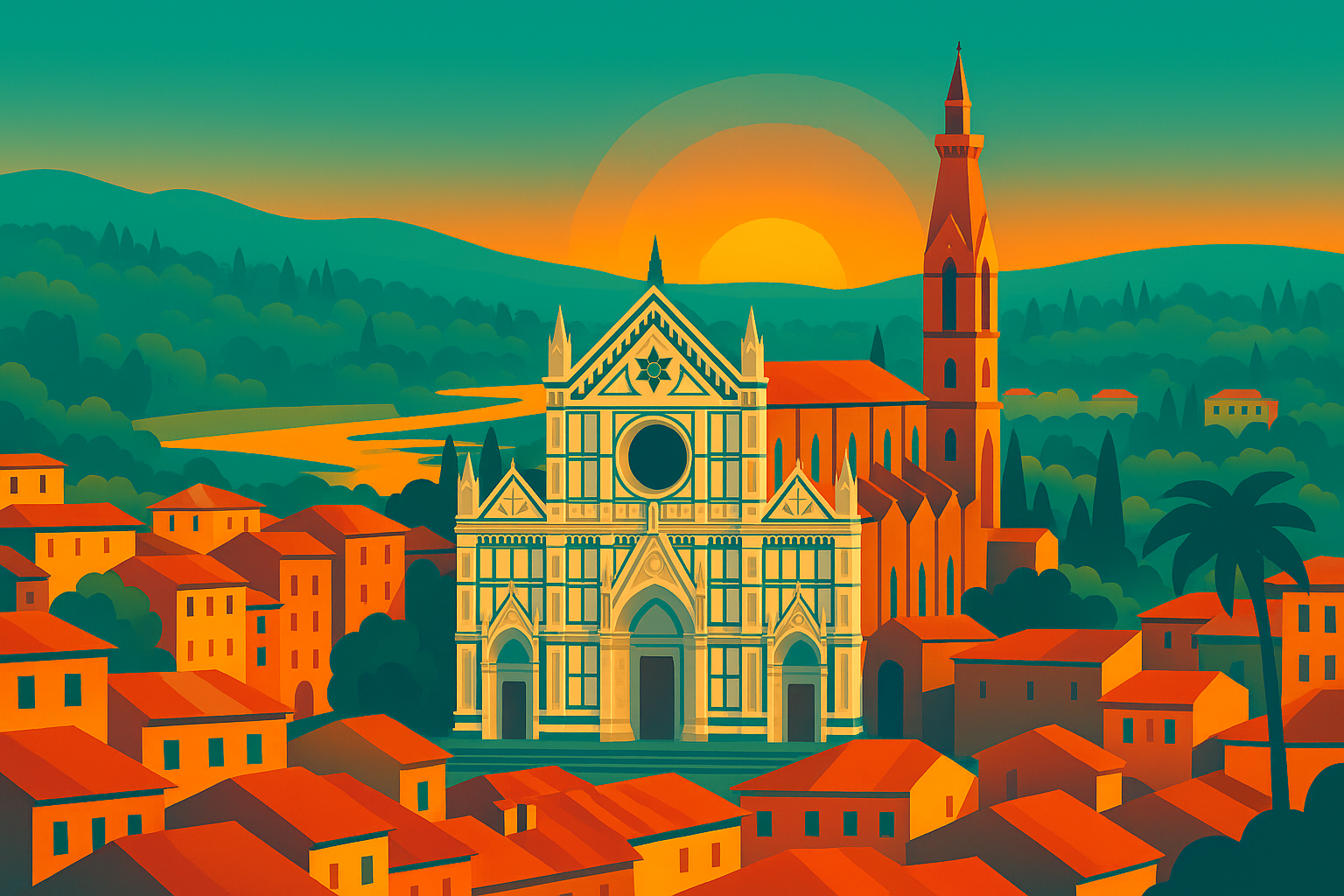
Basilica di Santa Croce
Experience the magic of Tuscany
Imagine driving through the Chianti hills, discovering medieval villages, and stopping for an aperitivo at sunset. Renting a car is the secret to experiencing Tuscany with true freedom. Book now for the best choice.
🔍 Choose your car for TuscanyThe Temple of Italian Glories: An Expert Guide to Florence’s Basilica di Santa Croce
In 1817, the French author Stendhal was visiting the Basilica di Santa Croce. As he emerged from the church, confronted by its staggering density of art and history, he was overcome. “I had reached that point of emotion,” he wrote, “I had palpitations of the heart, the life went out of me and I walked in fear of falling.” This experience, a profound, dizzying, ecstatic confusion, became known as “Stendhal Syndrome,” and it perfectly captures the essence of Santa Croce.
This is not just another church. It is a building of profound contradictions. It is the largest Franciscan church in the world, the final home of an order founded on ideals of poverty and humility. Yet it is simultaneously the Tempio dell’Itale Glorie—the “Temple of Italian Glories”—a lavish pantheon built to honor the most illustrious (and often secular) geniuses in Italian history: Michelangelo, Galileo, and Machiavelli.
To simply visit the church of Santa Croce is to misunderstand it. One must visit the complesso monumentale (monumental complex), a sprawling 12,000-square-meter site that, with a single ticket, grants access to the basilica, a museum, three cloisters, and one of the most perfect buildings of the Renaissance: the Pazzi Chapel. This guide will serve as your expert companion. We will navigate the layers of this extraordinary site, decode the symbolism of its art, honor the stories sealed within its tombs, and provide the practical advice needed to explore every corner of this Florentine treasure.
The Soul of a City: Atmosphere and Symbolism
Your experience begins in the Piazza di Santa Croce, one of Florence’s largest and most historic public squares. Its vast, open-armed shape was no accident; the Franciscans designed it in the 13th century to accommodate the enormous crowds who gathered for public sermons. This square became the city’s secular stage, hosting jousts, festivals, and, since the 16th century, the famously brutal Calcio Storico (historic soccer), which is still played here every June.
Looming over it all is the magnificent, polychrome marble façade. But this is the first of Santa Croce’s many illusions. The intricate neo-Gothic “mask” you see is not from the 13th century; it’s a 19th-century addition, completed in 1865. For over 500 years, the church hid behind a bare, unfinished stone front. Standing guard in the piazza is the imposing statue of Dante, the first “glory” you meet—a poet who, in a twist of history, isn’t actually buried here.
Step inside, and the atmosphere shifts dramatically. The interior, designed by Arnolfo di Cambio, is a masterpiece of Franciscan Gothic. It is overwhelming in its scale—a vast, 115-meter-long nave—but feels austere and humble. There is no soaring stone vault, but rather an open timber roof. The space is wide and horizontal, a “preaching church” built for the masses. But as you walk toward the altar, this public humility gives way to private, aristocratic wealth. The transept and 16 chapels explode with color. Here, the walls are not bare but are covered in fresco cycles by Giotto and his pupils, commissioned by the wealthy Bardi, Peruzzi, and Baroncelli banking families who funded the church’s construction.
Finally, a side door leads you out of the dim basilica and into the blinding brightness of the cloisters. This is a necessary gasp of air, a space of serene, repeating arches and meditative silence, leading you to the complex’s architectural jewel. The complex’s design is its narrative: a public, humble nave funded by private, opulent wealth, which in turn gives way to spaces of pure, rational thought.
A Story in Stone: The History of Santa Croce
The story of Santa Croce is the story of Florence. Legend holds that St. Francis of Assisi himself founded the original oratory, but the Franciscan friars formally settled here around 1228, on a marshy “island” outside the city walls. The massive basilica we see today was begun in 1294, its construction an act of civic and religious one-upmanship. The Franciscans (at Santa Croce) were in direct, public competition with the rival Dominican order (at Santa Maria Novella) to build the largest, most impressive church to minister to Florence’s growing population.
But the complex’s most unique identity—its “Pantheon”—was born in the 15th century. It began not with Michelangelo, but with the tombs for Leonardo Bruni and Carlo Marsuppini, the humanist Chancellors of the Florentine Republic. This was a revolutionary shift. The Republic paid for these magnificent monuments not to honor saints, but to celebrate civic virtue, intellectual scholarship, and public service. This secular ideal, honoring human genius, is the seed from which the entire “Temple of Italian Glories” grew.
This identity was cemented in the 16th century, though not without cost. In 1560, Giorgio Vasari, the great artist and art historian, was commissioned to “modernize” the church for the Counter-Reformation. In an act that pains historians to this day, he had his workers whitewash many of the priceless 14th-century frescoes, including Giotto’s, to install large stone altars. In a perfect historical irony, at the same time he was burying these medieval treasures, Vasari was designing the grand tomb for Michelangelo, elevating the artist to a national hero for the first time.
During the 19th-century Risorgimento (the movement for Italian unification), Santa Croce became a powerful secular symbol. The long-delayed, magnificent tombs for Machiavelli (1787) and Galileo (1737) were finally erected—a defiant celebration of Italian genius over political and religious censure. They were soon joined by monuments to poet Ugo Foscolo, composer Gioachino Rossini, and the grand, empty cenotaph for the exiled Dante. The complex’s great 20th-century tragedy was the 1966 Arno flood. The waters surged into the piazza, basilica, and cloisters, causing catastrophic damage. The most famous victim was Cimabue’s Crucifix, which was submerged for hours and became the international symbol of the flood’s cultural devastation and the new science of art restoration.
The Masterpieces: A Journey Through Florentine Art
The Basilica and its adjacent museum hold a collection that traces the entire arc of the Florentine Renaissance, from its earliest stirrings to its High Renaissance masters.
Giotto: The Revolution in the Transept
In the transept, to the right of the high altar, you find the chapels of the Bardi and Peruzzi families. These were frescoed by Giotto di Bondone, the “father of European painting.” This is where medieval art ends and the Renaissance begins. Giotto abandoned the flat, golden, symbolic style of Byzantine art. He created a world of three-dimensional space, narrative drama, and, for the first time, real human emotion. His figures have weight. His scenes, like the Death of St. Francis or the Trial by Fire, are filled with tangible grief, individual character, and psychological depth.
CRITICAL VISITOR NOTE: The Bardi Chapel, containing Giotto’s Stories of St. Francis, is currently closed for a multi-year restoration. The frescoes are not visible. The reopening is tentatively scheduled for Autumn 2025. The nearby Peruzzi Chapel frescoes are visible, but are in a very faint, damaged condition.
Donatello: A “Museum” of One Man’s Genius
Santa Croce is one of the best places in the world to understand Donatello’s revolutionary versatility, as it holds three major works from different phases of his career, in three different materials.
- The Wooden Crucifix (c. 1406-08): Located in the Bardi di Vernio Chapel (left transept), this is a masterpiece of “strong realism.” This is Donatello’s famed “peasant Christ.” Legend holds his friend Brunelleschi harshly criticized it, saying Donatello had “put a peasant on the cross.”
- The St. Louis of Toulouse (c. 1425): Now in the Museum (Refectory), this is a technically dazzling, monumental statue in gilded bronze.
- The Cavalcanti Annunciation (c. 1435): Found on the wall of the right nave, this “magnificent, lavishly gilded” relief is carved from the local pietra serena. It is a masterwork of psychological narrative, capturing the precise, human moment Mary is “startled” by the angel’s arrival.
The Museum (Museo dell’Opera di Santa Croce)
Accessible from the first cloister, the museum is housed in the former Refectory (Cenacolo). Its two greatest treasures tell a story of tragedy and dialogue. The first is the complex’s most poignant single object: Cimabue’s Crucifix (c. 1265). This is the “missing link,” a pre-Giotto masterpiece that already shows a new, human pathos in the suffering of Christ. It was 60% destroyed by the 1966 flood, and it now hangs as a haunting, restored ruin—a symbol of Florentine tragedy and resilience.
The second is Taddeo Gaddi’s Last Supper and Tree of Life (c. 1350), a colossal fresco by Giotto’s most talented pupil. In the same room, you can see Giorgio Vasari’s 1546 Last Supper, allowing for a direct, 200-year comparison of artistic vision.
The Renaissance Ideal: Brunelleschi’s Pazzi Chapel
While the basilica is a masterpiece of Italian Gothic, the complex’s single greatest architectural feature is found outside the church walls. This is a crucial piece of advice: do not miss the Pazzi Chapel. You must exit the basilica near the south transept and enter the primo chiostro (first cloister).
What you find is a building that is the philosophical opposite of the soaring, mystical basilica. Designed by Filippo Brunelleschi, the father of Renaissance architecture, it was commissioned in 1429 as the chapter house, or meeting room, for the Franciscan friars. The chapel is a manifesto in stone, described as “one of the most harmonious buildings of the early Florentine Renaissance.” Brunelleschi rejected the Gothic obsession with verticality and divine mystery. Instead, he created a rational, serene, and perfectly human-scaled space based on flawless geometry—squares and circles.
The defining visual motif is the clean, cool contrast of white plaster walls and the grey pietra serena (serene stone) that outlines every architectural element. The only major splashes of color come from the 12 glazed blue-and-white terracotta tondi (roundels) of the Apostles, created by the workshop of Luca della Robbia. Look up at the small dome above the altar: it features a precise astrological fresco depicting the sky over Florence on a specific date: July 4, 1442.
The Temple of Italian Glories: The Tombs of the Greats
This is why most people come. Santa Croce is a mausoleum for the very idea of Italian genius.
- Michelangelo Buonarroti (d. 1564): The most famous tomb, located in the right nave. Designed by Vasari, it features a bust of the artist and three allegorical figures mourning him: Painting, Sculpture, and Architecture. The tomb itself is an act of Florentine pride; Michelangelo died in Rome, but his body was “secretly kidnapped” by his nephew and smuggled back to Florence to be buried in the city he always considered home.
- Galileo Galilei (d. 1642): Located directly opposite Michelangelo. His tomb tells a story of science and faith. Condemned for heresy, he was buried quietly in a small side room. This grand monument was only erected in 1737, a victory for the Enlightenment. When his body was moved, three fingers were taken by admirers as “relics” of a scientific saint.
- Niccolò Machiavelli (d. 1527): The father of modern political science. Like Galileo, his ideas were too controversial for an immediate monument. His tomb was only built in 1787, honoring him as a hero of Italian political thought.
- Dante Alighieri (The Empty Tomb): One of the grandest monuments is a cenotaph—it is empty. Dante, the “father” of the Italian language, was exiled from his native Florence. He died and was buried in Ravenna in 1321. Ravenna has famously refused all of Florence’s requests to return his remains. This empty tomb is a monument to Florence’s profound, centuries-old guilt.
Finally, look down. The floor is paved with over 250 worn marble tomb slabs (lastre tombali). This was once a sign of humility for wealthy patrons, as they would be “walked on for all eternity.”
Planning Your Visit: Practical Information
Opening Hours, Prices, and Duration
The monumental complex is open Monday to Saturday from 9:30 AM to 5:30 PM. On Sundays and religious holidays, hours are 12:30 PM to 5:45 PM. The ticket office closes and last admission is strictly at 5:00 PM.
A full adult ticket costs €10.00. Reduced prices are available for ages 12-17, and entry is free for children under 12. This single ticket provides excellent value, as it includes the entire complex: the Basilica, the Museum, the two Cloisters, and the Pazzi Chapel. A quick, “checklist” visit requires at least 60 to 90 minutes, but this is not recommended. To truly absorb the tombs, the art, and the serene architecture, allow a minimum of 2.5 to 3 hours.
Be aware that the complex offers several free admission days throughout the year. This can be a trap for first-time visitors: on free days, only the basilica is open. The cloisters, museum, and Pazzi Chapel are closed. We advise against visiting on a free day if it’s your only opportunity.
How to Get There
The complex is located at Piazza Santa Croce 16. The best way to arrive is on foot. From Florence’s main train station, Santa Maria Novella (SMN), it is a pleasant 20 to 22-minute walk directly through the historic center. For those with mobility concerns, the small electric Autolinee Toscane buses are ideal. Lines C1, C2, and C3 all stop near the piazza at “Verdi” or “Ghibellina Pepi”.
CRITICAL INSIDER TIP: The visitor entrance and ticket office are not at the main, ornate façade. You must go to the left-hand (north) side of the basilica, to the smaller square named Largo Bargellini.
Facilities and Accessibility
This is a consecrated basilica, and a strict dress code is enforced: shoulders and knees must be covered. However, Santa Croce offers a useful service: free disposable robes are available at the entrance for those who are unprepared. Audio guides are available to rent. Restrooms are located in the first cloister. Photography for private use is permitted, but without flash or tripods.
Regarding accessibility, the complex is only partially accessible. Admission is free for visitors with disabilities and one carer. The main nave, aisles, and cloisters are wheelchair accessible via ramps. However, there is a significant barrier: the entire transept—which contains all the Giotto-school chapels, the main altar, and Donatello’s Crucifix—is on a raised platform and is not wheelchair accessible.
Best Time to Visit
As one of Florence’s best-loved sites, Santa Croce can become very crowded. The best time to visit is first thing in the morning, right at the 9:30 AM opening on a weekday. The vast nave can absorb a crowd, but the small chapels and the Pazzi Chapel become bottlenecks. The second-best time is after 3:30 PM, once the large tour groups have begun to depart. This is also the best time for photographers, as the low, late-afternoon sun illuminates the cloisters and Pazzi Chapel beautifully.
Beyond the Basilica: Exploring the Santa Croce Neighborhood
The Santa Croce neighborhood is one of Florence’s most authentic. After your visit, use the complex as a starting point for a thematic exploration.
The Hidden Gem: Scuola del Cuoio (Leather School)
This is the neighborhood’s most famous “secret.” The Scuola del Cuoio, or Leather School, was founded after WWII by Franciscan friars and local artisan families to teach a trade to war orphans. It is located inside the monastery complex, but it is not part of the basilica ticket. The entrance is separate, free, and found by walking around the back of the church’s apse to Via San Giuseppe 5R. You can watch master artisans hand-crafting bags and wallets, breathing in the rich smell of leather in a truly authentic setting.
Thematic Pairings
- For the Renaissance Sculpture Fan: After seeing Michelangelo’s tomb and Donatello’s Annunciation, walk 10 minutes to the Museo Nazionale del Bargello. This is the “sculpture” equivalent of the Uffizi and houses Donatello’s bronze David.
- For the Michelangelo Pilgrim: Just a block away is Casa Buonarroti, Michelangelo’s family home-turned-museum. It contains his earliest known marble works.
- For the Local Food Experience: Skip the tourist traps. Walk five minutes north to the Mercato di Sant’Ambrogio. This is Florence’s oldest (1873) and most authentic covered food market, the perfect place for an incredible and affordable lunch.
Best Photo Spots
- The Façade: The piazza is wide, allowing for a full shot. Use the Dante statue as a strong foreground element to frame the intricate façade.
- The Cloisters: The serene, repeating arches of the “Brunelleschi Cloister” and the “Primo Chiostro” make for classic, contemplative shots.
- The Pazzi Chapel: The most “Instagrammable” spot. Capture the perfect symmetry of the portico or the interior’s clean contrast of white plaster, grey stone, and blue Della Robbia terracottas.
- The Interior: The most powerful images are close-ups of the worn, 14th-century floor tombs or the allegorical statues mourning at Michelangelo’s tomb. Remember: no flash.
Santa Croce is not a single stop to be checked off a list. It is a dense, multi-layered library of Western history, chronicling the evolution of Florence’s soul—from Franciscan faith to Renaissance humanism and, finally, to the very concept of “Italy” itself. It demands time and contemplation. It is a place that will, if you let it, leave you with palpitations of the heart.