
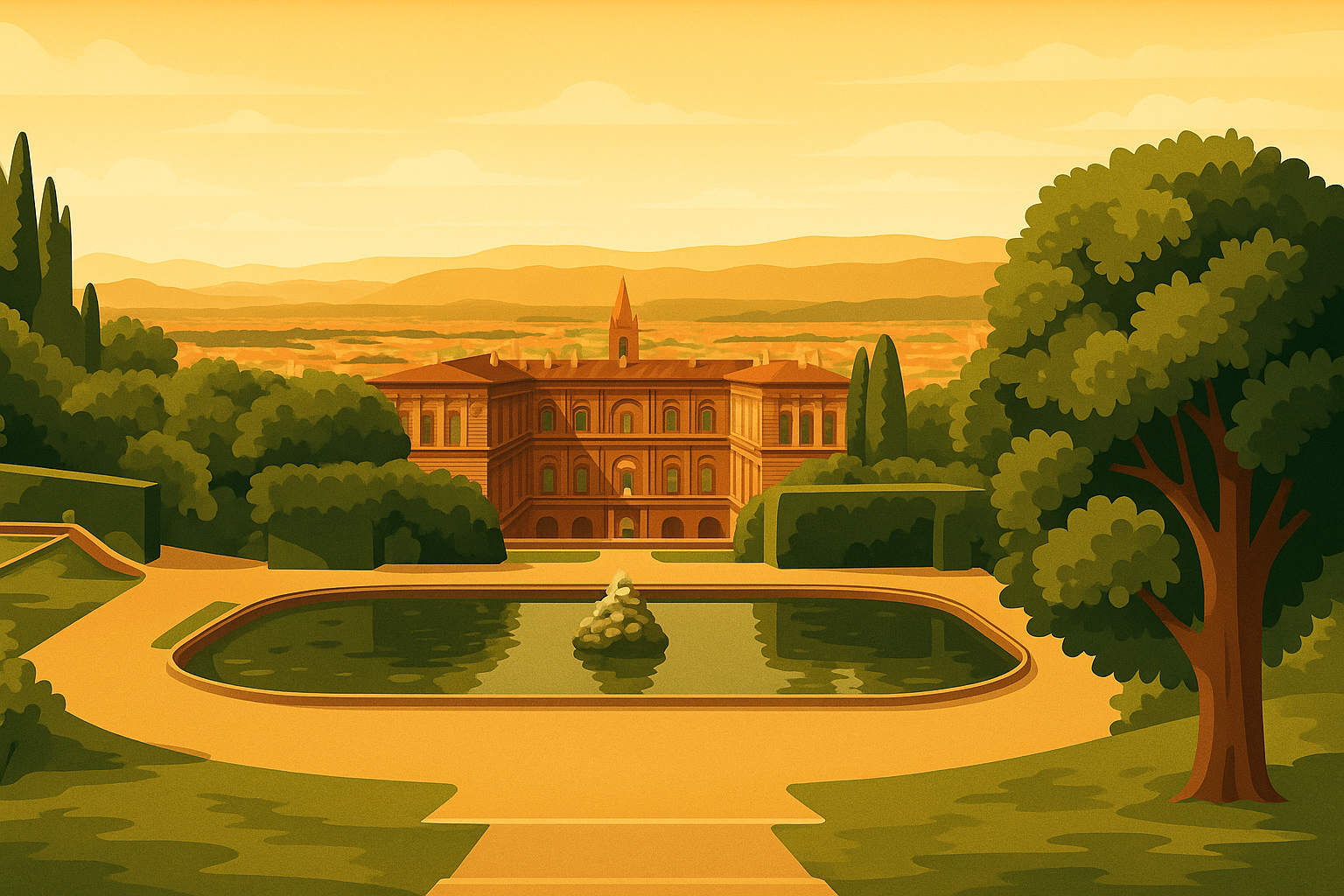
Boboli Gardens
Experience the magic of Tuscany
Imagine driving through the Chianti hills, discovering medieval villages, and stopping for an aperitivo at sunset. Renting a car is the secret to experiencing Tuscany with true freedom. Book now for the best choice.
🔍 Choose your car for TuscanyThe Medici Secret: Why Florence’s Boboli Gardens Aren’t What You Think (And Why That’s a Good Thing)
Let’s begin with a crucial piece of advice, a key to unlocking the soul of Florence: the Boboli Gardens (Giardino di Boboli) is not a flower garden. If you arrive expecting a delicate, colourful tapestry of petals, a gentle English-style park, you will be profoundly disappointed. Boboli is something else entirely—something far more significant. It is a 111-acre colossus of power, a declaration of dominance over nature rendered in stone, cypress, and water. This is a landscape designed to be read as much as admired.
This is the original giardino all’italiana, the 16th-century prototype of the formal Italian garden that would inspire royal courts across Europe, most famously at Versailles. Conceived in 1549 by one of the Renaissance’s most formidable women, Duchess Eleonora di Toledo, it was designed as the private backyard for the imposing Pitti Palace. To walk through Boboli is to walk through the Medici mind. It is a sprawling open-air museum where, as the creators intended, “Nature, Art, Science and Alchemy meet”. It is a place of rigorous geometry, hidden grottoes, and ancient sculpture. This guide will show you how to read its symbols, find its true treasures, and, most importantly, how to use your ticket to unlock an even better, secret view of Florence that most visitors miss.
The Soul of the Garden: Grandeur, Power, and Symbolism
The atmosphere at Boboli is one of grand, austere theatre. The guiding philosophy is not horticulture; it is Mannerist control. The garden’s entire design is a potent symbol of human intellect imposing its will on the perceived “chaos” of the natural world. This is the fundamental concept you must grasp to appreciate its unique beauty. It’s a garden that speaks of ambition, not of simple prettiness.
This is why you will not find rambling borders or wild fields of tulips. Instead, your senses will be guided by geometrically perfect avenues, symmetrical terraces, and evergreen hedges sculpted into architectural forms. The beauty here is structural, almost mathematical. It is found in the precise alignment of a cypress-lined avenue drawing your eye to a distant statue, the carefully engineered sound of a fountain echoing in a stone basin, and the dramatic interplay of bright Tuscan sun and deep, cool shadow.
Every element is a testament to Medici might. The garden lacks its own natural water source, a significant challenge in the hills of Florence. The fact that it is filled with monumental fountains is, in itself, a breathtaking symbol of power—a feat of 16th-century engineering that required piping water from the nearby Arno River. The entire 111-acre (or 45,000 square meter) park is a private collection, populated by ancient Roman and Renaissance statues. Each one is carefully placed to terminate a view, tell a mythological story, or celebrate the dynasty that willed this extraordinary landscape into existence.
A Landscape Written by Dynasties
The Boboli Gardens we see today is not a single creation but a magnificent historical document, written in layers by three successive dynasties over 400 years. To walk its paths is to trace the evolution of taste, power, and art from the High Renaissance to the 19th century.
It all began in 1549 when Eleonora di Toledo, the Spanish wife of Cosimo I de’ Medici, purchased the Pitti Palace and the hillside behind it. The first plan, laid out by Niccolò Tribolo, established the main axis rising from the palace, carving the great Amphitheater from the hill itself. This initial design set the stage for centuries of development.
After Tribolo’s untimely death, the project was continued by a supergroup of Mannerist masters, including Giorgio Vasari, Bartolomeo Ammannati, and the brilliantly eccentric Bernardo Buontalenti. This second phase, under the patronage of the alchemically-inclined Grand Duke Francesco I de’ Medici, produced the garden’s most secret and fantastic features. This is when the mysterious Grotta del Buontalenti was built, a space dedicated not just to art, but to the esoteric principles of alchemy and metamorphosis.
When the Medici line died out, the Habsburg-Lorraine dynasty inherited the gardens in the 18th century. It was they who made the revolutionary decision to open the park to the public for the first time in 1766, transforming a private treasure into a public institution. They also added the garden’s most whimsical and delicate structures, including the charming Rococo-style Kaffeehaus (a rare example in Tuscany) and the Limonaia (Lemon House), built to winter the family’s prized citrus collection. The House of Savoy made the final 19th-century additions, completing the masterpiece that is now rightly recognized as a UNESCO World Heritage site.
What to See: The Unmissable Masterpieces of Boboli
While the gardens are vast, the visit is logically organized along two main axes and punctuated by several “must-see” features. Allow yourself to wander, but be sure to seek out these key locations where the garden’s story is told most powerfully.
The Amphitheater: A Stage for Power
Your journey begins directly behind the Pitti Palace, at the magnificent Amphitheater. This grand, tiered space was literally born from the palace; its U-shape is the result of the quarry that was excavated to provide the pietraforte (strong stone) for the palace’s construction. Its centerpiece is a 3,500-year-old Egyptian obelisk, brought from Luxor in 1789, which stands over a massive granite basin taken from the Baths of Caracalla in Rome. Standing here, you are at the heart of the Medici stage, a space designed for lavish courtly spectacles and a clear visual link between the rulers’ home and their dominion over the landscape.
The Grottoes: A Journey into Alchemy
The garden’s true soul, however, lies in its grottoes. While the small Grotta di Madama is a lovely, intimate space, the undisputed masterpiece is the Grotta del Buontalenti. This artificial cave is a masterwork of Mannerist alchemy, designed to tell a symbolic story in three distinct rooms:
- Room 1 (Chaos & Metamorphosis): The entrance is a surreal fantasy of artificial stalactites, shells, and stone figures that seem to melt and merge with the walls. Here, you’ll find copies of Michelangelo’s Prisoners (the originals are in the Accademia Gallery) struggling to free themselves from the rock. It’s a perfect expression of the non-finito (unfinished) technique and the alchemical theme of raw matter transforming into life.
- Room 2 (Action): This smaller, more classical room houses Vincenzo de’ Rossi’s sculptural group Paris and Helen, an allegorical depiction of “Rapture” or abduction, representing the active forces of passion and change.
- Room 3 (Creation): The final, intimate, egg-shaped chamber reveals Giambologna’s Bathing Venus. She represents the perfect, completed form—a symbol of love, beauty, and fertility born from the preceding chaos. The journey is complete.
The Viottolone and the Isolotto: A Romantic Descent
The secondary axis, the Viottolone, is a long, majestic avenue lined with towering cypress trees and statues. It offers a completely different experience, descending the hill in a dramatic, shaded corridor. The walk down this path is one of the most evocative in Florence, a perfect frame for photography and quiet contemplation. It leads you to the garden’s most romantic feature: the Isolotto (Little Island), an oval basin dominated by Giambologna’s spectacular Fountain of the Ocean. Surrounded by water and citrus trees, this tranquil spot feels like a world apart from the formal grandeur of the upper gardens.
Planning Your Visit: Tickets, Hours, and Strategy
The gardens open reliably at 8:15 am year-round, making an early start the best way to experience the grounds in peace. Closing times, however, are highly seasonal and vary almost monthly. Expect a 4:30 pm closing in deep winter (Nov-Feb) and a 7:10 pm closing at the height of summer (Jun-Aug). Last admission is always one hour before closing. Be warned: the gardens have unusual closure days. They are closed on the first and last Monday of every month, as well as on January 1 and December 25.
A standard single-entry ticket costs €10.00 if purchased at the ticket office on the day of your visit, or €13.00 if pre-booked online (the difference being the reservation fee). This ticket presents two excellent strategic opportunities:
- The Pitti Palace Combo: For just €12.00 more, the 1-day combined ticket (€22.00–€25.00) also grants access to all the museums within the Pitti Palace, including the magnificent Palatine Gallery. This is an outstanding value for a full day of art and history.
- The Bardini Secret: Most importantly, your €10.00 Boboli ticket also includes same-day entry to the nearby Bardini Gardens—a fact many visitors unfortunately miss. This is the key to a perfect garden experience in Florence.
Plan for a minimum of 2–3 hours to walk the main paths and see the key sights without rushing. The terrain is steep, so wear comfortable shoes.
How to Get There
The main entrance to the Boboli Gardens is through the central courtyard of the Pitti Palace. The palace is located in the Oltrarno, Florence’s “other side” of the river, which is an easy and beautiful walk from the historic center.
On Foot (The Best Way): From the Ponte Vecchio, it is a scenic and straightforward 10-minute walk. From the main ‘Firenze Santa Maria Novella’ (SMN) train station, it is a pleasant 20 to 25-minute stroll through the city center, across the Arno, and to the palace. This walk is part of the experience, taking you through the artisan workshops and vibrant streets of the Oltrarno.
By Public Transport: If you prefer to ride, the solution is simple. From the SMN station area (near the “Stazione Scalette” stop), take one of the small electric buses. Line C4 (in the direction of “P.O.Palagi”) or line 11 (in the direction of “La Gora”) will work. The ride is short, and the “Pitti” stop will drop you directly in front of the palace.
Insider Tip: To avoid the main crowds at the palace, consider starting your visit at the quieter, southern entrance at Porta Romana. This allows you to enter from the bottom of the gardens and make a scenic climb up the grand Viottolone avenue, saving the main Amphitheater and palace view for a dramatic finale.
Facilities and Practical Advice
The gardens are equipped with basic, if somewhat sparse, amenities. Restrooms (WC) are available at several key points, including the Annalena entrance (Via Romana), near the Amphitheater, and near the Porcelain Museum. A bookshop is located in the main Pitti Palace courtyard, not in the gardens proper.
A serious word of warning: do not rely on the gardens for food or drink. The lovely 18th-century Kaffeehaus is the main on-site cafe, but it is notoriously and unpredictably closed. It is essential to bring your own water, especially in summer, and any snacks you may need. Drinking fountains with potable water are available but can be far apart.
On the matter of accessibility, the gardens are, by their 16th-century nature, extremely challenging. The Boboli Gardens are not recommended for visitors with mobility challenges or those using strollers. The terrain is steep, hilly, and the paths are made of loose gravel and pebbles. While accessible entrances exist at Pitti Square and Porta Romana, and a stairlift provides access to one toilet near the Amphitheater, the vast majority of this historic landscape is inaccessible.
The Best Time to Visit
Seasonally, the best time to visit depends on your goal. If you are seeking flowers, the answer is not Boboli, but its included partner. Aim for mid-April to May to see the Bardini Gardens’ famous purple wisteria tunnel in its spectacular full bloom. For walking Boboli itself, the pleasant weather of spring (April–June) and fall (September–October) is ideal. The summer months can be oppressively hot, and late autumn is often wet and muddy.
For the best experience, arrive at the 8:15 am opening to have the grand avenues almost to yourself and enjoy the soft morning light. Weekdays are always significantly quieter than weekends.
Beyond the Garden Walls: Essential Nearby Visits
Your Boboli ticket is a key that unlocks more than just one garden. To make the most of your day, combine your visit with these essential partners.
- Palazzo Pitti: This is the most obvious and essential companion. The 1-day combined ticket is the most logical way to experience both the palace and its gardens. After exploring the grounds, step inside to immerse yourself in the opulent Palatine Gallery (which holds a stunning collection of works by Raphael and Titian), the gilded Royal Apartments, and the Gallery of Modern Art.
- The Bardini Gardens (The Essential Visit): This is the single most important strategic tip for your visit. Your €10.00 Boboli ticket includes free and “skip-the-line” access to the Giardino Bardini, a short walk away. We recommend going after Boboli. Where Boboli is grand and austere, Bardini is intimate and lush with flowers. Best of all, from its hilltop cafe, the Bardini Garden offers what is arguably the single best panoramic view of Florence’s skyline—a stunning vista that many find superior to the more crowded Piazzale Michelangelo.
- Forte di Belvedere: A back gate of the Boboli Gardens connects directly to the Forte di Belvedere, a massive 16th-century Medici fortress. It often hosts contemporary art exhibitions and provides another spectacular (though similar) vantage point over the city and countryside.
Best Photo Spots
- The Duomo View: For the best shot of Florence from within Boboli, climb the hill to the terrace of the Kaffeehaus. Even if the cafe itself is closed, the terrace is often accessible and perfectly frames Brunelleschi’s dome between the cypress trees.
- The Cypress Alleys: For that classic, dramatic “Tuscan” photo, use the long, cypress-lined Viottolone or the arched pergola of the Ragnaie (spider’s lane) to create images with powerful symmetry and leading lines.
- The Modern Shock: Find the monumental bronze head, Tindaro Screpolato (The Cracked Tyndareus) by Igor Mitoraj. The juxtaposition of this modern, fractured face against the classical Renaissance landscape is unforgettable.
- The Reflection: The basin of the Isolotto, with Giambologna’s Fountain of the Ocean at its center, offers beautiful reflection opportunities in the still water of the late afternoon.
A Final Thought
The Boboli Gardens is not a simple park; it is a complex lesson in power, history, and art. It demands work from its visitors—the willingness to climb its steep paths and to read its allegories rather than just look for flowers.
So, here is the secret to a perfect day: treat the Boboli Gardens as a magnificent, sprawling museum of sculpture and history. Immerse yourself in its grandeur and its intellectual design. Then, use your ticket to go to the Bardini Gardens for the flowers, the intimacy, and the postcard view of Florence you were looking for. This two-step process transforms a potentially confusing visit into an unforgettable Florentine experience.