
Casa Buonarroti
Experience the magic of Tuscany
Imagine driving through the Chianti hills, discovering medieval villages, and stopping for an aperitivo at sunset. Renting a car is the secret to experiencing Tuscany with true freedom. Book now for the best choice.
🔍 Choose your car for TuscanyThe Michelangelo You Don’t Know: Inside Casa Buonarroti, Florence’s Hidden Gem of Genius and Legacy
In Florence, art is often a battle. It is a battle for tickets to the Uffizi, a battle for a ten-second, unobstructed view of David at the Accademia, and a battle against the tidal waves of tourists that define the city’s high season. Yet, just a ten-minute walk from the crowds in Piazza della Signoria, on the quiet Via Ghibellina, lies a profound antidote. Here, you can stand, often completely alone, in a silent room before two original marble sculptures carved by a teenage Michelangelo. This is Casa Buonarroti, one of the most unique and misunderstood visitor experiences in Florence.
Let’s clear up the primary misconception immediately: this is not the house where Michelangelo was born, nor is it the one he lived in for most of his life. It is something far more interesting. It is a “place of memory and of celebration of the genius of Michelangelo,” a 17th-century palazzo built not by the artist, but by his adoring great-nephew to function as a magnificent shrine to the family name.
A visit here offers a rare dual experience. On the ground floor, you witness the explosive, raw beginning of Michelangelo’s genius. Upstairs, you are enveloped in a sumptuous Baroque palace that showcases the rich art collections of the Buonarroti family. This is the place to see not only his first masterpieces but also the world’s largest collection of his private drawings—the intimate thoughts he arguably never wanted the world to see.
An Atmosphere of Legacy and Family Pride
The feeling inside Casa Buonarroti is one of curated reverence. It does not feel like a home; it feels like a monument. This was entirely by design. The atmosphere is a fascinating paradox, a dialogue between two different centuries: the raw, untamed power of the 15th-century Renaissance, as seen in Michelangelo’s marbles, is housed within the opulent, highly symbolic shell of the 17th-century Baroque.
This building is a physical manifestation of legacy. While Michelangelo the artist achieved unparalleled fame, he was also obsessed with his family’s social standing. He descended from a noble Florentine family that had fallen on hard times, and he spent his life trying to restore its wealth and status. He was determined to establish an “honorable home” in Florence, a grand palace that would represent the Buonarroti family with dignity for centuries.
He never built it himself, but his descendants did. When you walk through the doors, you are not simply entering a museum. You are entering a 400-year-old act of family devotion, a physical testament to the artist’s ultimate success in achieving not just artistic immortality, but the social and dynastic legacy he so deeply craved. The atmosphere is one of immense, calculated family pride.
The Tale of Two Michelangelos
To understand the palazzo, you must understand the story of two different men, separated by a generation but united in purpose, both named Michelangelo.
Michelangelo the Artist (1475-1564): The Landowner
The museum’s connection to the artist is one of property, not residency. On March 3, 1508, Michelangelo, who was already famous and wealthy, purchased four adjoining buildings on this spot at the corner of Via Ghibellina and the (now named) Via Buonarroti. He added a fifth building in 1514.
Documents show that he did, in fact, live in two of these modest, pre-existing houses between 1516 and 1525. This was the period when he was consumed by one of his greatest professional failures: the commission to design a marble façade for the Basilica of San Lorenzo, a project he labored on for years but which was ultimately canceled. In 1534, Michelangelo left Florence for Rome permanently, never to return. But he remained obsessed with his family’s status in his native city, repeatedly asking his nephew, Leonardo, to use his wealth to acquire and build a grand family palace.
Michelangelo the Younger (1568-1647): The Creator
The palazzo we visit today is the vision of the artist’s great-nephew, “Michelangelo Buonarroti the Younger.” An influential man of letters and a major promoter of cultural activities in 17th-century Florence, he was the son of Leonardo and the true creator of the museum.
Starting in 1612, a full 48 years after the great artist’s death, the Younger began a 30-year project to demolish the old houses and erect this grand palace in their place. This was not just an act of architecture; it was an act of reclamation. The great-nephew’s father, Leonardo, had given away some of the family’s greatest treasures to the Medici, including the Madonna of the Stairs and many of Michelangelo’s drawings. Now a cultural powerhouse in his own right, Michelangelo the Younger used his considerable influence to persuade the Grand Duke, Cosimo II dei Medici, to return these priceless works to the family. The new palazzo was built specifically to house them. It was a successful campaign to consolidate the family’s legacy and reclaim its most precious assets from the city’s rulers.
What to See: A Journey Through Art and History
While visitors come for the artist, they are often surprised to find that the museum’s main floor (piano nobile) is a masterpiece in its own right. The Younger commissioned the greatest artists of his day to create a “sumptuous baroque display” celebrating his great-uncle, turning the palace itself into a work of art.
The Early Marbles: A Teenage Genius at Work (Ground Floor)
On the ground floor, you meet Michelangelo as a teenager, and the experience is breathtaking.
- Madonna of the Stairs (c. 1490-91): This is his earliest known work in marble, carved when he was just 15 or 16. It is a work of profound skill, showing his “passionate study of Donatello.” He employs Donatello’s rilievo schiacciato (flattened relief) technique to create an incredible sense of depth and solemnity in just a few millimeters of marble. This is the work of a student, but a student who has already absorbed and equaled the master.
- Battle of the Centaurs (c. 1491-92): Carved shortly after for Lorenzo de’ Medici, this is the other side of his genius. If the Madonna is about quiet intimacy, the Battle is about explosive, classical power. It is an eloquent testimony to his “unquenched love for classical art.” A swirling, chaotic mass of 20 nude figures, carved with an anatomical confidence that is simply shocking for a 17-year-old. This single block of marble predicts the Last Judgment, and it is one of the most important works of the entire Renaissance.
The Piano Nobile: A Baroque Masterpiece
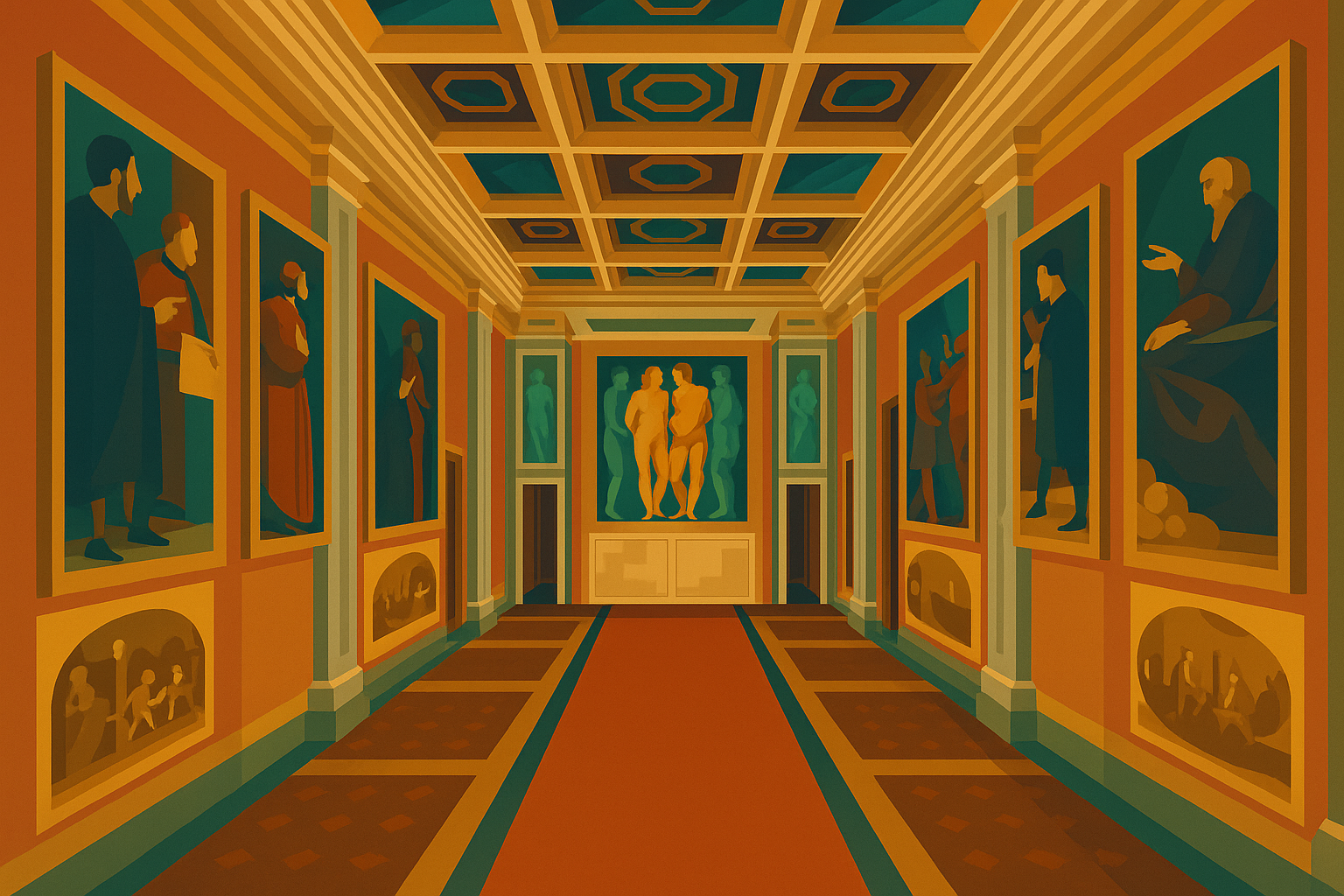
The main floor is where the great-nephew’s vision truly comes to life. The heart of his project is the Galleria, decorated between 1613 and 1635. It is a stunning, complex “eulogy of Michelangelo” told through painting and sculpture. The ceiling canvases depict the “death and apotheosis of the artist,” while the walls feature ten enormous canvases illustrating “meetings between Michelangelo and popes and sovereigns,” functioning as 17th-century propaganda to cement his divine status. Don’t forget to look down at the rare, beautifully preserved 1616 floor of “glazed polychrome tiles from Montelupo.”
In a stunning testament to his progressive patronage, Michelangelo the Younger commissioned one of the Galleria’s most important paintings from a female artist: Artemisia Gentileschi. Her work, L’Inclinazione (The Inclination), is a powerful and sensual allegory of natural talent or “genius.” That it was commissioned for this specific room, dedicated to the ultimate “genius,” is a remarkable statement.
The celebratory program continues in the adjacent rooms. The Camera della notte e del dì (Room of Night and Day) further honors the artist, while the Camera degli Angioli (Room of the Angels) served as the family chapel and for centuries was the honored setting for the Madonna of the Stairs. The Studio was the great-nephew’s library, its walls frescoed with portraits of “illustrious Tuscans,” symbolically placing Michelangelo at the apex of all Tuscan intellectual achievement.
The Drawing Collection: The Mind of the Master
Upstairs, in a specially climate-controlled room, the museum guards its greatest treasure: the largest collection of Michelangelo’s original drawings in the world, consisting of 205 “precious sheets.” This collection exists in defiance of the artist’s own wishes. Giorgio Vasari, his biographer, wrote that Michelangelo, before his death, “burned ‘many drawings, sketches, and cartoons… so that no one would see the labors he endured… in order to appear nothing but perfect.'”
He wanted the world to see only the finished, divine David. He wanted to hide his process. Casa Buonarroti preserves precisely what he wanted hidden. Here you see his “labors,” his disegno (drawing/design), his mind at work. Because these paper sketches are incredibly fragile, the museum shows “small samples” on a “rotating display.” To compensate, the museum has begun publishing a brilliant high-resolution online digital catalog of the collection, accessible to all.
The Architectural Models: Ghosts of Unbuilt Dreams
Finally, the collection includes crucial artifacts of Michelangelo’s work as an architect. Most notable is the large wooden model for the façade of San Lorenzo. This is the very project he was working on while living on this property. The model is the “ghost” of one of his most ambitious, and heartbreaking, unbuilt masterpieces.
Planning Your Visit: Practical Information
Opening Hours, Tickets, and Prices
The museum is open daily from 10:00 a.m. to 4:30 p.m. A critical detail is that the ticket office closes 30 minutes before the museum, at 4:00 p.m., so do not arrive any later. The museum is closed every Tuesday, as well as on January 1, Easter Sunday, August 15, and December 25.
A full-price ticket is € 8.00, with a reduced price of € 5.00.
Insider Tip: The Casa Buonarroti has a partnership with the nearby Basilica of Santa Croce. Holders of a ticket to the Monumental Complex of Santa Croce are eligible for the reduced € 5.00 admission, making a combined visit an excellent value.
While you can book tickets online through the official website, it incurs a € 2.00 pre-sale fee. Given the museum’s wonderful lack of crowds, pre-booking is almost never necessary. Plan to spend 60 to 90 minutes here. Its manageable size makes it the perfect cultural stop to fit into a packed Florence schedule.
How to Get There
Casa Buonarroti is located at Via Ghibellina 70, 50122 Firenze. It is centrally located in the Santa Croce district, “hidden in plain sight.”
- By Foot (Recommended): It’s a stone’s throw (less than 2 minutes) from Piazza Santa Croce, a pleasant 10-minute walk east from Piazza della Signoria, and a 10- to 15-minute walk southeast from the Duomo.
- From Santa Maria Novella (SMN) Train Station: The easiest public transport option is the small electric city bus (ATAF) C1 or C3. Get off at the Ghibellina – Buonarroti stop, which is right by the museum. A taxi will take 10-12 minutes.
Accessibility: A Critical Note for Visitors
This is the most important practical information for many visitors. The museum’s official designation is “Restricted access.” Here is the candid reality:
Michelangelo’s two priceless marble reliefs (Madonna of the Stairs and Battle of the Centaurs) are located on the ground floor and are accessible. However, the entire main collection—the piano nobile with the 17th-century Baroque galleries, the Artemisia Gentileschi painting, and the rotating display of Michelangelo’s drawings—is on the first floor (the US second floor), up a significant, 17th-century palace staircase.
There is no confirmed elevator for public use. Therefore, visitors with mobility impairments or those who cannot climb a long flight of stairs will, unfortunately, be unable to see the majority of the museum’s collection. For these visitors, the museum’s excellent Google Arts & Culture virtual tour is the best alternative, providing a high-resolution virtual visit of the entire museum.
Nearby Attractions and Photo Spots
Casa Buonarroti is the perfect anchor for a “Michelangelo & Santa Croce Itinerary.”
- Basilica di Santa Croce (The Essential Pairing): This is the non-negotiable next stop, just a 2-minute walk away. This pairing allows you to experience the “Alpha and Omega” of Michelangelo’s life. At Casa Buonarroti, you see his very first marbles; in Santa Croce, you stand before his monumental tomb.
- Museo Nazionale del Bargello: A 5- to 10-minute walk away, the Bargello is essential for completing your tour of Michelangelo’s Florentine sculptures, housing his Bacchus, Brutus, and the Tondo Pitti.
- Scuola del Cuoio (Leather School): For a break from art, visit the historic leather school operating inside the Santa Croce monastery to watch artisans at work.
While flash photography is forbidden, the quiet rooms offer unique photo opportunities. Get low and shoot the Battle of the Centaurs from the side to capture the deep relief. Point your camera down in the Galleria to capture the vibrant Montelupo tiles, and look up to photograph the frescoed dome in the Camera degli Angioli.
Conclusion: Finding Michelangelo’s Soul
Don’t go to Casa Buonarroti expecting the David. Go to understand the man. You will see the raw, explosive talent of his teenage years in the Battle of the Centaurs, and then, in the quiet drawing room upstairs, you will see the sacred, private thoughts he committed to paper. It is an intimate portrait of genius, not a monument to fame. The Accademia has his most famous work; Casa Buonarroti has his soul.