
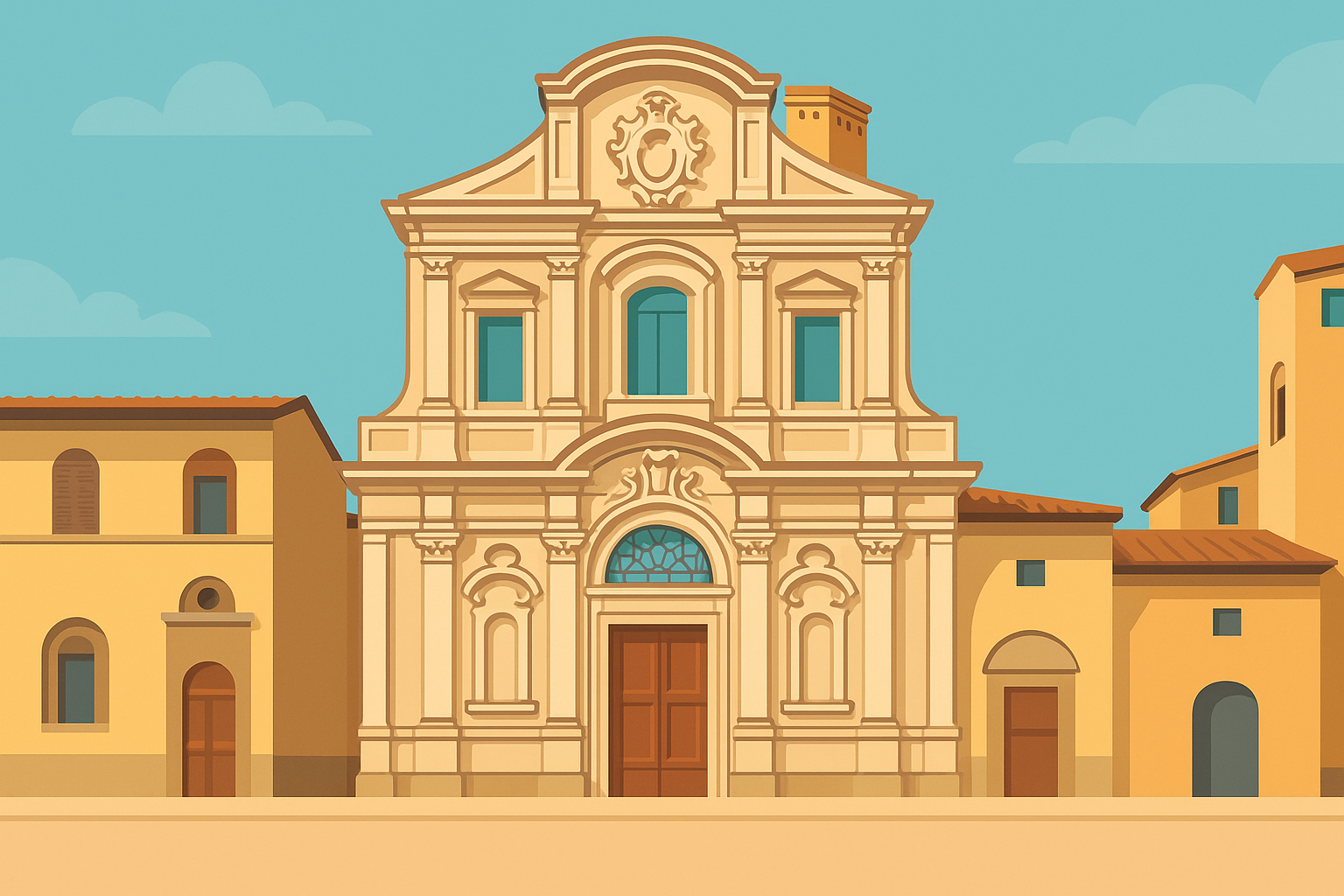
Church of San Salvatore in Ognissanti
Experience the magic of Tuscany
Imagine driving through the Chianti hills, discovering medieval villages, and stopping for an aperitivo at sunset. Renting a car is the secret to experiencing Tuscany with true freedom. Book now for the best choice.
🔍 Choose your car for TuscanyThe Quiet Sanctuary Where Florence’s Giants Rest: Ognissanti and the Unseen Renaissance
To the discerning cultural traveler, Florence often feels like a dazzling, open-air textbook on the Renaissance. Yet, the true depth of its history often lies hidden, just a few streets removed from the throngs near the Ponte Vecchio. The Chiesa di Ognissanti—the Church of All Saints—is precisely this kind of essential, subtle discovery. Situated peacefully on the bank of the Arno River at Borgo Ognissanti, 42, the church presents a compelling architectural paradox. It is cloaked in a grand, theatrical 17th-century Baroque facade that strikingly conceals a far older, deeply significant 13th-century Gothic sanctuary within.
This unassuming Franciscan church holds relics of unparalleled significance, acting as an intimate repository for some of the most personally meaningful art of the Florentine Renaissance. It is here, far from the overwhelming scale of the Duomo, that two of the era’s titans—Sandro Botticelli and Domenico Ghirlandaio—executed an artistic duel, creating symmetrical masterpieces that still stand prominently in the nave. More profoundly, Ognissanti serves as the final resting place for both Botticelli and, crucially, for Amerigo Vespucci, the storied explorer from whom the American continent derives its name. A visit here transcends mere sightseeing; it is an intimate engagement with the intertwined threads of Florentine art, finance, and the Age of Discovery.
Why Ognissanti is an Essential Florentine Experience
Stepping inside the Chiesa di Ognissanti is an immediate exercise in historical decompression. While the exterior, engineered by Matteo Nigetti, promises 17th-century drama, the long, single nave retains its original, stark Gothic structure. This fosters an atmosphere of quiet, spiritual reflection that is exceptionally rare among the major churches of Florence. This contemplative air is deeply rooted in the church’s founding history and its original patron order.
Ognissanti was established in the mid-13th century by the Umiliati, or the “Humble Ones,” a Benedictine lay order renowned not just for their piety, but for their spectacular commercial success. Their presence here highlights a critical, often overlooked aspect of Renaissance patronage. The Umiliati strategically utilized the nearby Arno and Mugnone rivers, harnessing water power for the complex and lucrative processing of wool cloth. This intensive industrial activity generated enormous wealth, which the order systematically translated directly into artistic commissions and charitable works.
The symbolism is potent: this sacred space was initially funded by the grit and prosperity of Florentine trade, illustrating that commerce was not merely a backdrop but the very financial engine of the Renaissance. The Umiliati’s influence is physically manifested in the church’s earliest surviving treasures, including the magnificent Cross of Ognissanti, now housed in the left transept. After meticulous restoration, this profound piece of early realism was authenticated as an autographed work by Giotto, dating to around 1315—a vital milestone demonstrating the Umiliati’s ability to commission leading artists at a pivotal moment when art was shifting from medieval iconography to naturalistic representation.
A Journey Through Art and History
The artistic legacy of Ognissanti is inextricably linked to the power of its key patrons, particularly the illustrious Vespucci family. These wealthy merchants, who maintained strong ties with the powerful Medici, established the Vespucci Chapel within the church, cementing Ognissanti’s position as a nexus where art, commerce, and political destiny converged.
The Fresco Duel: Ghirlandaio vs. Botticelli
The apex of Ognissanti’s artistic history occurred in 1480 with the commission of two symmetrical frescoes, originally for the apse but later moved to the central nave: Ghirlandaio’s St. Jerome in His Study and Botticelli’s St. Augustine in His Study. This arrangement created a deliberate artistic rivalry, a “fresco duel” that drove both masters to demonstrate their prowess.
Ghirlandaio, the noted realist and chronicler of his age, renders St. Jerome with exquisite detail, surrounded by the objects of his disciplined scholarship, reflecting the merchant class’s practical intellect. In direct contrast, Botticelli, the poetic idealist, portrays St. Augustine in a moment of pensive, almost anguished thought, capturing the emotional and intellectual complexity of the high Renaissance. The direct comparison between these two works—representing two competing artistic philosophies—is one of the church’s most important and intellectually stimulating features.
The Vespucci Legacy: A Glimpse into the Age of Discovery
The most extraordinary testimony to this patronage is Domenico Ghirlandaio’s fresco, the Madonna della Misericordia (Madonna of Mercy), painted for the Vespucci Chapel. This work depicts the Virgin Mary protecting members of the Vespucci family beneath her mantle. Amidst the noble crowd, Ghirlandaio included a small but hugely consequential portrait of a young boy peeking out from beneath the Virgin’s robe—Amerigo Vespucci. Created decades before he sailed across the Atlantic, this detail provides an unparalleled, tangible link between the intimate world of 15th-century Florentine piety and the sweeping global drama of the Age of Discovery.
A Final Resting Place for a Master
The profound personal narrative surrounding the church culminates with the tomb of Sandro Botticelli, whose full name was Alessandro di Mariano di Vanni Filipepi. Botticelli, who died in 1510, requested to be buried not in a family plot, but specifically at the feet of Simonetta Vespucci, the probable muse for his greatest allegorical works, The Birth of Venus and Primavera. This gesture—the romantic artist laid forever next to his muse, within the chapel of her powerful family—solidifies Ognissanti as a profoundly personal shrine. It completes a powerful thematic loop, honoring the family who commissioned the art, the art that glorified the city, and the enduring connection between a genius and his inspiration.
Navigating Your Visit: Practicalities and Insider Tips
Visiting Ognissanti requires careful logistical planning, as the site operates under two distinct schedules and administrations—a crucial detail often missed in broader travel guides. The property is comprised of the main church and the former convent refector, known as the Cenacolo. Understanding this dual reality is the key to a complete experience.
Mastering the Dual Schedule: Church vs. Cenacolo
The Chiesa di Ognissanti (Main Church), where you will find the Botticelli and Vespucci tombs, the paired frescoes, and the Giotto Crucifix, operates as a free, active Franciscan church. Its hours are generally consistent, running in a split day from 9:00–13:00 and again from 15:00–19:30. Importantly, the main church is reliably closed all day on Tuesdays. Admission is Free.
However, access to the adjacent Cenacolo di Ognissanti (Refectory), which houses Domenico Ghirlandaio’s spectacular 1480 fresco of The Last Supper, is governed by state museum schedules. The Cenacolo charges an admission of €5.00 and access is severely limited, typically available only on Thursday, Friday, and Saturday mornings, from 9:00–13:00. This limited access is why strategic timing is essential for those seeking Ghirlandaio’s work, which is widely considered an inspiration for Leonardo da Vinci’s later masterpiece in Milan.
For a complete visit, plan to spend 60 to 90 minutes absorbing the layered history and exceptional art in both locations.
Best Time to Visit for Tranquility
To maximize your experience and ensure access to both the church and the highly restricted Cenacolo, the optimal time to visit is Thursday, Friday, or Saturday morning, right at 9:00 AM. Arriving at opening allows you to see Ghirlandaio’s Last Supper and the main church’s treasures before any small tour groups arrive. This strategy is particularly valuable for securing a quiet moment to appreciate the masterpiece’s detail and psychological narrative. If you are only interested in the free art within the main church, the period immediately after the afternoon reopening, around 3:00 PM, is often exceptionally quiet, particularly during the shoulder seasons.
Visitor Etiquette and Accessibility
As an active place of worship, all visitors are required to dress modestly—shoulders and legs must be covered. Carrying a light scarf or shawl is a simple way to ensure respectful entry. To protect the fragile frescoes and maintain the reflective atmosphere, flash photography is strictly prohibited.
The main Chiesa di Ognissanti is typically fully accessible. The separate Cenacolo di Ognissanti is noted as being partially accessible, utilizing a footboard to provide level access into the refectory. Visitors requiring specific mobility assistance should contact the Cenacolo directly to confirm current arrangements.
How to Get to Ognissanti
The church benefits from a highly advantageous, yet slightly peripheral, location that makes it easily accessible while avoiding the most severe tourist congestion. You’ll find it at Borgo Ognissanti, 42, on the eponymous piazza facing the Arno River.
For most visitors, walking is the simplest option. Ognissanti is approximately a 10-minute, flat walk from Florence’s central hub, the Firenze Santa Maria Novella (SMN) train station. If approaching from the historic core (Piazza del Duomo or the Uffizi Gallery), a leisurely 10 to 15-minute stroll west along the Lungarno (the Arno riverbanks) is recommended. This route provides stunning perspectives of the city and smoothly transitions you into the quieter, architecturally rich Santa Maria Novella district.
For those using public transport, the nearest stops, often labeled “Borgo Ognissanti” or “Sant’Onofrio,” are served by multiple ATAF bus lines, including the C2, C4, 30, 39, and 6.
Beyond the Church: Exploring the Neighborhood
Ognissanti is strategically positioned to serve as a gateway to Florence’s quieter, more rewarding neighborhoods. After your visit, take a leisurely walk east along the Lungarno toward the Ponte Vecchio to rejoin the city’s historic heart.
For a deeper dive into Renaissance art, cross the Arno via a nearby bridge like the Ponte alla Carraia and explore the Oltrarno district. This neighborhood retains its artisan workshops and genuine Florentine atmosphere. Here, you can visit the Basilica of Santa Maria del Carmine and its world-famous Brancacci Chapel. Pairing Ognissanti (featuring works from 1315 to 1480) with the Brancacci Chapel (housing masterpieces by Masaccio from the 1420s) provides a powerful, chronological survey of Florentine painting. The immediate area, Borgo Ognissanti street, is also renowned for its antique shops and designer boutiques, offering an elevated shopping experience.
Capturing the Moment: Best Photo Spots
While flash is forbidden inside, Ognissanti offers compelling photographic opportunities.
- Exterior Grandeur: The most dramatic shot is from across the Piazza Ognissanti, emphasizing the bold, symmetrical design of the 17th-century Baroque façade. Frame your shot to include the luminous detail of Benedetto Buglioni’s glazed terracotta lunette above the door—a Renaissance jewel set in a Baroque frame.
- Interior Harmony: Inside, focus your lens on the harmonious opposition of Botticelli’s St. Augustine and Ghirlandaio’s St. Jerome. Their symmetrical placement makes for a compelling shot illustrating the artistic competition of the 15th century.
- The Insider Detail: The most poignant photograph is the simple, round tombstone of Sandro Botticelli set into the pavement of the south transept. Capturing the plain inscription “Sandro Filipepi” near the Vespucci Chapel provides an intimate visual reminder of the artist’s profound legacy.
Final Thoughts: The Soul of a Hidden Florence
Ognissanti is a necessary pilgrimage for the traveler seeking the true heart of Renaissance Florence—a place where the titans of art and exploration rest side-by-side. It is a profound historical document that teaches us that even in a city defined by a single period, history is layered, dynamic, and full of beautiful contradiction.
To truly grasp the genius loci of Ognissanti, don’t rush the main church to get to the Cenacolo. Take five minutes to locate the simple tombstone of Botticelli in the south transept. Contemplate that this master rests not in a grand monument, but quietly, at the feet of the woman who inspired him, bridging mythology and reality right beneath your feet.
Ognissanti offers not just world-class art, but historical context, tranquility, and a highly personal connection to Florence’s golden age, making it arguably the most essential and yet most overlooked masterpiece on the Arno.