
Church and Museum of Orsanmichele
Experience the magic of Tuscany
Imagine driving through the Chianti hills, discovering medieval villages, and stopping for an aperitivo at sunset. Renting a car is the secret to experiencing Tuscany with true freedom. Book now for the best choice.
🔍 Choose your car for TuscanyStanding on the bustling Via dell’Arte della Lana, you’ll find one of Florence’s great architectural anomalies: the Church and Museum of Orsanmichele. At first glance, it’s a massive, rectangular stone block that feels more like a fortress than a place of worship. Yet this singular structure is simultaneously a solemn church, a former state granary, and a premier gallery of Renaissance sculpture. Its name, a contraction of San Michele in Orto (Saint Michael in the Garden), hints at a simpler past but belies its unique and profoundly political heritage.
Perfectly positioned midway between the city’s religious heart, the Duomo, and its seat of civic government, the Palazzo della Signoria, Orsanmichele embodies the powerful triangulation of faith, state, and commerce that defined the Florentine Republic. Unlike the soaring cathedrals that dominate the skyline, this is a building defined by its duality. Constructed in the 14th century, its ground floor serves as a sacred oratory, while the two upper stories were ingeniously designed as communal warehouses, safeguarding the city’s grain supply against famine.
This brilliant blend of spiritual sanctuary and practical security was embraced by the city’s powerful craft guilds, the Arti. They used the building’s exterior niches as a competitive stage, commissioning masterpieces from the greatest sculptors of the early Renaissance, including Donatello, Lorenzo Ghiberti, and Andrea del Verrocchio. Today, while faithful copies grace the exterior, the original, priceless works reside safely in the upper-floor museum. Following a recent restoration, this treasure trove was officially reopened to the public in early 2024, offering an intimate encounter with the dawn of Renaissance genius.
The Soul of the City in Stone and Bronze
As you approach Orsanmichele, you are immediately struck by its severe, utilitarian architecture. It is heavy, blocky, and more reminiscent of a civic palazzo than a traditional church, notably lacking a conventional bell tower (campanile). This architectural sobriety is entirely deliberate; it signals the building’s fundamental identity as a creation of the Commune, dedicated first and foremost to the city’s economic survival and governance.
The building’s external facades feature fourteen deep niches, or tabernacles, which today display impressive copies of the original sculptures. These niches were assigned to the most powerful guilds of Florence—the Arti Maggiori and Mediane—transforming the exterior into a public ledger of economic clout and civic pride. The placement of each guild’s patron saint, from the Furriers and Silk Weavers to the Judges and Notaries, was not merely a devotional act; it was a potent demonstration of that organization’s political standing and contribution to the Republic.
Look closely at the materials, and you’ll see the story of Florence’s stratified ruling class written in stone and metal. The wealthiest guilds, particularly the Bankers (Arte del Cambio) and the Wool Workers (Arte della Lana), commissioned their statues in the most expensive material available: gilded bronze. The decision to cast Ghiberti’s Saint Matthew or Donatello’s original St. Louis of Toulouse in bronze was an unmistakable statement of financial supremacy. In contrast, guilds of lesser means commissioned their works in marble. The facade of Orsanmichele thus functions as a permanent record, proving that commercial prosperity was inseparable from the Republic’s artistic ambition.
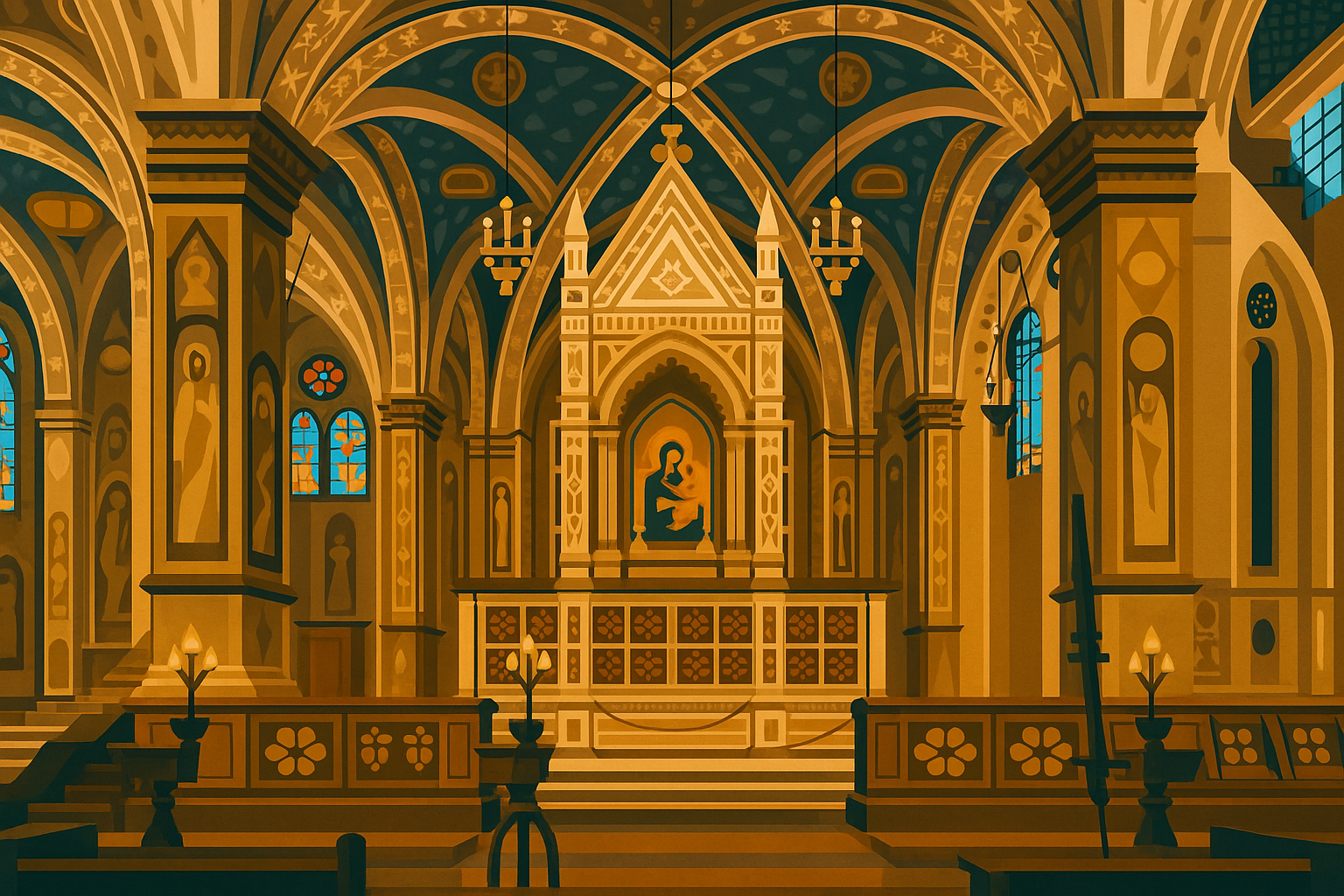
This civic severity gives way to an atmosphere of solemn reverence the moment you step inside the ground-floor sanctuary. Here, you encounter the structure’s spiritual centerpiece: the astounding marble Tabernacle by Andrea di Cione, better known as Orcagna. Completed in 1359, this elaborate, polychromatic Gothic masterpiece frames Bernardo Daddi’s venerated Madonna and Child. Its dazzling, intricate detail provides a stunning contrast to the rough stone of the exterior, signifying the building’s transformation from a noisy grain market to a hallowed site of miracles.
A Story of Grain, Plague, and Genius
The history of Orsanmichele is intrinsically linked to the evolution of Florence itself, rising from humble origins to become the stage for a sculptural revolution. The site was initially occupied by a small 8th-century church, San Michele in Orto. After its demolition, the space was converted into an open loggia that served as a bustling grain market. A devastating fire in 1304 destroyed this original structure, prompting the city government to respond with powerful civic foresight.
Beginning in 1337, architects including Simone Talenti, Neri di Fioravante, and Benci di Cione constructed a more durable, rectangular building. The ground floor functioned as a covered loggia for trade, while the two spacious upper floors were designated as a municipal granary. This strategic cereal warehouse was built to guarantee the food supply, offering protection against famine, political siege, and crop failure. This function underscores the Florentine Republic’s governance model, where economic stability and public welfare were paramount. The ability to guarantee security through stored resources provided the fiscal buffer that enabled the city to embark on its ambitious artistic patronage.
The shift from a commercial hub to a religious sanctuary was accelerated by the great catastrophe of the Black Death in 1348. An image of the Madonna, located at the heart of the loggia, became a focal point of intense public devotion. Miraculous cures were credited to the image during the plague years, leading to a massive swell in piety that solidified the need to officially convert the building into a church. The loggia arches were walled up, the structure was consecrated, and Orcagna’s magnificent Tabernacle was commissioned shortly after, an enduring testament to the city’s thanksgiving.
By the early 15th century, the building’s external transformation was complete. The powerful Guilds had taken over the maintenance and decoration of the 14 exterior tabernacles. The resulting commissions became the proving ground for a new artistic style, challenging medieval concepts and initiating the High Renaissance. The fierce competition among the Arti forced sculptors to innovate, leading to enduring masterpieces that marked the true dawn of Renaissance sculpture.
Exploring Orsanmichele: From Sanctuary to Granary Gallery
Orsanmichele’s architecture is a fascinating example of functional adaptation, blending Gothic solemnity with warehouse pragmatism. The original loggia structure, characterized by large arched openings, was enclosed by architects like Simone Talenti, who integrated elegant, late-Gothic trifora (three-light) and bifora (two-light) mullioned windows. These now illuminate the interior sanctuary and the upper granary floors, some still featuring stained glass designed by Niccolò di Pietro Gerini depicting scenes from the life of the Virgin.
The Ground Floor Sanctuary and Orcagna’s Masterpiece
The architectural centerpiece of the church’s ground floor is undoubtedly Orcagna’s Tabernacle. Erected between 1359 and 1360, this colossal, freestanding structure is recognized as the zenith of Italian Gothic relief sculpture. Crafted entirely of marble and lavishly inlaid with colored stone and glass mosaics, it houses Daddi’s venerated Madonna delle Grazie. The contrast between the Tabernacle’s dizzying, delicate filigree and the building’s otherwise stern, rectilinear form is breathtaking. Take your time here to absorb the intricate details and the palpable sense of devotion that funded its creation.
The Ascent to the Masterpieces
Above the solemn oratory lie the two great halls of the museum, originally designed for massive grain storage. The journey to these masterpieces is part of the experience, often involving a climb up a narrow, spiral stone staircase that wraps around one of the internal piers. As you ascend, you can feel the building’s history in the cool stone beneath your hands. The structure of these upper floors—large, open spaces supported by robust piers that once contained chutes for distributing wheat—speaks to its original civic purpose.
The Granary Museum: Face to Face with Giants
To truly understand Orsanmichele, you must visit the upper floors. The 13 original, colossal statues commissioned by the guilds were removed from the exterior niches to protect them from environmental degradation. Here, in the former granary, you are granted an unparalleled opportunity for intimacy with these foundational works of the Renaissance.
Instead of viewing distant figures confined to dark niches, you encounter them at eye level. Donatello’s commanding St. Mark, commissioned by the Linen Weavers, and the striking bronze Saint Matthew by Lorenzo Ghiberti, funded by the Bankers, are mounted on plinths that allow for viewing “in the round.” This is particularly impactful for monumental groups like Nanni di Banco’s Four Crowned Saints, displayed as a classical gathering, and Andrea del Verrocchio’s kinetic bronze group, The Incredulity of Saint Thomas, considered one of the era’s greatest masterpieces. Seeing them here, you can appreciate the artists’ technical genius and the powerful emotions they carved into marble and cast in bronze.
The View from the Top: Florence Framed
The final reward for your ascent is the view. The elegant bifora windows of the highest granary floor frame splendid, unique perspectives of the old city. This panoramic vantage point offers an unparalleled look at Florence’s skyline, perfectly framing the Duomo’s dome and the tower of the Palazzo Vecchio through the Gothic stonework. This unique photographic opportunity alone makes the full visit essential.
Planning Your Visit: A Practical Guide
A trip to Orsanmichele requires a bit of planning to fully appreciate its treasures, especially given its unique schedule.
Opening Hours and Tickets
The complex is generally open six days a week, remaining closed every Tuesday.
- Monday to Saturday (excluding Tuesday): 8:30 AM to 6:30 PM.
- Sunday: Hours are significantly restricted, from 8:30 AM to 1:30 PM. Be aware that the ground-floor church closes even earlier, at 12:00 PM, for religious services.
The standard full admission price for the Church and Museum is €8.00. However, for a comprehensive cultural itinerary, the Bargello Museums combo ticket is an excellent value. Priced at €25.00, this ticket grants entry to Orsanmichele plus four other major collections: the Bargello National Museum, the Medici Chapels, Palazzo Davanzati, and Casa Martelli. Access is also free of charge on the first Sunday of every month. A focused visit, including the oratory, the ascent, the sculpture gallery, and time for the views, typically requires 90–120 minutes.
Best Time to Visit
Timing is paramount for the best experience. The atmosphere is most peaceful during a weekday morning, ideally right at the 8:30 AM opening time on a Wednesday, Thursday, or Friday.
The most strategic day to visit is Monday. With major museums like the Uffizi and Accademia closed, Orsanmichele offers a rare opportunity to experience Renaissance masterpieces with significantly smaller crowds.
Sunday visits should be approached with caution. Plan to arrive early, as the last admission to the museum is at 12:40 PM and the church closes at noon.
How to Get There
Orsanmichele’s prime location in the absolute heart of Florence makes walking the best way to arrive. Situated on Via dell’Arte della Lana (43.7708 N, 11.2553 E), it is just steps from both the Duomo and Piazza della Signoria.
The entire area falls within Florence’s strict Limited Traffic Zone (ZTL). Driving directly to the site is prohibited without a permit and strongly discouraged. If arriving by car, use a designated parking garage outside the ZTL and walk. For those coming from further afield, the C1 and C2 electric micro-buses have convenient stops nearby. From the Santa Maria Novella train station, it’s a pleasant 10- to 15-minute walk.
Facilities and Accessibility
As a protected historic monument, Orsanmichele offers essential amenities but has significant accessibility limitations. Restrooms and a bookshop are available. Reservations are mandatory for school groups and advised for large visitor groups.
Crucially, while the ground-floor church is partially accessible with a ramp, the full experience is not available to all. The official museum administration explicitly states that the upper floors, which house the original sculptures and panoramic viewpoints, do not have facilities for disabled access that can accommodate wheelchairs.
Beyond Orsanmichele: Connecting the Dots
Orsanmichele is the perfect hub for exploring the core of Renaissance Florence. A visit is best complemented by exploring the nearby attractions that complete its story.
The most logical next stop is the Bargello National Museum, just a short walk away. The Bargello houses Donatello’s iconic Saint George, a piece originally commissioned for one of Orsanmichele’s exterior niches. Visiting Orsanmichele first provides the perfect context for the guild competitions before seeing more monumental originals.
From Orsanmichele, you can trace Florence’s civic power triangle. To the south lies the Palazzo Vecchio and Piazza della Signoria, the seat of secular governance. To the north, the path leads directly to the Duomo Complex, the city’s spiritual climax. Walking between these three points makes the deep connection between Florence’s religious, state, and commercial interests tangible.
Capturing the Moment: Best Photo Spots
Orsanmichele offers three distinct photographic opportunities, moving from street-level detail to breathtaking panoramas.
- The Exterior Niches: The dramatic tabernacles with their replica statues are excellent subjects. Morning light is best for highlighting the details of the sculptures and the adjacent guild coats of arms.
- Orcagna’s Tabernacle: Capturing this masterpiece is challenging in the dim light but highly rewarding. Focus on its intricate marble lace and the gold accents of the relief carvings.
- The Framed Skyline: The most essential photograph is from the upper museum floor. Position yourself at one of the large Gothic bifora windows to capture the Duomo’s dome or the tower of Palazzo Vecchio perfectly framed by the stone arch. This unique view is a signature shot of any Orsanmichele visit.