
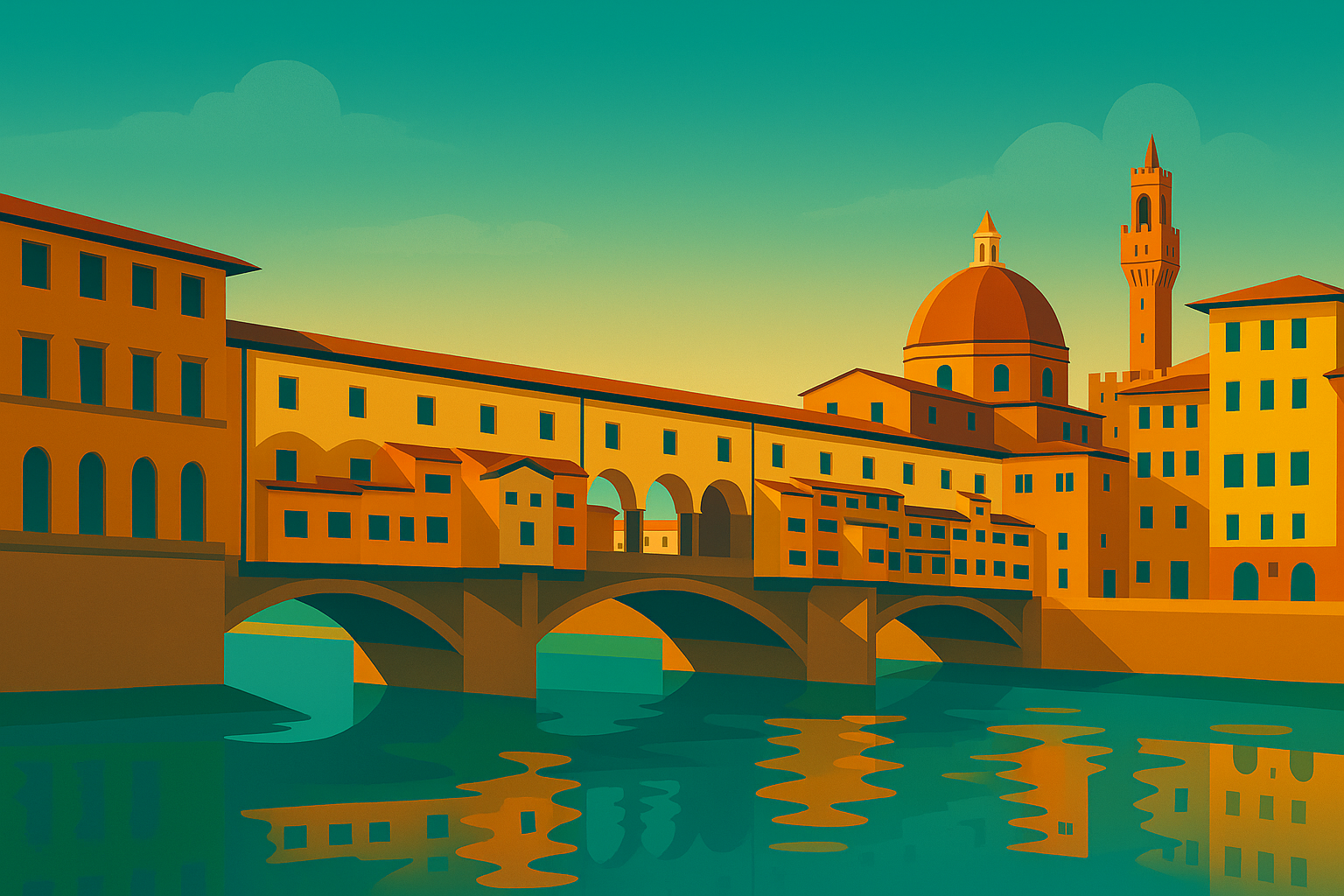
Corridoio Vasariano
Experience the magic of Tuscany
Imagine driving through the Chianti hills, discovering medieval villages, and stopping for an aperitivo at sunset. Renting a car is the secret to experiencing Tuscany with true freedom. Book now for the best choice.
🔍 Choose your car for TuscanyFlorence’s Secret Passage: The New Vasari Corridor Unveiled
Imagine a secret passage, suspended high above the bustling streets and crowds of Florence. A private, elevated walkway built for dukes and duchesses, allowing them to move unseen between the seat of government and their royal residence. For centuries, this was the function and the mystique of the Vasari Corridor. After an ambitious eight-year, €11 million restoration, this architectural marvel reopened in December 2024, but it is not the Corridor you may remember or have heard about. It has been fundamentally reborn.
This is not just a story of restoration, but of reinterpretation. The famed gallery of self-portraits that once lined its walls is gone, relocated to the main Uffizi Galleries. In its place is a new, profound experience—one that invites you to focus on the passage itself: its spartan elegance, its incredible history, and the unparalleled views it offers of the city. It’s a journey back to its original purpose, a walk through a conduit of power, now punctuated by ancient Roman sculptures and memorials that tell a deeper story of Florence itself. This is your definitive guide to understanding and visiting the new Vasari Corridor in 2025.
A Passage of Power: The Story of the Vasari Corridor
To walk the Corridor is to walk through a fascinating slice of Florentine history. Its creation was a bold statement of absolute power, born from a duke’s desire for security and a display of dynastic might.
A Duke’s Demand for Secrecy and Speed
The year is 1565. Cosimo I de’ Medici, the first Grand Duke of Tuscany, feels insecure. Having replaced the old Republic of Florence, he is acutely aware of lingering republican sentiments and the dangers of public life. The official reason for the Corridor’s commission is the upcoming wedding of his son, Francesco I, to Joanna of Austria—a chance to showcase Medici engineering prowess. But the true motivation is security. Cosimo needs a way to move “freely,” “unnoticed,” and “safely” between his government offices in the Palazzo Vecchio and his new private residence, the Palazzo Pitti.
He turns to his most trusted architect, Giorgio Vasari, with an audacious demand. The result is an astonishing feat of engineering. Vasari completes the entire, nearly kilometer-long structure in just five months, a timeline that demonstrates the Grand Duke’s absolute authority to reshape the city to his will. The Corridor becomes a physical manifestation of the Medici’s new monarchical rule, allowing them to traverse the heart of Florence without ever setting foot on its streets, forever separated from the populace below.
Shaping the City from Above
The Corridor’s construction had immediate and lasting impacts on Florence. Its path over the Ponte Vecchio passed directly above the city’s meat market. The “unpleasant smells” were deemed an offense to the “Grand Duke’s sensitive nose,” and Cosimo I had the market forcibly removed. By 1593, the butchers’ stalls were replaced by the goldsmiths and jewelers who still occupy the bridge today—a deliberate act of urban gentrification befitting a ducal route.
The Corridor’s history has remained intertwined with the city’s tragedies. It was severely damaged in 1993 by a Mafia car bomb on the nearby Via dei Georgofili and also sustained damage during Nazi bombings in 1944. As you walk through the restored passage today, you will encounter powerful memorials to these events, including painstakingly reconstituted paintings that were ripped to pieces by the 1993 explosion, serving as a stark reminder of the city’s resilience.
The New Vasari Corridor: What to Expect After the Great Restoration
For those who visited before its closure in 2016, the experience will be dramatically different. The key to enjoying the new Corridor is to manage your expectations and embrace its new identity.
From a Gallery of Faces to a Passage Through Time
For decades, the Vasari Corridor was famous for housing the Uffizi’s unique collection of over 1,000 artist self-portraits, a “who’s who” of art history from Rembrandt to Velázquez. This collection has been permanently removed and is being integrated into the main Uffizi galleries.
The directorate’s decision was deliberate: to strip the Corridor “back to the bare bones” and restore it to its “original Spartan look.” The goal is to shift your focus from the Corridor as a container for paintings to the Corridor as the primary artifact. The main exhibit is now the passage itself—its historical character, its unique engineering, and its breathtaking views. Some visitors, expecting the dense gallery of old, have been disappointed, but those who come prepared for an architectural and historical immersion will find it deeply rewarding.
Not Empty, But Reimagined: The New Collection
The “bareness” of the Corridor is a misconception. It now houses a subtle, thematically brilliant permanent exhibition that reconnects it to its original purpose. Along the walls, you will find restored 16th-century frescoes that once adorned its exterior. But the centerpiece is a stunning archaeological collection.
Approximately 300 ancient Greek and Roman marble epigraphs (inscriptions) now line the walls, an idea that aligns with Vasari’s own 16th-century concepts for the space. The section over the Ponte Vecchio has been transformed into a gallery of over 50 Roman busts. This is not a random replacement; it’s a stroke of curatorial genius. Cosimo I explicitly modeled his rule on that of Imperial Rome to legitimize his family’s transition from bankers to absolute monarchs. By placing portraits of Roman emperors like Augustus, empresses like Sabina, and intellectuals like Cicero along this private ducal path, the Uffizi has made that symbolic connection tangible. The Corridor has returned to its original narrative: a passage where the power of the Medici is reflected and legitimized by the power of Imperial Rome.
Walking in the Footsteps of Dukes: The Route Explained
The 760-meter journey is a sequential narrative of power, engineering, and political compromise, offering perspectives on Florence you can get nowhere else.
From the Uffizi to the Ponte Vecchio
Your journey begins on the west side of the Uffizi Gallery. The Corridor exits the main building, crosses the Lungarno degli Archibusieri, and runs along the north bank of the Arno, elevated on a series of imposing arches. This is where it joins the Ponte Vecchio, passing directly over the famous goldsmiths’ shops. The exterior views of this section are among the most iconic in Florence.
The Mannelli Compromise and a Ducal Church Balcony
At the south end of the Ponte Vecchio, you’ll witness a fascinating architectural record of a 16th-century political standoff. Vasari’s planned route was blocked by the Torre dei Mannelli, a medieval tower owned by a noble family who staunchly refused to let it be altered. Even the Grand Duke had to compromise. Vasari was forced to build the Corridor around the tower using heavy brackets, a sharp detour that remains a testament to the limits of Medici power.
Further on, the Corridor ingeniously integrates with the Church of Santa Felicità. It passes directly through the church’s interior, where Vasari built an elegant, screened-off balcony. This private ducal box allowed the Medici family to attend mass with a privileged view of the altar, “without being seen by the people.” It is perhaps the most potent symbol of their elevated, quasi-divine status.
The Power of the View
The Corridor terminates in the Boboli Gardens, near the Grotto of Buontalenti. Throughout the walk, the windows themselves tell a story. The original 16th-century windows were small, allowing the Medici to “spy” on the city below. The large, panoramic windows that today offer the famous, stunning views over the Arno are a much later addition, reportedly enlarged in 1939 for the visit of Adolf Hitler, adding another dark and complex layer to the structure’s history.
Your 2025 Visit: A Practical Guide to the Vasari Corridor
Visiting the Vasari Corridor requires mandatory reservations and careful planning. There are two distinct ways to experience it, each with its own logistics and pricing.
Choosing Your Experience: Daytime Combo vs. Special Evening Visit
Critically, you must choose between two mutually exclusive options.
- Modality 1: Standard Daytime Visit (“Uffizi + Vasari Corridor”)
This is a combined ticket (€47 if booked in advance) that includes entry to both the Uffizi Gallery and the Vasari Corridor. It runs from Tuesday to Sunday, with entry times from 10:15 to 16:35. This option is aimed at first-time visitors who want to see both attractions, but it is logistically complex.
- Modality 2: Special Evening Visit (“Corridoio Vasariano–Aperture straordinarie”)
This is a standalone, Corridor-only ticket (€24 if booked in advance) available only on Fridays from July 4th to December 26th, 2025 (excluding August 15th). It runs from 19:00 to 23:00. This is the superior choice for a more focused, atmospheric experience without the requirement of visiting the Uffizi. It is cheaper, logistically simpler, and allows you to see the city tinged with the colors of sunset and night.
Booking and Procedures: A Step-by-Step Guide
Punctuality is mandatory for both visit types. Failure to arrive at your designated meeting point and time will result in the loss of your right to enter.
For the Standard Daytime Visit:
- Book your combined “Uffizi + Vasari Corridor” ticket for a specific time slot. This time is for your Uffizi Gallery entry.
- CRITICAL: You must enter the Uffizi Gallery at least 2 hours before your scheduled access time for the Vasari Corridor. This is because the Corridor is a one-way exit, and you cannot return to the Uffizi.
- Proceed to the Room D19 Meeting Point (Venetian small Chapel) on the first floor of the Uffizi 5-10 minutes before your Corridor time slot.
- The 45-minute visit is an accompaniment by museum staff and exits into the Boboli Gardens.
For the Special Evening Visit:
- Book your “Corridoio Vasariano–Aperture straordinarie” ticket for a specific time slot (e.g., 19:00, 19:20, etc.).
- This ticket provides access to the Vasari Corridor only.
- Go to the designated meeting point outside the Uffizi, next to the infopoint in Piazzale degli Uffizi, at least 10 minutes before your scheduled time. This is a different meeting point from the daytime visit.
- The visit follows the same one-way route, exiting at the Boboli Gardens.
Essential Rules and Accessibility
- One-Way Route: The route is strictly one-way from the Uffizi to the Boboli Gardens. It is impossible to walk it in reverse.
- Bag Policy: Large bags, backpacks, suitcases, and large umbrellas are strictly forbidden.
- Accessibility: The Corridor is now accessible to visitors with disabilities, but with strict conditions. Visitors must use their own wheelchair or walking frame, and the total weight (device + user) cannot exceed 230 kg or a length of 120 cm. Courtesy wheelchairs are available at the Uffizi entrance, subject to availability.
Insider Tip: The Cloakroom Challenge
The one-way route creates a major logistical issue. If you deposit a coat or bag at the Uffizi cloakroom, you must walk all the way back from the exit at Palazzo Pitti (a 15-20 minute walk) to retrieve it. Travel light and keep your belongings with you.
Insider Tips for the Best Experience
The Best Photo Opportunities
The most unforgettable photos are not of the interior collection, but from the Corridor’s windows. The large, panoramic windows at the center of the Ponte Vecchio offer unparalleled, symmetrical views up and down the Arno River. Frame your shots to capture the iconic bridges and the warm light reflecting off the water, especially during the golden hour of the evening visits.
The Full Medici Citadel Itinerary
To truly understand the Corridor’s purpose, integrate it into a larger narrative. Follow the historical path of the Medici themselves for a coherent and immersive day.
- Morning: Start at the Uffizi Gallery, the former government “offices.” Allow 2-4 hours.
- Afternoon: Take your pre-booked Vasari Corridor tour, experiencing the ducal “commute.”
- Late Afternoon: Emerge at the Boboli Gardens, the private ducal grounds. From there, proceed to the Palazzo Pitti, the magnificent ducal residence, to explore its museums and the Royal Apartments.
This itinerary transforms your visit from a series of separate attractions into a single, powerful story of the Medici’s Florence, moving from public government to private power via the exclusive link that connected them.