
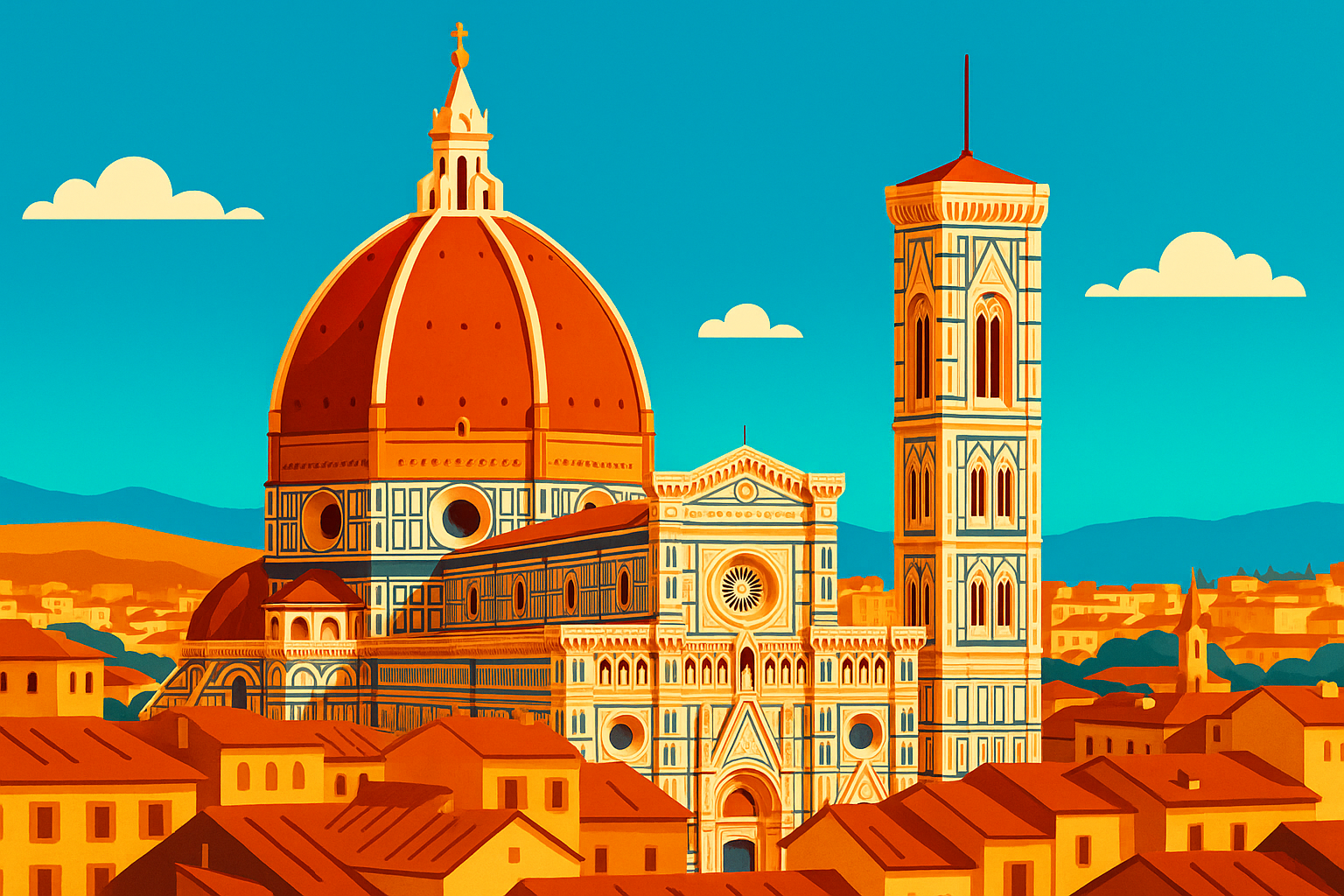
Florence Cathedral
Experience the magic of Tuscany
Imagine driving through the Chianti hills, discovering medieval villages, and stopping for an aperitivo at sunset. Renting a car is the secret to experiencing Tuscany with true freedom. Book now for the best choice.
🔍 Choose your car for TuscanyThe Heart of the Renaissance: A Complete Guide to Florence’s Duomo Complex
Even before you arrive in Florence, its defining silhouette is universally recognisable. The Cattedrale di Santa Maria del Fiore, known to the world simply as the Duomo, is not just a building; it is the emblem of a city and the cradle of the Renaissance. Its massive, terracotta-tiled dome, engineered by the genius Filippo Brunelleschi, dominates the skyline—a testament to human ingenuity that remains the largest masonry dome in the world.
When you first emerge from the narrow medieval streets into the Piazza del Duomo, the visual impact is overwhelming. The complex, a designated UNESCO World Heritage site, glows with its intricate polychrome façade of white, green, and pink marble, presenting one of the most breathtaking architectural sights on the planet.
However, this initial wave of wonder is often followed by profound confusion. The “Duomo” is not one entity but a complex of six distinct monuments: the Cathedral, the Dome, Giotto’s Bell Tower, the Baptistery of San Giovanni, the Opera del Duomo Museum, and the Santa Reparata crypt. This creates the central paradox of a visit: the Cathedral itself is free to enter, but the line can stretch for hours under the Tuscan sun. After that long wait, many visitors are surprised to find a vast, austere, and relatively “empty” interior. This guide is designed to navigate this paradox, explaining that the true treasures of the Duomo—its priceless art, its archaeological roots, and its staggering views—are found not in the free space, but in the ticketed monuments that surround and support it.
The Experience: From Vibrant Piazza to Soaring Emptiness
The atmosphere in the Piazza del Duomo is one of constant, vibrant movement. It is the spiritual and geographical heart of Florence, a stage where locals, tourists, and history converge. The sheer scale of the complex is humbling. The façade, a stunning 19th-century neo-Gothic masterpiece, is a visual feast of sculpture and geometric patterns that tells the story of the Virgin Mary, to whom the cathedral is dedicated.
Stepping inside the free Cathedral area, the atmosphere shifts dramatically. The opulent, decorative exterior gives way to a vast, soaring Gothic interior that feels, by contrast, stark and cavernous. This is by design. The vastness was built to hold 30,000 worshippers, a statement of Florentine power. The relative emptiness, however, is also a result of careful curatorial decisions. Many of the original masterpieces that once filled this space, including works by Donatello and Michelangelo, were moved to the adjacent museum for preservation, particularly after the devastating 1966 flood.
This intentional emptiness forces your eye upward, toward the cathedral’s true spiritual and artistic focal point: the interior of Brunelleschi’s dome. From the floor, 90 meters (300 feet) below, the 3,600-square-meter fresco of Giorgio Vasari’s Last Judgment swirls with hundreds of figures, leading your gaze from the depths of hell to the light of heaven at the lantern’s apex.
A Story of Ambition and Genius: The History of the Duomo
The Duomo is the result of centuries of ambition, competition, and genius. Construction began in 1296 on the site of the older, crumbling 5th-century church of Santa Reparata. The city of Florence commissioned a new cathedral to reflect its growing power and, crucially, to surpass those of its rivals, Siena and Pisa.
The original Gothic design was conceived by Arnolfo di Cambio. His plan was so ambitious that by 1380, the cathedral was largely built, but with one critical, 140-year-long problem: a colossal 45.5-meter (150-foot) wide octagonal hole in the roof. The technology to build a dome of this size simply did not exist. Traditional Gothic flying buttresses were forbidden by the city fathers, and a wooden support structure (centering) was deemed impossible to build at that scale. The “unbuildable” dome became the ultimate symbol of Florence’s challenge.
This challenge was famously solved by Filippo Brunelleschi, a goldsmith by trade, whose work between 1420 and 1436 is considered the spark that ignited Renaissance architecture. A common misconception, however, is that the stunning façade is original. In fact, Arnolfo’s original façade was left unfinished and dismantled in 1587. For over 300 years, the front of the church was a blank, unadorned brick wall. The intricate, polychrome neo-Gothic façade we see today was designed by Emilio De Fabris and only completed in 1887, finally unifying the complex’s visual style.
Exploring the Monuments: A Guide to the Six Wonders
To truly appreciate the complex, you must see its individual parts as chapters in a single, epic story.
Brunelleschi’s Dome: The Engineering Marvel
The Dome is the undisputed star. It is a revolutionary double-shell structure, and climbing the 463 steps between its two layers is a journey into the mind of a genius. Brunelleschi won the 1418 competition by proposing to build it without the “impossible” wooden centering. His solution lay in three core innovations:
- A Double Shell: An internal dome made of brick and stone provides the structural integrity, while a separate, lighter outer shell covered in terracotta tiles protects it from the elements. The staircase you climb runs between these two shells.
- Spina di Pesce (Herringbone Brick): He devised a self-supporting herringbone brick pattern that locked the bricks in place as they were laid, allowing the dome to curve upward and inward without collapsing.
- Horizontal “Chains”: He embedded massive stone and iron “tension rings” within the structure, which act like hoops on a barrel to counteract the immense outward force (hoop stress) that threatened to tear the dome apart.
Brunelleschi also had to invent his own tools, including a revolutionary, three-speed, ox-powered hoist with a reverse gear—a machine unheard of at the time and considered the birth of modern construction engineering.
Giotto’s Campanile (The Bell Tower)
Standing 84.7 meters (278 feet) tall, the bell tower is a masterpiece of Florentine Gothic architecture. Its history is a “relay race” of Italy’s greatest artists. Giotto di Bondone designed it and began work in 1334, but only completed the first level before his death. The project was taken over by Andrea Pisano and later completed in 1359 by Francesco Talenti. Talenti made a critical change: he scrapped Giotto’s original plan for a 122-meter-tall spire, instead creating the large, flat viewing terrace that provides today’s famous 360-degree views of the city and the Dome itself.
The Baptistery and the “Gates of Paradise”
The octagonal Baptistery of San Giovanni is one of the oldest buildings in Florence, dating to the 11th century. It is famous for its three sets of magnificent bronze doors. The most celebrated are the East Doors, created by Lorenzo Ghiberti (1425–1452) and depicting ten scenes from the Old Testament with a revolutionary use of perspective. Michelangelo was so moved by their beauty that he declared them worthy of being the “Gates of Paradise,” and the name has stuck ever since. It is crucial for visitors to know that the doors seen on the Baptistery today are high-quality replicas. The priceless, gilded originals were moved inside the Opera del Duomo Museum for protection.
The Opera del Duomo Museum: The Hidden Treasure
This is arguably the most important part of the entire complex for art lovers. This modern, beautifully curated museum is where all the priceless, original masterpieces were moved for preservation. This is not an optional extra; it is essential to understanding the Duomo. Here you will find:
- Michelangelo’s haunting Bandini Pietà
- Donatello’s raw, wooden Penitent Magdalene
- The original, fully restored, and gilded “Gates of Paradise” by Ghiberti
- All the original statues and hexagonal reliefs from Giotto’s Bell Tower
- Brunelleschi’s original construction models and tools
- A breathtaking full-scale reconstruction of the original, 14th-century façade
Santa Reparata: A Journey to Roman Florence
Located beneath the Cathedral floor, this archaeological site is a journey into Florence’s Roman and early Christian past. Here, you can walk on the original mosaic floors of the 5th-century basilica that the Duomo was built upon and see the simple, humble tomb of Filippo Brunelleschi himself, buried in the foundations of his greatest achievement.
Planning Your Visit: Tickets, Passes, and Opening Hours
Navigating the Duomo complex requires a clear strategy. The six monuments have different, staggered hours, and access is managed by a three-tiered pass system. All passes are valid for three consecutive calendar days, which is a necessity, not a bonus, as seeing everything in one day is nearly impossible.
The Cathedral floor is free to enter, but the queue is infamously long, often taking one to two hours. The smart option is to purchase one of the three passes sold by the Opera di Santa Maria del Fiore. The Brunelleschi Pass is the only one that includes the Dome climb and it sells out weeks, or even months, in advance.
Insider Tip: Any of the paid passes, even the cheapest €15 Ghiberti Pass, grants you access to the Santa Reparata crypt. The entrance is inside the cathedral via a separate, clearly marked line, letting you bypass the hours-long free queue entirely.
| Pass Name | Price (EUR) | Includes Dome Climb? | Includes Bell Tower Climb? | Includes Art & History (Museum, Baptistery, Crypt)? | Best For… |
|---|---|---|---|---|---|
| Ghiberti Pass | €15 | No | No | Yes | The Art Lover (Best Value) |
| Giotto Pass | €20 | No | Yes | Yes | The Photographer (Best Views) |
| Brunelleschi Pass | €30 | Yes (Timed Entry) | Yes | Yes | The Completist (Must Book Ahead) |
A full visit of all six monuments requires a half-day, or ideally, is spread across two days. The Dome and Bell Tower climbs each take about 45 minutes. The Museum requires at least 90 minutes, and the Baptistery and Cathedral/Crypt about 30 minutes each.
| Monument | Mon–Fri Hours | Saturday Hours | Sunday Hours | Key Closures |
|---|---|---|---|---|
| Cathedral | 10:15–15:45 | 10:15–15:45 | Closed | Closed for worship |
| Dome Climb | 08:15–18:45 | 08:15–16:30 | 12:45–16:30 | Timed entry required |
| Bell Tower | 08:15–18:45 | 08:15–18:45 | 08:15–18:45 | Timed entry required |
| Baptistery | 08:30–19:30 | 08:30–19:30 | 08:30–19:30 | Varies on 1st Sunday |
| Museum | 08:30–19:00 | 08:30–19:00 | 08:30–19:00 | Closed 1st Tue of month |
| Santa Reparata | 10:15–15:45 | 10:15–15:45 | Closed | (Follows Cathedral) |
Note: Hours are subject to change for religious ceremonies; always verify on the official website before visiting.
Getting There: Navigating Florence’s Heart
The Duomo complex is located in the Piazza del Duomo, the absolute center of Florence’s historic core. The entire area is a Zona a Traffico Limitato (ZTL), or a limited traffic zone, and is almost entirely pedestrian-only.
The easiest and most scenic way to arrive is on foot. From the Santa Maria Novella (SMN) Train Station, the piazza is a pleasant and straightforward 10 to 15-minute walk (approximately 800 meters). While walking is highly recommended, small electric “Autolinee Toscane” buses (lines C1 and C2) are designed to navigate the narrow central streets and have stops within a 5-minute walk of the piazza.
Practicalities: Facilities, Luggage, and Accessibility
The Duomo complex is a collection of historic religious buildings, not a modern, consolidated museum. This creates logistical challenges. All primary visitor services—including the only official restrooms, a bookshop, a café, and the official luggage storage—are located within the Opera del Duomo Museum.
The luggage policy is critical: bulky bags and backpacks are strictly forbidden on both the Dome and Bell Tower climbs. If you have a timed climb slot, you must first go to the Museum (a separate building) to check your bags, then walk to the climb entrance, and finally return to the Museum to retrieve your items. Be sure to plan an extra 20-30 minutes for this process.
Accessibility at the complex is a stark contrast.
- Accessible: The Cathedral (main floor), the Baptistery, and the Opera del Duomo Museum are all wheelchair accessible. The Cathedral has a dedicated ramped entrance (Porta dei Canonici, on the right side).
- Not Accessible: The complex’s two main ticketed experiences, the Dome Climb (463 steps) and the Bell Tower Climb (414 steps), are not accessible. There is no elevator (ascensore). The climbs are steep, narrow, and explicitly discouraged for anyone with motor impairments, heart conditions, vertigo, or claustrophobia.
When to Go for the Best Experience
The best time to visit Florence, and the Duomo, is during the shoulder seasons (April, May, September, and October) to avoid the intense summer heat and the largest crowds.
For those aiming to enter the free Cathedral, the best strategy is to arrive 30 minutes before it opens at 10:15. This allows you to be among the first in, avoiding the midday, multi-hour queue. For the Dome and Bell Tower climbs, booking the very first time slot of the day (08:15) is highly recommended. The narrow stairwells become extremely congested as the day goes on, and an early start ensures a more comfortable climb with cooler temperatures and fewer people.
Capturing the Moment: The Best Photo Spots
Capturing the perfect photo of the Duomo requires knowing where to stand.
- The Iconic Postcard Shot (OF the Dome): The single best view of Brunelleschi’s Dome is from the top of Giotto’s Bell Tower. This vantage point is high enough to be level with the Dome, offering a clear, unobstructed photograph.
- The Interior Fresco Shot: The only way to get close-up photos of Vasari’s Last Judgment frescoes is by climbing the Dome itself. The narrow walkway just below the paintings offers an intimate, unparalleled view.
- The Full City Skyline Shot: For the classic panoramic view of the entire Florence skyline, with the Duomo as its centerpiece, the best location is Piazzale Michelangelo, a 30-minute walk or short bus ride across the Arno River, especially at sunset.
- The “Insider” Close-Up: The second-floor terrace of the Opera del Duomo Museum offers a fantastic, uncrowded, and close-up view of the Dome’s architectural details.
Conclusion: The Key to Unlocking the Duomo
The Cattedrale di Santa Maria del Fiore is a monumental achievement of art and engineering, but a rewarding visit requires modern-day strategic planning. Its six parts tell a complete story—of Roman origins in the crypt, medieval faith in the Baptistery, Gothic ambition in the Bell Tower, Renaissance genius in the Dome, and curatorial preservation in the Museum.
Understanding the “why” behind the complex—why the Cathedral is bare, why the Museum is essential, and why the passes exist—transforms a confusing and potentially frustrating experience into a profound journey through the birthplace of the modern world.
The most critical piece of advice for any traveler is this: The Brunelleschi Pass, which is the only ticket that allows access to climb the Dome, sells out weeks, and often months, in advance. Do not assume you can buy it upon arrival. We strongly recommend booking your pass on the official website before you even book your flights. This single, non-negotiable step is the key to unlocking the Duomo’s most famous experience.