
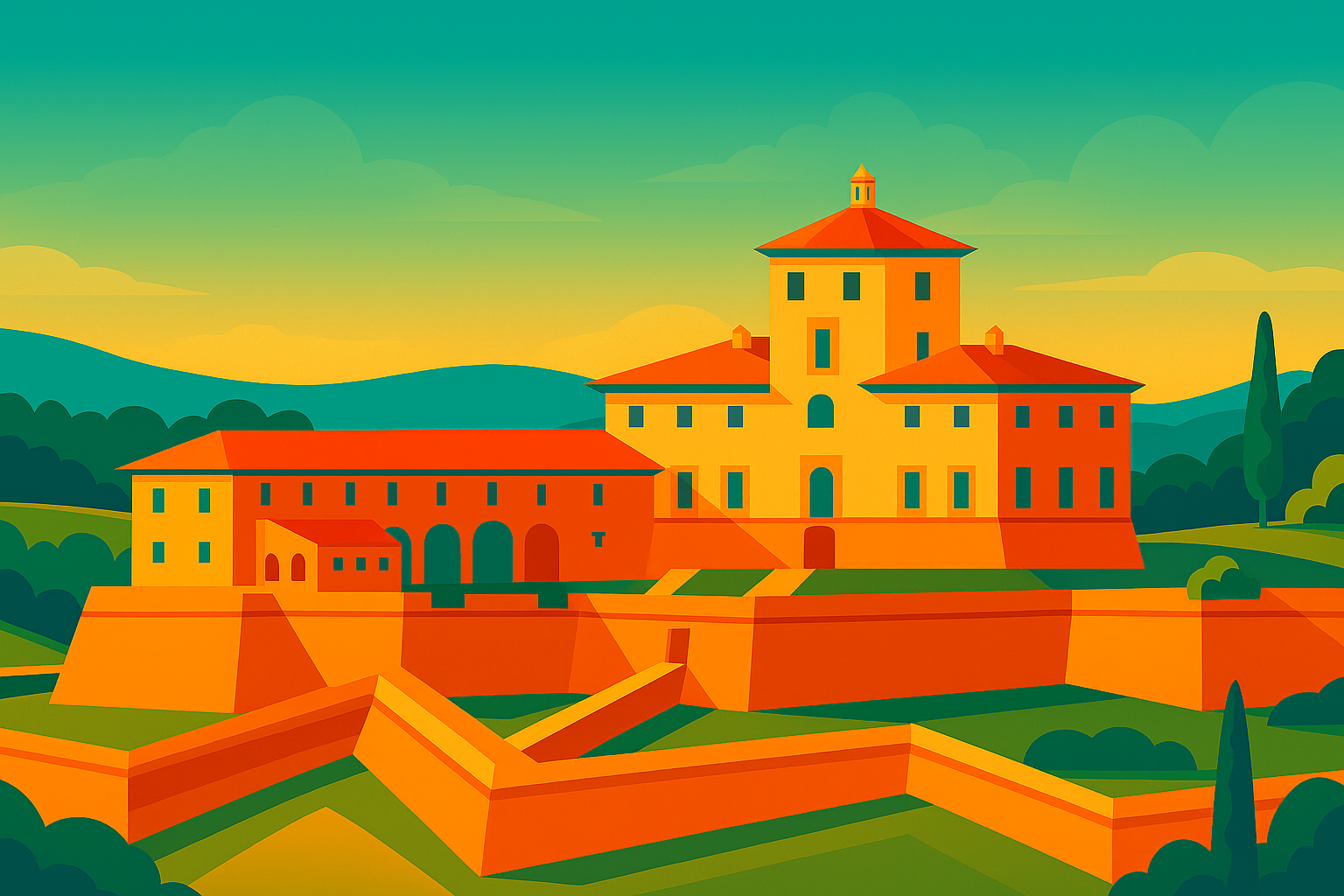
Fort Belvedere (Florence)
Experience the magic of Tuscany
Imagine driving through the Chianti hills, discovering medieval villages, and stopping for an aperitivo at sunset. Renting a car is the secret to experiencing Tuscany with true freedom. Book now for the best choice.
🔍 Choose your car for TuscanyFlorence from the Top: Forte di Belvedere, Where Medici Power Meets the Horizon
Perched high above the Oltrarno district, a silent guardian watching over Florence, Forte di Belvedere stands as one of the city’s most potent, yet peacefully understated, historical landmarks. This is more than just a viewpoint; it’s a profound statement carved in stone, a complex architectural marvel, and today, a dynamic cultural epicenter. To stand on its ramparts is to occupy the same space as the Medici dukes, to see the city not just as a collection of beautiful buildings, but as a domain to be protected, controlled, and admired.
Commissioned by the pragmatic Grand Duke Ferdinando I de’ Medici and brought to life by the visionary Bernardo Buontalenti between 1590 and 1595, the Fort was born from a fascinating duality. Its first purpose was unequivocally military: a commanding fortification designed to protect Florence’s vulnerable southern flank, strategically connected to the seat of power through a network of clandestine passages. The second, and perhaps more enduring purpose, was political: a magnificent, visible assertion of Medici power and wealth. From its elevated position, at approximately 43.7601° latitude and 11.2541° longitude, the city’s compact Renaissance core unfolds in a breathtaking 360-degree panorama, seamlessly linking the monumental historic center with the soft, rolling Tuscan hills. This blend of severe military defense and the refined ducal life, embodied by the elegant Palazzina at its heart, is the key to understanding Forte di Belvedere.
Why Forte di Belvedere is an Unmissable Florentine Experience
While the crowds jostle for position in Piazza del Duomo, a different atmosphere pervades the Forte di Belvedere. There is a surprising serenity here, the deliberate silence of strategic success. The sheer scale of the fortress commands respect, yet it invites contemplation. Despite its imposing inclined bastions and powerful design, historical records confirm a remarkable fact: the fortress never suffered a siege. Not a single shot was ever fired from its ramparts in genuine defense of the city. Its immense value was therefore psychological and symbolic, projecting an image of impenetrable Medici might that deterred any potential aggressor.
The entire structure was an instrument of high-level political propaganda. The military elements, though functionally severe and representing the pinnacle of Italian military architecture, were visually softened by the graceful Palazzina di Belvedere nestled within. This elegant villa, clearly visible from the city below, served as a constant reassurance to the populace of Medici stability and aristocratic refinement. The massive fort was the ultimate deterrent, while the villa was the symbol of the cultured life it protected.
Standing here, your perspective shifts. It is more than a beautiful vista; it is an exercise in historical interpretation. As you gaze out, you are seeing your surroundings as the ruling family once did—surveying their domain, recognizing the deep, symbiotic bond between the compact, monumental city below and the landscape that sustained it. Your eyes can trace a path from the nearby Basilica of San Miniato al Monte to the distant hills of Fiesole, transforming mere sightseeing into a profound act of historical and geographical reading.
A Fortress of Power and Propaganda: The Story of the Fort
The construction of Forte di Belvedere was a pragmatic response to the political and military vulnerabilities faced by the Medici Grand Duchy in the late 16th century. Grand Duke Ferdinando I required more than just a fortress; he needed an unbreachable citadel capable of withstanding a modern siege, protecting the entire apparatus of government, and serving as an ultimate sanctuary for his dynasty in times of crisis.
Buontalenti’s masterful design delivered on all fronts, creating a multi-layered security system that was seamlessly integrated into the city’s infrastructure. The Fort was connected directly to the Palazzo Pitti, the ducal residence, and the sprawling Boboli Gardens through a network of internal, hidden passageways. This ingenious system ensured the Grand Duke and his family could execute a rapid, secure withdrawal in the event of plague, civil unrest, or military threat, vanishing from the public eye into their fortified retreat.
The Medici Treasury and its Legendary Traps
A key secondary function of the Fort, often overlooked, was its role as the state-of-the-art secure vault for the vast Medici treasury. This wasn’t just a storeroom; it was the financial heart of the dynasty, holding immense wealth and highly sensitive state valuables. This concentration of defensive, residential, and fiduciary functions elevated its importance far beyond that of a standard military outpost.
Within the Palazzina, the security system surrounding the treasury has become the stuff of legend. The vault, a small room accessible only via a narrow staircase, was said to be a masterpiece of Renaissance engineering and paranoia. Historical accounts, bordering on folklore, depict a space protected by complex mechanisms. Doors were supposedly rigged with traps, including sharp blades ready to pierce any unauthorized intruder. One rumor even suggested a mechanism that could deliberately flood the entire chamber to neutralize any persistent threats. While these dramatic specifics may be embellished, they underscore the absolute importance the Medici placed on the Fort, transforming it from a defensive point into a symbol of untouchable power.
From Military Stronghold to Modern Art Stage
After centuries of military ownership, the Fort was acquired from the Italian Army in 1951. Following extensive restoration, it opened to the public in 1955, embarking on a new life as a major cultural venue. This transition was cemented by the landmark 1972 Henry Moore exhibition, an event that fundamentally redefined the Fort’s cultural identity. The monumental showcase, which attracted over 345,000 people and high-profile international guests, proved that the severe Renaissance walls provided a spectacular and powerful backdrop for contemporary sculpture. This tradition continues to this day, with the Fort hosting major retrospective exhibitions dedicated to figures like Antony Gormley and Eliseo Mattiacci. Now managed by the MUS.E Foundation, it operates as a multidisciplinary cultural center, dedicated to interweaving history, landscape, and modern artistic expression.
Planning Your Visit: The Essentials
A trip to Forte di Belvedere requires a bit of planning, but the rewards are immense. Understanding its seasonal nature and opening times is the first step to a successful visit.
Opening Hours, Tickets, and a Budget-Friendly Secret
The most crucial thing to know is that the Fort is a seasonal attraction. It typically operates only during the warmer months, generally from June to October. Outside of this window, the site is usually closed for the winter, a common source of disappointment for unprepared visitors. Always check the official MUS.E website for the exact opening and closing dates for the current year.
During its open season, the Fort is open from Tuesday through Sunday, from 10:00 to 20:00, and is closed on Mondays (unless it’s a public holiday). Be mindful of the last admission time, which is strictly one hour before closing at 19:00.
The standard full admission price for non-residents is a very reasonable €5.00. This ticket grants you access to the main contemporary art exhibitions held within the Palazzina and across the ramparts. For residents of the Florence metropolitan area, admission is free, reinforcing the Fort’s role as a vital community cultural resource.
Here’s a valuable insider tip for budget-conscious travelers or those primarily interested in the panoramic views:
While the €5 ticket is for the exhibitions, access to the main viewing terraces and the panoramic cafeteria is often free, especially during evening events. Always ask at the entrance.
This represents a significant opportunity for travelers seeking the iconic Florentine sunset without the commitment of the full exhibition ticket. A recommended visit duration of 90 to 120 minutes is generally sufficient to tour the entire perimeter, explore the Palazzina, and enjoy a drink at the scenic cafeteria.
The Best Time to Go: Chasing the Golden Hour
Given its operating schedule and its reputation as a premier panoramic location, the absolute best time to visit Forte di Belvedere is during the late afternoon or early evening to witness the sunset. Arriving roughly two hours before the 20:00 closing time allows you to complete the historical and artistic circuit before the magical golden hour commences. As the sun begins its descent, a warm, ethereal light bathes the Duomo, Palazzo Vecchio, and the historic center, creating perfect conditions for photography and quiet reflection.
This timing is further justified by the Fort’s cultural calendar. The summer season is packed with programming, including the *Forte in Musica* concert series and cultural talks held at sunset. A late visit can transform your sightseeing trip into a richer, multisensory Florentine experience.
How to Reach the Summit
Located at Via di S. Leonardo, 1, the Fort’s greatest military advantage—its altitude—presents the modern visitor with a significant physical challenge. The approach is steep and demanding, a fact reflected in its accessibility score of 50.
The Ascent: Walking vs. Public Transport
The steep incline leading up to the fortress from the Oltrarno or the Giardino Bardini should not be underestimated. The path is often paved with uneven stone or cobblestones, requiring substantial effort. For travelers with any mobility challenges, those with young children, or anyone simply wishing to conserve energy, relying solely on walking is strongly discouraged, especially in the summer heat.
The most practical, comfortable, and efficient method of arrival is by using Florence’s public transport network. Bus Line 13 serves the area directly, allowing you to bypass the arduous ascent entirely. The correct stop is Galileo Forte Di Belvedere. Integrating this simple bus ride into your itinerary is a key piece of logistical advice that will prevent fatigue and frustration, ensuring you arrive ready to explore.
Arriving by Car or Taxi
While the Fort has a dedicated parking area, Parcheggio del Forte Belvedere, the approach roads like Via del Forte di S. Giorgio are narrow, steep, and can be challenging for drivers unfamiliar with historic Italian city centers. For most visitors staying in the city, taking Bus 13 or a taxi is a far more convenient and stress-free option.
What to See and Do at the Fort
Once you’ve arrived, the Fort offers a layered experience that combines art, history, and breathtaking nature.
The Unbeatable Panoramas: Best Photo Spots
Forte di Belvedere is celebrated for its spectacular 360-degree views, offering almost limitless photographic potential. However, two vantage points are particularly effective for capturing the definitive image of Florence.
- The Northern Bastion (The Renaissance Profile): The rampart wall facing directly north, overlooking the city, is the primary destination for photographers. This location provides the iconic shot where the architectural titans of Florence—Brunelleschi’s Cupola, Giotto’s Campanile, and the rugged tower of Palazzo Vecchio—are perfectly aligned. The proximity offers a uniquely intimate perspective of the sea of terracotta rooftops.
- The Western Curve (Oltrarno and River View): For a different angle, move along the western curve of the ramparts. This spot offers expansive views of the Oltrarno district and the serpentine path of the Arno River as it flows west. It allows you to capture the less-seen side of the city, with the Ponte Vecchio visible in the distance against the backdrop of rolling Tuscan hills.
A key strategy is to deliberately incorporate the modern context. Use the contemporary art installations, which often feature monumental sculptures placed on the ramparts, to frame the historical skyline. This creates the characteristic aesthetic of Forte di Belvedere—a powerful dialogue between centuries.
Exploring the Palazzina and Relaxing at Belvedere Firenze
Don’t forget to explore the elegant Palazzina di Belvedere at the Fort’s center. It hosts the main indoor exhibitions and offers a glimpse into the refined world that existed within these formidable walls. After exploring, the centerpiece of the visitor services is the panoramic cafeteria, Belvedere Firenze. It’s strategically positioned to offer refreshments and light meals alongside the iconic city view, making it the perfect spot to rest and absorb the scenery.
Beyond the Ramparts: Connecting Your Visit
Forte di Belvedere sits at the geographical and historical apex of the Oltrarno district, making it a perfect anchor for a day of exploration.
The Fort is intrinsically linked to the Palazzo Pitti and the Boboli Gardens. A logical full-day itinerary involves tracing the path of Medici power: start at their opulent ducal residence, wander through their magnificent gardens, and conclude your journey at their secure military bastion.
Immediately adjacent to the Fort is the magnificent Giardino Bardini. These gardens offer a wonderful contrast to the military austerity of the Fort, showcasing exquisite Italian baroque landscaping, dramatic tiered staircases, and unique viewing perspectives that beautifully complement the broader vista from the ramparts.
Finally, when comparing viewpoints, the Fort offers a distinct experience from the universally popular, but significantly more crowded, Piazzale Michelangelo. While the Piazzale provides the broad, classic postcard view, the Fort delivers a quieter, more curated, and historically weighted perspective. This unique blend of history, art, and topography solidifies its position as a must-visit cultural landmark.