
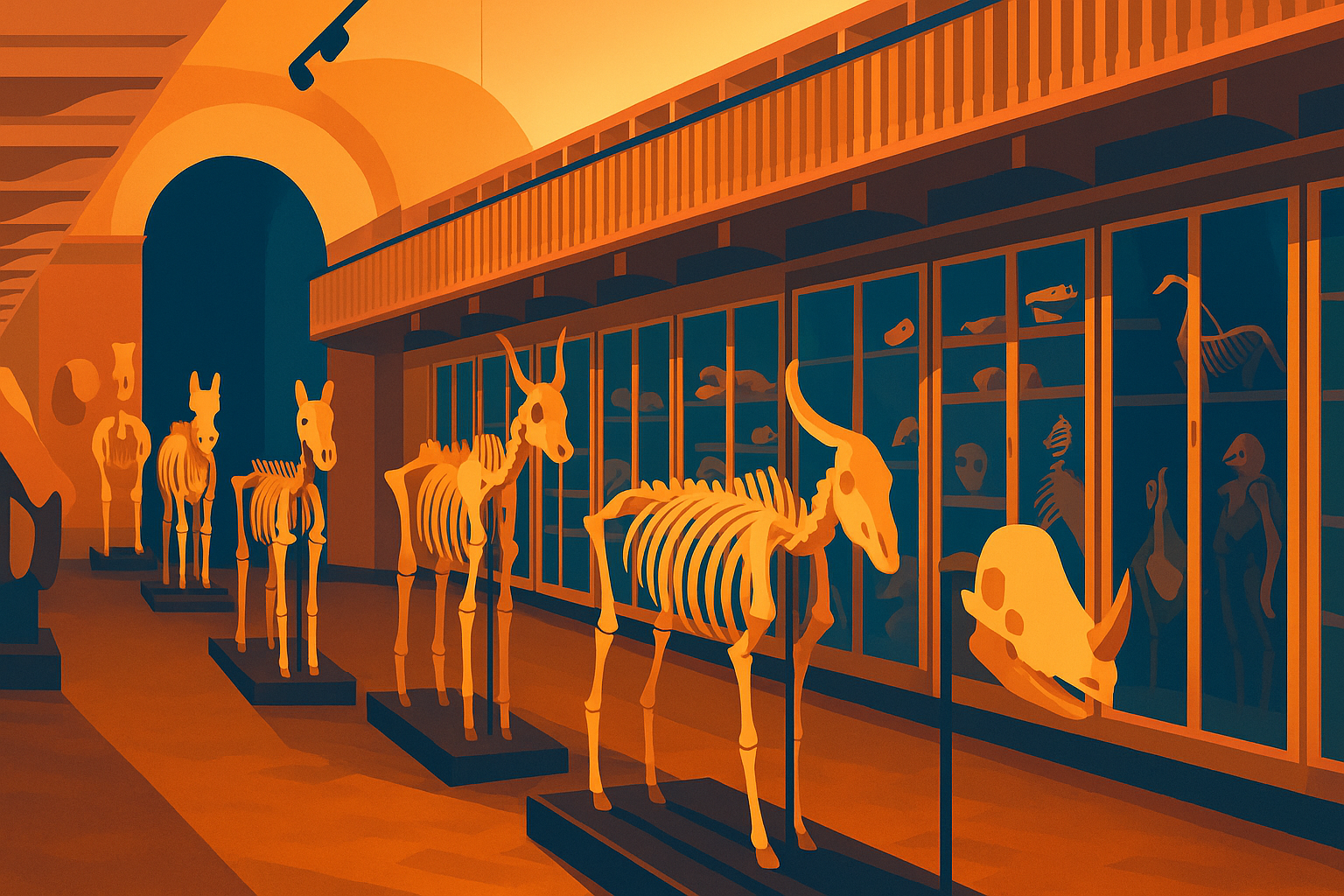
La Specola – Natural History Museum of the University of Florence
Experience the magic of Tuscany
Imagine driving through the Chianti hills, discovering medieval villages, and stopping for an aperitivo at sunset. Renting a car is the secret to experiencing Tuscany with true freedom. Book now for the best choice.
🔍 Choose your car for TuscanyMost visitors flock to Florence for a vision of humanity perfected, captured in the cool, flawless marble of Michelangelo’s David or the ethereal grace of Botticelli’s Venus. They seek a beauty that transcends the messy reality of the physical body. But across the Arno river, in the quieter, artisan-filled streets of the Oltrarno district, another Florence awaits. Here, just steps from the grand Pitti Palace, lies a museum that houses a different kind of Venus—one adorned not with divine light, but with a pearl necklace and strands of real human hair, her torso opening to reveal the intricate, visceral machinery of her organs.
This is the Museo di Storia Naturale “La Specola,” the oldest public science museum in Europe. Founded in 1775 and brilliantly renovated for its reopening in February 2024, it is a place of two distinct, powerful souls. It is a “Museum of Light,” a breathtaking product of the Enlightenment’s grand, rational project to classify and comprehend all of nature. But it is also a “Museum of Dark,” a place of hushed, theatrical chapels that display the beautiful, morbid, and strangely sensual side of anatomical science.
La Specola is magnificent, but it can also be one of Florence’s most logistically confusing destinations. This guide will lead you through its history, its contrasting atmospheres, and most importantly, its complex collections, ensuring you experience the full, profound journey it offers.
A Journey Through Contrasting Worlds: The Atmosphere of La Specola
A visit to La Specola is a walk through two profoundly different states of mind. You encounter the “Museum of Light” first. These are the main zoological and mineralogical halls, which embody the Enlightenment’s obsessive quest for rational order. You’ll find yourself wandering through silent, 19th-century corridors lined with endless walls of original glass-and-wood cases. This is the “System of Nature” made manifest: a silent, static, and overwhelming attempt to capture and categorize the entirety of the known world. The 2024 reopening has added a bright, modern, and dazzling Mineralogy wing, a brilliant counterpoint to the older, more somber halls.
Then, for those who manage to secure a spot on the separate guided tour, the atmosphere shifts dramatically. You enter the “Museum of Dark”—the anatomical wax rooms. The air here is different: hushed, clinical, theatrical, and almost reverent. It feels less like a museum and more like a series of private chapels, each display case a reliquary holding a sacred, unsettling truth. It is a seductive entanglement of art and science, a space that evokes both intellectual awe and a deep, visceral discomfort.
The symbolism of this duality is the museum’s true power. The zoological halls represent humanity’s attempt to order nature, to place itself above it. The anatomical rooms represent humanity’s raw confrontation with its own nature—our mortality, our decay, and the “terrible beauty” of our internal mechanics. This is most evident in the small, baroque dioramas by Gaetano Zumbo, which depict the horrors of plague and decomposition. These are not merely scientific tools; they are profound artistic meditations on death, true *memento mori*.
A Palace of Science for the People: The History of La Specola
To understand La Specola is to understand its founder, Grand Duke Peter Leopold of Lorraine. A true ruler of the Enlightenment, he established the Imperial and Royal Museum of Physics and Natural History in 1775 as his great utopian project: a “Palace of Science” for everyone.
The very concept was revolutionary. It was one of the first museums in Europe established as a public institution, intended for the education of all citizens “without limitations of origin, gender or class.” This was not a private royal cabinet of curiosities; it was a powerful tool for mass education. The project began when the naturalist Giovanni Targioni Tozzetti was tasked with cataloging the vast, scattered Medici collections of fossils, animals, and minerals—items previously held in the Uffizi as a *Wunderkammer*. Peter Leopold’s vision was to move these artifacts into a dedicated, rational, scientific institution, which he housed in the Palazzo Bini Torrigiani, right next to his own residence at the Pitti Palace.
The museum’s first director, Felice Fontana, was entrusted with its scientific development. It was Fontana who established the ceroplastics (wax modeling) workshop in 1771. His aim was profoundly practical: to create a complete, three-dimensional encyclopedia of the human body. These “permanent, odor-free, and incorruptible” models would replace the need for messy, temporary, and difficult-to-acquire human cadavers for teaching anatomy to medical students.
By the 19th century, this grand, unitary vision of a single museum for all science began to fragment as disciplines specialized. The priceless collection of physics instruments, including those that had belonged to Galileo, was transferred to what is now the Museo Galileo. This “great schism” explains why La Specola today is primarily a museum of zoology and anatomy, and why a visit to the Museo Galileo is its perfect thematic complement, reuniting the two halves of Florence’s scientific soul.
What to See: Navigating the Collections
The museum’s architecture and its collections are deeply intertwined, forming a series of “temples” dedicated to different forms of knowledge. Here’s how to navigate them.
The Zoological Halls: A 19th-Century Ark
The standard €10 ticket grants you access to the historic Zoological Halls. These 23 rooms display a fraction of the museum’s immense collection of over 4 million specimens. The exhibition layout is intentionally historic, preserving the 19th-century atmosphere of systematic discovery.
The undeniable star of this collection is the Medici Hippopotamus. This was a 17th-century Medici pet that once lived in the adjacent Boboli Gardens. Upon its death, it was stuffed by artisans who, reportedly, had only a “vague idea” of what the species actually looked like. The result is a wonderfully bizarre, slightly “fanciful” creature that is now a priceless artifact of museological history itself. Other highlights include a mummified crocodile from Ancient Egypt, giant Galápagos tortoises, and vast, mesmerizing collections of birds and mollusks. This is not a “dead zoo”; it is a vital scientific archive, holding “type specimens” (the first of a species ever described) and, most poignantly, specimens of now-extinct animals, including the Thylacine (Tasmanian Tiger).
The New Wings (2024): Botanical Waxes and Dazzling Minerals
The February 2024 reopening transformed the visitor experience by opening two stunning new sections, both included in the standard ticket. The Botanical Wax Collection, created by the same 18th-century workshop but hidden from the public for over a century, is now on display. These models of plants, fruits, and botanical pathologies possess an exceptional realism and extraordinary beauty.
Alongside it is the spectacular new Mineralogy Wing. This dazzling and modern exhibition reunites the museum with its origins by displaying the wonderful collections of minerals and gemstones that once belonged to the Medici family, presented in a brilliantly lit, contemporary setting.
The Legend: The Anatomical Wax Collection
The museum’s most famous, and most restricted, collection is the Anatomical Waxes. Access to these rooms is only available via a supplemental, timed, guided tour.
The collection begins with the 17th-century “anatomical theatricals” by Gaetano Zumbo. These are small, macabre, and intensely artistic dioramas whose primary intent is not science but contemplation. They vividly depict the horrors of plague, syphilis, and bodily decomposition with a powerful emotional charge.
The main collection (1771-1893) is the work of the workshop founded by Fontana and perfected by the master modeler Clemente Susini. This is pure Enlightenment science. The 513 models are life-sized, hyper-realistic, and were created for a clear didactic purpose: to teach anatomy. Each model is a faithful reproduction of a dissected corpse, and they were so accurate that they sometimes depicted glands and structures unknown to science at the time.
The icon of the collection is the “Anatomical Venus” (*Venerina*). She is a life-sized, dissectible female figure, reclining in a state of ambiguous ecstasy. Adorned with a pearl necklace and real human hair, she masterfully blurs the line between scientific specimen and erotic art. Often containing a small, perfectly formed fetus, she links generation with dissection. Her name is a powerful, dark pun: she is the Venus de Medici (like the classical statue in the Uffizi) and also the Venus of the *Medici* (Italian for “doctors”). She is the ultimate symbol of the museum’s two souls: the idealized beauty of Renaissance art and the cold, flayed, empirical specimen of science.
The Restricted Halls: Skeletons and Stars
Two other magnificent spaces require special access. The Salone degli Scheletri (Hall of Skeletons) is a magnificent 19th-century hall featuring wood paneling (*boiserie*), a gallery, and 120 display cases. It houses some 3,000 osteological artifacts, dominated by the massive skeleton of an Asiatic Elephant that came to Florence alive in 1655. Access to this hall is highly restricted and available only via a private guided tour booked well in advance.
The museum’s most stunning architectural feature is the Tribuna di Galileo. Inaugurated in 1841, this is a “secular temple” dedicated to the memory of Galileo and the experimental method. A breathtaking example of late Florentine neoclassical design, it features a central statue of Galileo surrounded by vibrant frescoes depicting key moments in Italian science. It is topped by the Torrino Astronomico (Astronomical Tower), the observatory that gives the museum its name (“La Specola”), offering 360-degree views of Florence.
Planning Your Visit: Tickets, Hours, and Insider Tips
Navigating La Specola’s ticketing is the most challenging part of the visit. Understanding it is key to avoiding disappointment.
Opening Hours & Prices
The museum is open Tuesday to Sunday, from 09:00 to 17:00. The last entry is at 16:00. It is closed every Monday, and on January 1, Easter, May 1, August 15, and December 25.
The standard (*ordinario*) ticket costs €10 (€5 reduced for ages 6-14 and over 65). Free entry is granted to children under 6, visitors with disabilities and one companion, and ICOM members, among others. Online booking via Vivaticket is strongly recommended for the standard ticket.
Deconstructing Your Ticket: How to See the “Hidden” Collections
This is the most critical information for any visitor. The standard ticket does not include the museum’s most famous exhibits.
The €10 standard ticket includes:
- The Zoology Collection
- The Mineralogy Collection
- The Botanical Wax Collection
This ticket EXCLUDES the Anatomical Waxes, the Tribuna di Galileo, and the Salone degli Scheletri.
To see these collections, supplemental tickets are required, and the process is not intuitive. The €3 supplemental tickets for the Anatomical Waxes and the Tribuna di Galileo cannot be booked online. They are sold only at the museum ticket office on the day of the visit, on a first-come, first-served basis.
This table clarifies the complex access system:
| Collection/Attraction | Included in €10 Ticket? | Access Method | Cost Supplement | Wheelchair Accessible? |
|---|---|---|---|---|
| Zoology Collection | Yes | Standard entry | None | Yes |
| Mineralogy Collection | Yes | Standard entry | None | Yes |
| Botanical Wax Collection | Yes | Standard entry | None | Yes |
| Anatomical Wax Models | No | Guided Tour (Tue-Sun: 11:00, 12:00, 15:00) | €3 | No |
| Tribuna di Galileo & Torrino | No | Guided Tour (Sun only: 10:00) | €3 | Partially |
| Salone degli Scheletri | No | Private Guided Tour (Book in advance) | €50+ (group) | Yes |
A standard visit covering Zoology, Minerals, and Botany takes approximately 90 to 120 minutes. If you successfully add the 60-minute Anatomical Wax tour, plan for at least 3 hours in total.
To see the famous anatomical waxes, you must buy a €3 supplemental, timed-entry guided tour ticket in person at the museum ticket office; it cannot be booked online. Arrive before 09:00 AM to secure a spot, as they sell out almost immediately.
How to Get There
La Specola is located at Via Romana, 17, 50125 Firenze, in the historic Oltrarno district.
The best way to arrive is on foot, as it is perfectly integrated into the Oltrarno’s main sites. It is a brief 5-minute walk from the exit of the Boboli Gardens or the main entrance of the Palazzo Pitti. From the Ponte Vecchio, it is a pleasant 10-15 minute walk through charming streets.
If using public transport (Autolinee Toscane), the best options are the small electric *bussini* (mini-buses):
- Bus C4: This bus stops at “Santo Spirito,” which is a 2-minute walk from the museum entrance.
- Bus 11: This line also has stops near the museum.
A critical tip for Florence’s buses: tickets are not sold on board. They must be purchased *before* boarding from a *tabacchi* (tobacconist shop) or newsstand. Once on the bus, the ticket must be immediately validated in the small yellow machine.
Practical Information
Facilities & Accessibility
The museum has a bookshop on the ground floor, toilets, and free self-service lockers for small bags. Guide dogs are welcome. There is no internal café, so plan to find refreshments in the nearby Piazza Pitti or Piazza Santo Spirito.
Accessibility at La Specola is a critical, two-part issue.
- What IS Accessible: The main museum route (Zoology, Mineralogy, and Botanical Waxes), spread over several floors, is wheelchair accessible via lifts. There are accessible restrooms.
- What is NOT Accessible: It must be stated clearly and empathetically: the Anatomical Wax Model collection is NOT accessible by wheelchair. This is a crucial fact for visitor planning, likely due to the historic, narrow passages of that specific 18th-century wing.
Best Time to Visit
The best time of day to visit is right at opening. Arrive at 08:45 to be first in line when the museum opens at 09:00, especially from Tuesday to Saturday. This is the single most important strategy for securing one of the limited, in-person-only spots for the anatomical wax tour.
The best time of year is the low or shoulder season (November through March). La Specola is one of Florence’s greatest indoor attractions, perfect for a cool or rainy day. In the low season, the city is less crowded, and you will face less competition for the limited-availability tour spots.
Beyond La Specola: Connections and Complementary Visits
La Specola is the cultural anchor of the Oltrarno. The most natural way to plan a day is to combine it with its adjacent neighbors: the Palazzo Pitti and the magnificent Boboli Gardens.
For a thematically perfect pairing, a visit to the Museo Galileo (located across the river near the Uffizi) is essential. This museum holds the physics instruments and scientific devices that were once part of La Specola’s original, unified collection. Visiting both “reunites” the collection and tells the complete story of Florentine science.
Finally, use the visit as a springboard to explore the authentic *rive gauche* of Florence. Wander to the Piazza Santo Spirito for its vibrant local atmosphere or visit the Brancacci Chapel to see Masaccio’s frescoes, whose revolutionary use of anatomical realism in art provides a fascinating parallel to La Specola’s work in science.
Best Photo Spots
Non-flash photography for personal use is generally permitted.
- The Panoramic Shot: The 360-degree view of Florence from the Torrino (Observatory tower) is unmatched, though it requires the special Sunday guided tour.
- The Architectural Shot: The interior of the Tribuna di Galileo. Capture the stunning neoclassical dome, the central statue, and the colorful frescoes.
- The Systematic Shot: The long, repeating vistas of the zoological halls, with their historic, glowing 19th-century cases creating patterns of light and shadow.
- The Color Shot: The dazzling and vibrant new Mineralogy collection offers a burst of color and modern design.
- The Macabre Shot: The hyper-detailed, theatrical dioramas by Zumbo and the uncanny, reclining “Anatomical Venus” in her glass case. (Note: The wax collection is dark, and photography can be difficult).