
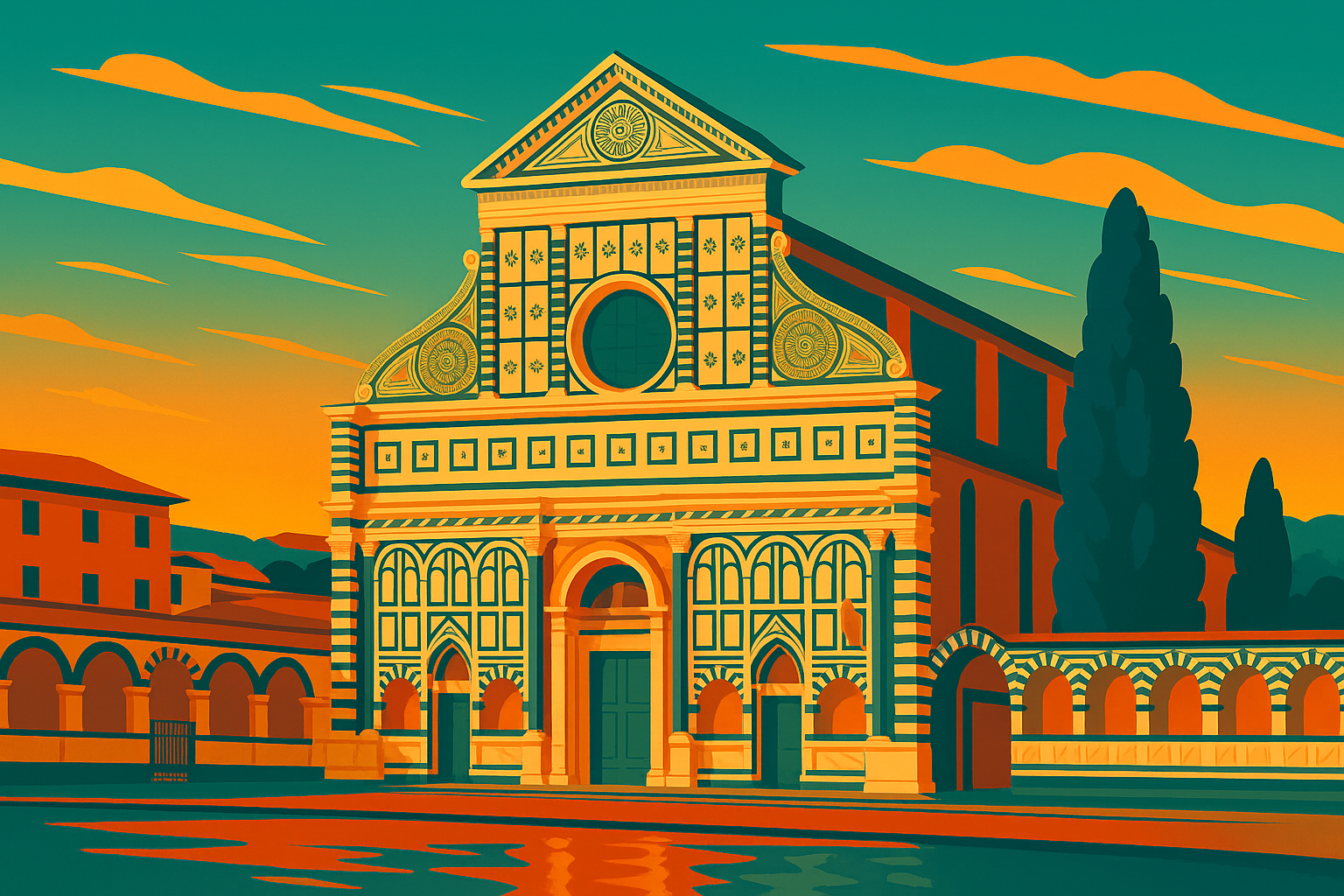
Monumental Complex of Santa Maria Novella
Experience the magic of Tuscany
Imagine driving through the Chianti hills, discovering medieval villages, and stopping for an aperitivo at sunset. Renting a car is the secret to experiencing Tuscany with true freedom. Book now for the best choice.
🔍 Choose your car for TuscanyFlorence’s First Masterpiece: Why Santa Maria Novella Is the City’s True Renaissance Welcome
For most travelers arriving in Florence, the Basilica di Santa Maria Novella is the first great monument they see. Its vast, luminous piazza unfolds directly opposite the city’s main railway station, a breathtaking welcome of green and white marble geometry. Yet, in a city dominated by the gravitational pull of the Duomo and the Uffizi, this church is often treated as a secondary stop, a landmark to be ticked off a list rather than truly experienced.
This is a profound mistake. Santa Maria Novella is not just another church; it is the essential prologue to the Florentine Renaissance. To visit the Duomo first is to read the triumphant final chapter of a book you haven’t started. To visit Santa Maria Novella first is to understand how—and why—the Renaissance began. Chronologically, it is the first great basilica in Florence, and within its walls, you can trace the entire arc of Western art in a single, 100-yard walk. It is a living library of art history, a place where revolutionary ideas were forged in paint and stone.
The Intellectual Heart of the Renaissance
The atmosphere of Santa Maria Novella is one of cool, intellectual rigor, a direct reflection of its founders. While the rival Basilica of Santa Croce was built by the Franciscans—an order of emotional preaching and poverty—Santa Maria Novella is the principal church of the Dominicans. The Dominicans were the “Order of Preachers,” a society of theologians, scholars, and inquisitors. Their mission was to study, to teach, and to combat heresy through logic and intellectual argument.
This church was their headquarters, and the art they commissioned is not merely decorative; it is didactic. It is a series of brilliant, rational sermons in paint, designed to educate and persuade. Every fresco, every sculpture, and every architectural choice serves a purpose, communicating a complex theological idea with stunning clarity.
Masaccio’s Trinity: The Big Bang of Perspective
The most powerful of these sermons is found in the third bay of the left nave: Masaccio’s Holy Trinity. Painted around 1425–1426, this fresco is arguably the most important painting of the early Renaissance. At first glance, it appears as a stunning trompe l’oeil illusion, a hole punched through the wall into a perfectly rendered classical chapel. But its genius is not the trick; it’s the theology.
Masaccio, for the first time in history, uses the new science of linear perspective to place the divine Trinity within a rational, human-scale, classical space. He creates a single, unified pyramid of figures: God the Father supports the Cross, with the Holy Spirit descending as a dove, while Mary and John stand on a ledge inside the “chapel.” Just outside, on our level, are the kneeling donors who paid for the work. The message is a Dominican argument of profound logic: the divine is rational, and it inhabits the same orderly, measurable world that we do.
The lesson is completed by the memento mori at the very bottom—a skeleton laid in a tomb. The inscription above it is a chilling, direct address to the viewer: “WHAT YOU ARE, I ONCE WAS; WHAT I AM, YOU WILL BECOME”. It is the ultimate one-two punch of Dominican preaching: a rational warning of your mortality, followed immediately by the rational promise of salvation through the Trinity above.
A Battlefield of Prestige and Art
Walking through the vast, open nave of Santa Maria Novella is like reading a “who’s who” of medieval and Renaissance Florence. The church, consecrated in 1420, became the most desirable burial place for the city’s wealthiest and most powerful families. The side chapels were not just places of worship; they were private funerary monuments, financed by banking clans like the Strozzi, Bardi, and Rucellai to ensure their salvation and—just as importantly—to publicly cement their status.
This created an intense spiritual and artistic competition. Each family vied to commission the most famous artists for the most lavish frescoes, turning the church into a showcase of prestige and a hotbed of artistic innovation.
The Tornabuoni Chapel: High Society and a Hidden Genius
Nowhere is this more evident than in the main chancel, the Tornabuoni Chapel. In 1485, the chapel’s patronage was secured by Giovanni Tornabuoni, a powerful and enormously wealthy banker allied with the Medici family. He commissioned the largest workshop in Florence, run by Domenico Ghirlandaio, to cover the walls in frescoes depicting the Life of the Virgin and the Life of St. John the Baptist.
But the real subjects are the Tornabuoni family and their contemporaries. Ghirlandaio populated these sacred stories with dozens of exquisitely dressed members of Florentine high society. In the Birth of the Virgin, for example, a procession of noblewomen, led by Giovanni’s daughter Ludovica Tornabuoni, arrives to visit St. Anne as if attending a 15th-century society party. It is a breathtaking blend of the sacred and the secular, a snapshot of Florence at the height of its power.
The chapel holds an even deeper secret. As Ghirlandaio and his workshop painted this masterpiece, a 14-year-old apprentice was learning his craft among them: a young boy named Michelangelo Buonarroti. This chapel is not just a triumph of Renaissance art; it is the very classroom where the future sculptor of the David learned the human form.
Architectural Brilliance in Two Acts
The genius of Santa Maria Novella is told in two distinct, revolutionary architectural acts: the innovative façade that greets you from the piazza, and the groundbreaking cloisters hidden within the museum complex.
First, the façade. When Leon Battista Alberti was commissioned by Giovanni Rucellai to complete the church’s face around 1458, he faced a massive challenge. He was a pure classicist, obsessed with the “perfect geometry and rational order” of ancient Rome, but he was hired to finish a half-built, “disorderly” Gothic church. His solution is a masterpiece of harmony. To connect his new design with Florence’s older, beloved Romanesque buildings (like the Baptistery), he used the same signature green and white marble in strict geometric patterns. He then applied a rigid system of classical pilasters and proportions to the entire structure, effectively pressing the unruly Gothic energy into a rational, square-based grid.
His masterstroke was his invention of the two giant S-curve scrolls (volutes) that flank the upper section. This piece of architectural poetry was the first of its kind, elegantly solving the awkward Gothic problem of how to connect the tall, narrow central nave to the low, wide side-aisles. It was a design so perfect, it would be copied on church façades for the next 300 years.
The second act begins after you enter the museum. Your ticket includes the full complex, which contains the cloisters. The most famous is the Chiostro Verde (Green Cloister), named for the haunting terra verde (green earth) pigment used by the artist Paolo Uccello in his 15th-century frescoes. Here, you must find the lunette fresco depicting The Flood and The Waters Receding. Uccello was famously, wildly obsessed with the new science of perspective. The fresco is a disturbing, monochrome vision of chaos, organized by an iron-clad logic. He depicts two arks—one for the flood’s arrival, one for its retreat—both receding dramatically to a single, mathematically precise vanishing point, creating a vortex of terrifying, rational space.
Planning Your Visit
Opening Hours, Prices, and Ideal Duration
The Basilica di Santa Maria Novella complex is open daily, but as an active place of worship, its hours are variable and essential to check before your visit.
- Monday–Thursday: 9:00 a.m. to 5:30 p.m.
- Friday: 11:00 a.m. to 5:30 p.m.
- Saturday: 9:00 a.m. to 5:00 p.m.
- Sunday and religious holidays: 1:00 p.m. to 5:00 p.m.
The last admission is one hour before closing time. A single ticket provides remarkable value at €7.50. A reduced ticket is available for €5.00 for minors aged 11 to 18, and admission is free for children under 11 and residents of Florence. This ticket grants access to the entire monumental complex: the Basilica, the Museum, the Green Cloister, the Cloister of the Dead, and the spectacular Spanish Chapel.
While some guides suggest a 90-minute visit, this is a rush. To truly absorb the art—to stand before Masaccio’s Trinity, to decipher Ghirlandaio’s frescoes, and to explore the cloisters—plan for a minimum of two hours.
How to Get There and Avoid the Common Mistake
The basilica’s location is its greatest practical advantage. It stands directly across the piazza from Florence’s main train station, Firenze Santa Maria Novella (SMN). If you are arriving by train, it is the first magnificent landmark you will see. It is also an easy 8- to 10-minute walk from the Duomo. This convenience, however, comes with a critical insider tip that is vital for avoiding frustration. The complex has two different entrances for two different types of tickets, a detail that confuses nearly all first-time visitors.
- For Pre-Booked Online Tickets: If you purchased your ticket in advance (highly recommended in peak season), your entrance is at Piazza della Stazione 4. This is the “Museum” entrance, located on the side of the complex closer to the train station.
- For Walk-Up Tickets: If you need to buy a ticket on the day of your visit, you must go to the main entrance at Piazza Santa Maria Novella 18. This is the beautiful, famous façade facing the main square.
Knowing this simple difference will save you from waiting in the wrong line and allow you to begin your visit seamlessly.
Facilities and Practical Services
The Santa Maria Novella complex is a well-managed historic site, but it remains a consecrated church. The most important rule is the strict dress code. Both men and women must have their shoulders and knees covered. You will be denied access for wearing shorts or sleeveless tops.
Multimedia audio guides are available for rent and are highly recommended for interpreting the dense layers of art and history. For groups of six or more, the use of a headset system is mandatory to maintain the atmosphere of sacred silence. The complex is impressively accessible for wheelchair users, with ramps and platforms for the Basilica and Museum. However, the main Tornabuoni Chapel and the two elevated chapels in the transept are not wheelchair accessible due to historic staircases.
When to Go and Where to Get the Best Photos
Santa Maria Novella is one of Florence’s most popular sites, and the main nave can become extremely crowded. To experience the church as intended—in relative peace—timing is everything. The best time to visit Florence is generally the shoulder season (April-June or September-October), but for a daily strategy, the answer is undisputed: arrive at 9:00 a.m. sharp on a weekday.
By arriving just before opening, we walked right in. Other times during the day had a very long line.
This small effort rewards you with at least an hour of quiet contemplation before the major tours arrive around 10:30 a.m.
To capture the unique character of the complex, focus on three key shots:
- The Façade: Stand in the center of the Piazza Santa Maria Novella in the morning light to capture the full, harmonious geometry of Alberti’s masterpiece.
- The Nave: From the base of the central nave, look up at Giotto’s Crucifix. The photo should emphasize the revolutionary, human weight of Christ’s body hanging in the vast, vertical void of the Gothic architecture.
- The Cloister: In the Chiostro Verde, find Paolo Uccello’s The Flood. Take the photograph from a slight angle to exaggerate the dramatically skewed perspective of the ark.
An Essential Complementary Visit
There is one “nearby attraction” that is not just convenient, but essential: the Officina Profumo-Farmaceutica di Santa Maria Novella. Founded in the 13th century by the same Dominican friars, this is one of the oldest pharmacies in the world. While the church was their contribution to theology, the pharmacy was their contribution to science. The friars used the monastery’s herb gardens to develop botanical remedies, pioneering the fields of chemistry and herbal medicine.
Do not leave the piazza without walking two minutes around the corner to Via della Scala 16. Stepping inside is like walking into a frescoed, 17th-century grand salon, enveloped in the scent of centuries-old potpourri and herbal elixirs. Today, it is a sumptuously decorated luxury boutique selling soaps, perfumes, and ancient preparations like the “Acqua di Rose,” in production since 1381. It is the living, breathing, sensory counterpart to the basilica’s intellectual history.
A Final, Hidden Story
After you have seen the “big three” in the main basilica—Giotto’s Crucifix, Masaccio’s Trinity, and Ghirlandaio’s Tornabuoni Chapel—your visit is still not quite complete. As a final tip, walk through the museum complex to the Refectory. There, you will find a monumental, 21-foot-long canvas of The Last Supper.
It is not by a famous male master. It was painted by Sister Plautilla Nelli, a 16th-century Dominican nun who founded and ran an all-woman art workshop from her convent. Recently restored and given its due, this powerful, expressive work is one of the most significant paintings by an early modern female artist in the world. It is the perfect, quiet final word in a complex built on eloquent sermons, and a final reminder of the hidden stories Florence is still waiting to tell.