
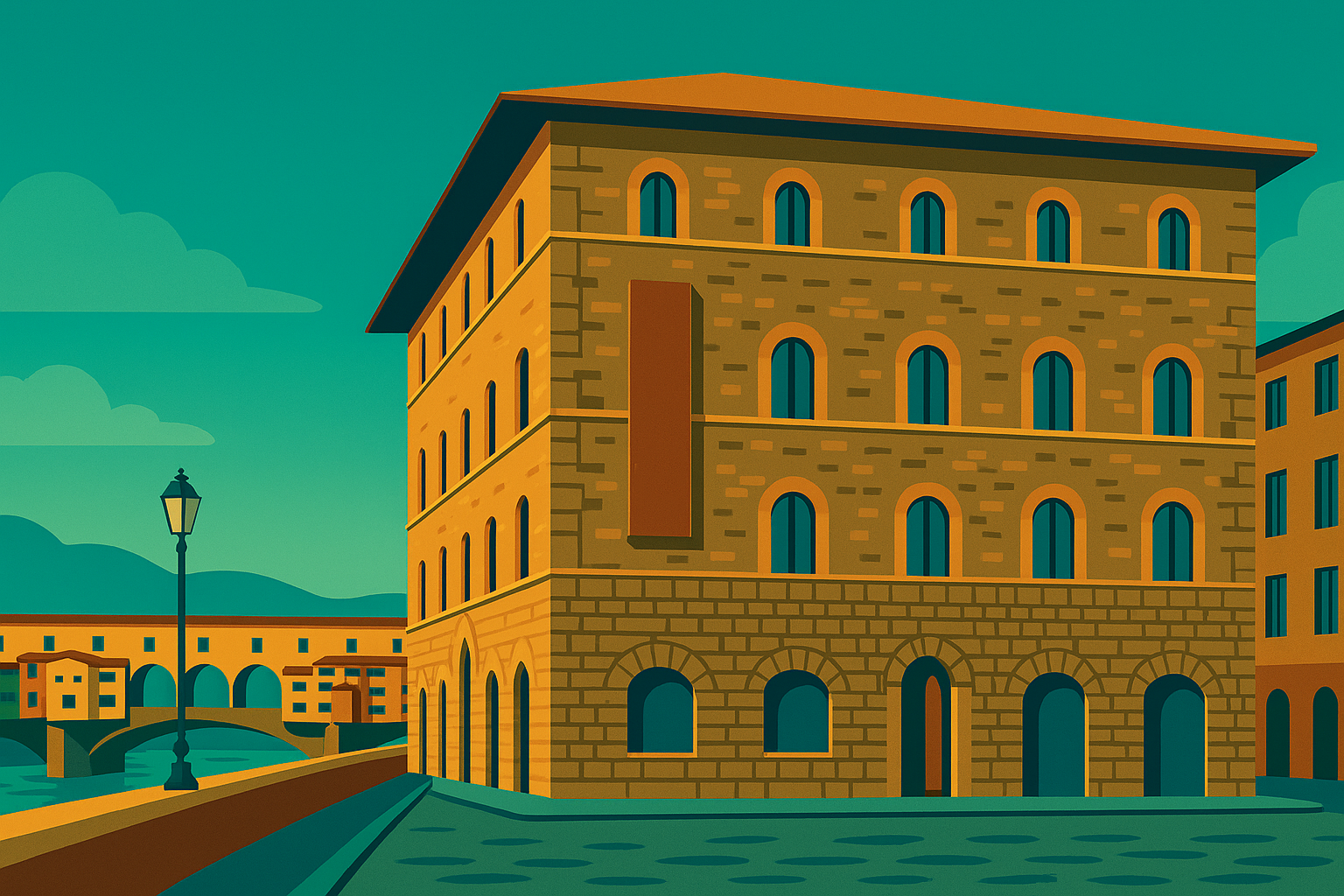
Museo Galileo
Experience the magic of Tuscany
Imagine driving through the Chianti hills, discovering medieval villages, and stopping for an aperitivo at sunset. Renting a car is the secret to experiencing Tuscany with true freedom. Book now for the best choice.
🔍 Choose your car for TuscanyThe Other Renaissance: Inside the Florentine Museum Where Science Changed the World
In Florence, art is gravity. It pulls you into the orbit of the Uffizi Gallery and the Accademia, holds you captive in frescoed chapels, and can leave you wonderfully, totally exhausted—a phenomenon so common it has a name, Stendhal Syndrome. But step out of the Uffizi’s exit, just a few feet away on the Piazza dei Giudici, and you will find an austere medieval palace that offers the perfect antidote.
This is the Museo Galileo. It is not a gallery of art, but a vault of ideas.
Housed in the ancient Palazzo Castellani, this museum is the intellectual engine room of the Renaissance, containing the very tools that dismantled one worldview and built another. While Michelangelo was sculpting David, other geniuses were crafting magnificent globes and astrolabes to map the heavens. This collection is where the abstract theories of the Scientific Revolution become tangible, a place where you can stand face-to-face with the actual instruments that changed humanity’s place in the cosmos.
This is Florence’s great hidden narrative—a story of ambitious patrons, secret scientific societies, and the birth of the modern world, told through objects of breathtaking beauty and ingenuity.
Why Visit? A Sanctuary for the Courage to Question
Unlike the crowded, echoing halls of its famous neighbors, the Museo Galileo is quiet, contemplative, and academic. The prevailing sound is one of respectful murmurs and the gentle whirring of interactive displays. The atmosphere invites you to slow down and think, not just observe. It’s a place to recharge your intellectual batteries after the sensory overload of the city’s art galleries.
But the museum’s most arresting display is not a machine; it is a relic. In a small, spotlit glass vessel, displayed with the reverence of a holy artifact, is the middle finger of Galileo’s right hand.
This is not just a macabre curiosity; it is the museum’s symbolic heart, a deliberate act of “secular canonization.” When Galileo died in 1642, under house arrest for heresy, he was buried almost in secret in a small, unmarked spot in the Basilica di Santa Croce. It took nearly a century, until 1737, for Florence to defy the Church and move his body to the magnificent monumental tomb where it lies today.
During that transfer, admirers and disciples took several of his fingers, a tooth, and a vertebra, preserving them as relics. This act, mirroring the medieval Catholic tradition of venerating saints, was a profound statement of the Enlightenment. It was the “canonization” of a “martyr of science.” The very finger that pointed the telescope at the heavens, revealing an inconvenient truth, is now an object of veneration. The museum, therefore, is more than a collection; it is a sanctuary dedicated to the process of discovery and the courage to question.
The Story of the Collection: Power, Prestige, and Public Education
The breathtaking collection of over 1,000 instruments exists for one reason: Florence’s two most powerful ruling dynasties, the Medici and the Lorraine, were obsessed with science as a tool of power, prestige, and public policy. The museum’s two floors perfectly capture this 500-year story, and as you walk through them, you are physically experiencing the evolution of the scientific method itself.
The Medici Era: Science as Prestige
The collection’s origin traces to Cosimo I de’ Medici in the 16th century. For the Medici, science was power. They began collecting the world’s finest scientific instruments—intricate astrolabes, enormous terrestrial globes, and precise mathematical tools—as symbols of their intellectual and cultural dominance. This was a statement: Medici power was not just financial or artistic, but cosmological. These treasures were initially housed in the Palazzo Vecchio’s “Sala delle Carte” (Map Room) and later in the Uffizi. The Medici were also the patrons of Galileo, and their protection (which ultimately failed him) is why his most important instruments remain in Florence today.
The Accademia del Cimento: Science as Experiment
A crucial interlude, born from Galileo’s legacy, was the Accademia del Cimento (Academy of Experiment). Active from 1657 to 1667 and protected by Cardinal Leopoldo de’ Medici, this was one of Europe’s first scientific societies dedicated purely to experimentation. Meeting in the Palazzo Pitti, Galileo’s pupils conducted systematic experiments in thermometry, barometry, and pneumatics. Many of their original, beautifully crafted, and strangely elegant glass thermometers—early attempts to quantify the world—are on display.
The Lorraine Dynasty: Science as Education
When the Medici line died out, the Habsburg-Lorraine dynasty took control of Tuscany in the 18th century. Grand Duke Peter Leopold, a true Enlightenment ruler, transformed the collection’s purpose. He founded the first public museum of physics and natural history (the Reale Museo di Fisica e Storia Naturale, or “La Specola”) in 1775, moving the instruments there for all to see. Leopold also added new didactic instruments: large, ornate machines to demonstrate electrostatic principles, apparatuses to prove the laws of physics, and even a collection of startlingly realistic obstetrical wax models for medical training.
The collection was finally consolidated in its current home in 1930. In 2010, it was renamed the “Museo Galileo” to celebrate the 400th anniversary of his groundbreaking publication, Sidereus Nuncius (The Starry Messenger).
A Walk Through the Collections: From the Cosmos to the Classroom
The museum’s 18 exhibition rooms are a journey through time, with the two floors representing the two great dynasties and their distinct approaches to science.
First Floor: The Medici Collection
This is the realm of Renaissance astronomy, cartography, and mathematics. The rooms are filled with objects that are as much works of art as they are scientific tools, reflecting the Medici desire to possess and display knowledge.
- Highlight 1: Santucci’s Armillary Sphere. You cannot miss this magnificent, room-filling armillary sphere. Built by Antonio Santucci, it is an incredibly intricate and beautiful model of the pre-Copernican (Ptolemaic) universe, with the Earth at its center. Its gilded wooden rings represent the celestial spheres, a stunning visualization of an entire worldview that was about to be shattered.
- Highlight 2: The Galileo Rooms. The heart of the museum. Here, you will find Galileo’s personal artifacts. Stand before his two surviving telescopes, humble instruments of wood and leather that forever changed our view of the heavens. See the framed objective lens from the telescope he used to discover Jupiter’s moons (it was cracked by accident after his death), his geometric and military compass, and, of course, the famous “secular relic” of his middle finger.
Second Floor: The Lorraine Collection
The atmosphere shifts from passive observation to active experimentation. The instruments here were designed not just to be owned, but to be used—to demonstrate, to teach, and to prove.
- Highlight 3: Machines for Physics. These rooms are filled with stunning, ornate electrostatic machines, Leyden jars, and vacuum pumps. Looking like something from a classic science-fiction film, these beautiful devices of brass, glass, and velvet were used in Enlightenment-era parlors and labs to demonstrate the new laws of physics to an astonished public.
- Highlight 4: Medical & Chemical Collections. This section includes the 18th-century obstetrical wax models from the Santa Maria Nuova Hospital and Grand Duke Peter Leopold’s personal chemistry cabinet, showing the Enlightenment’s push to apply science to medicine and industry.
- Highlight 5: Interactive Area. The itinerary ends with a modern, hands-on section where you can use interactive exhibits to understand the principles behind the historical instruments—like learning to tell time with an astrolabe or understanding the mechanics of a lens.
Planning Your Visit: Hours, Tickets, and Insider Strategy
Planning a visit to the Museo Galileo is simple, but there is one critical detail to remember: the early Tuesday closing.
The museum is open daily from 9:30 a.m. to 6:00 p.m. except for Tuesdays, when it closes early at 1:00 p.m. The ticket office always closes 30 minutes before the museum, so on Tuesdays, you must arrive by 12:30 p.m. The museum is closed on January 1 and December 25.
Admission for a full-price ticket is €13.00. Reduced tickets are available, and the museum is included in the popular Firenze Card circuit. A small discount is also offered if you present a ticket from the Basilica di Santa Croce from the same year.
| Day | Opening Hours | Full Price | Key Detail |
|---|---|---|---|
| Monday | 9:30 – 18:00 | €13.00 | Normal Hours |
| Tuesday | 9:30 – 13:00 | €13.00 | Early Closing |
| Wed–Sun | 9:30 – 18:00 | €13.00 | Normal Hours |
| Closures | Jan 1, Dec 25 | N/A | Closed all day |
The museum’s own FAQ suggests an average visit lasts 1 to 2 hours. This short duration is not a weakness; it’s a strategic asset. A 4-hour visit to the Uffizi is culturally enriching but physically and mentally exhausting. The Museo Galileo, being right next door and rarely crowded, is the perfect “palate cleanser.”
Book a morning Uffizi slot, then use the Museo Galileo as a quiet, fascinating, and refreshing stop in the afternoon, breaking up the day and preventing “art fatigue.”
The App and Earbud Strategy: Your Essential Key
Here is the single most important piece of practical advice for visiting the Museo Galileo: the entire interpretive layer of the museum is digital. There is very little physical signage or text in the galleries.
The museum offers a free official app for smartphones and tablets, and free WiFi is available to download it on-site. This app provides all the audio commentary, text descriptions, and videos for the instruments on display. A visitor without a smartphone or, crucially, their own earbuds, will miss the entire story.
Download the app before you go, arrive with a fully charged phone, and bring your favorite earbuds. This simple preparation will transform a potentially confusing visit into a rich, seamless, and fascinating experience.
How to Get There
The Museo Galileo is located in the absolute heart of Florence’s pedestrian-only historic center, on the bank of the Arno River. Driving a personal car here is not an option.
- On Foot (The Best Method): Walking is the easiest and most enjoyable way to arrive. The museum is impossible to miss. It is a one-minute walk from the Uffizi Gallery, less than a three-minute walk from the Ponte Vecchio, and a pleasant 8-10 minute walk south from the Duomo.
- From the Train Station (Santa Maria Novella): If you are arriving at Florence’s main train station, it is a scenic 15- to 20-minute walk through the city center. For those with limited mobility, the best option is to take one of the small electric buses operated by Autolinee Toscane. Lines C1 or C4 are the most direct. The key stop to get off at is “Galleria Degli Uffizi,” which is just steps from the museum’s entrance. Remember to buy your bus ticket before boarding from a tabacchi (tobacco shop) or newsstand.
- By Car or Taxi (Discouraged): The museum is deep inside the ZTL (Restricted Traffic Zone). Personal cars are prohibited. A taxi can drop you off nearby, but walking is invariably the simplest choice.
Facilities and Accessibility
The Museo Galileo is modern, well-equipped, and a model of accessibility in a city of ancient buildings.
- Accessibility: The museum is fully accessible to visitors with motor disabilities. However, there is a crucial instruction: the main entrance on Piazza dei Giudici has steps. The accessible, barrier-free entrance is at a different address: Lungarno Anna Maria Luisa de’ Medici n. 2. Visitors must use the intercom at this entrance to request assistance. Inside, elevators and wheelchair lifts provide access to all floors. Admission is free for visitors with disabilities and one companion.
- Visitor Amenities: Free lockers are available at the entrance. A high-quality, specialized bookshop is located on the ground floor, and a baby changing table is available in one of the restrooms on the second floor.
- Note on Children: The museum officially notes that it is a history of science museum, not a “science center.” The historical approach may be difficult for children under 8 to appreciate without booking one of the museum’s excellent guided tours.
The “Galileo Trail”: A Complete Florentine Story
The museum is the epicenter of a walkable, thematic “Galileo Trail” that tells the complete story of the scientist’s life and legacy in Florence.
- Stop 1: The Museo Galileo (The Mind and the Work). Start your journey here. This is where you connect with his genius, see the tools he built, and ponder the relics he left behind.
- Stop 2: The Uffizi Courtyard (The Public Man and the Fame). As you leave the museum, walk next door into the magnificent Piazzale degli Uffizi. Along the portico, stop and find the imposing marble statue of Galileo Galilei. It places him in the pantheon of great Florentines, sanctioned by the very Medici patrons who funded his research.
- Stop 3: Basilica di Santa Croce (The Body and the Legacy). A beautiful 5- to 10-minute walk east is the Basilica di Santa Croce, the “Temple of Italian Glories.” Inside, along the north aisle, you will find Galileo’s imposing, monumental tomb.
By visiting these three sites in order, you are no longer just “checking boxes.” You are participating in a complete narrative: the Work, the Fame, and the Legacy. It transforms a day of sightseeing into a compelling story.
Best Photo Spots
Non-flash photography for personal use is permitted, but tripods and selfie sticks are not allowed.
- The “Hero” Shot: The magnificent, room-filling Santucci’s Armillary Sphere. Its intricate golden rings and immense scale make it the museum’s most photogenic object.
- The “Sci-Fi” Shot: The collection of Lorraine electrostatic machines on the second floor. With their large glass discs and brass conductors, they look like props from a vintage science-fiction film.
- The “Context” Shot: The museum’s windows offer stunning, crowd-free views looking directly out over the River Arno and the eastern facade of the Uffizi.
- The “Iconic” Shot: A close-up of Galileo’s two original, leather-and-wood-bound telescopes. You are looking at the instruments that changed everything.
Final Thoughts
Florence is a city that can overwhelm you with art. It is easy to become numb to beauty, to have your eyes glaze over at the prospect of another Madonna and Child. The Museo Galileo is the perfect antidote.
When you feel “arted-out” from the Uffizi, escape here. This is not a passive experience; it’s an intellectual one. In 90 minutes, you will trade painted divinity for the tangible tools of human genius, and you will leave with a far deeper understanding of the Renaissance—not just as a period of art, but as the moment we, as a species, truly discovered where we are in the universe. It is the “other half” of the Renaissance story, and it is essential.