
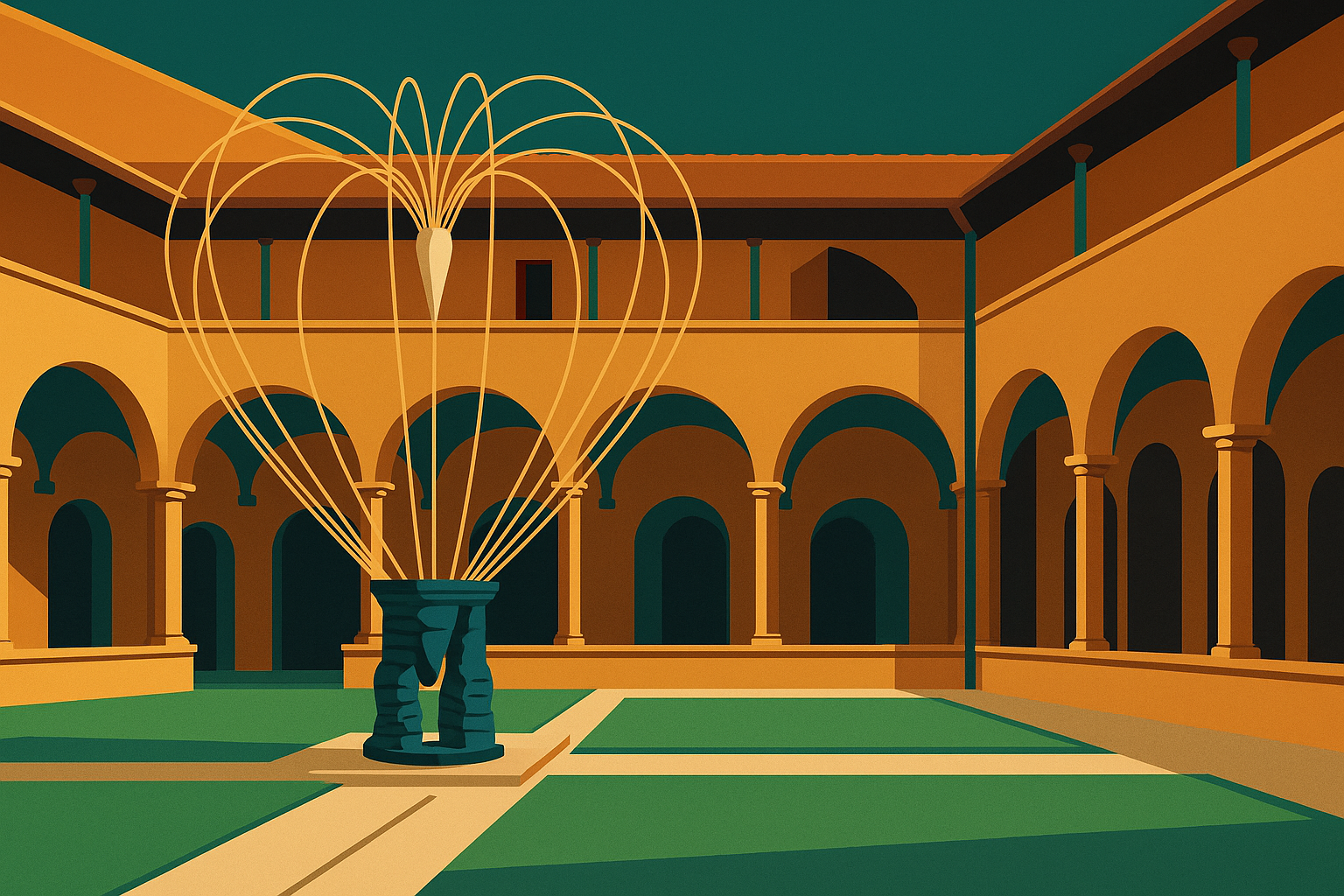
Museo Novecento
Experience the magic of Tuscany
Imagine driving through the Chianti hills, discovering medieval villages, and stopping for an aperitivo at sunset. Renting a car is the secret to experiencing Tuscany with true freedom. Book now for the best choice.
🔍 Choose your car for TuscanyThe Other Florence: Inside the Museo Novecento’s Modern Soul
In Florence, the past is not just present; it is pervasive. The city is a monument to the Renaissance, a living museum where the ghosts of Michelangelo, Brunelleschi, and Botticelli walk every piazza and patrol every loggia. It is a cultural weight so profound that it can feel all-consuming. For the traveler saturated with High Renaissance masterpieces, the question inevitably arises: “Is this all there is?”
The answer is a definitive “no,” and it is found in the sun-drenched, quiet expanse of Piazza Santa Maria Novella.
Housed within the ancient Spedale delle Leopoldine, a 13th-century hospital, the Museo Novecento is Florence’s deliberate and eloquent counter-narrative. It is the city’s 20th-century artistic soul, a place that proves Florence’s creative genius did not end with the fall of the Medici. This is not just a collection of modern art; it is a meticulously crafted argument for the city’s continuous cultural vitality. Visiting the Novecento is not a rejection of the Renaissance. It is the essential, missing chapter that follows it. It offers precisely what so many visitors crave but rarely find: a different perspective, a moment of quiet contemplation, and a bridge from the city’s monumental past to its living, breathing present.
An Atmosphere of Healing and Light
To step into the Museo Novecento is to experience an immediate atmospheric shift. The crowds, the noise, and the visual saturation of the Uffizi or the Accademia dissolve. The museum’s dominant sensation is one of light, air, and profound quiet. This is by design, and it begins with the building itself.
The museum is housed in the former Ospedale di San Paolo, a complex founded in the 13th century to serve as a hospital and shelter for pilgrims. This origin is not a historical footnote; it is the museum’s symbolic core. For centuries, this was a place defined by its social vocation of care and healing, run by all-female communities. Today, that mission of care has been reborn. The structure that once healed the body now serves to heal civic memory, preserving the 20th-century art that was, for decades, forgotten by its own city.
Unlike the sterile “white cube” of a typical modern art gallery, the art here is framed by ancient pietra serena stone, vaulted ceilings, and the magnificent proportions of a 15th-century cloister. The result is a contemplative, almost spiritual environment, where each painting and sculpture is given the space to be seen, and you are given the quiet to truly see it.
A Museum Born from Disaster
The museum’s collection was not acquired over decades; it was born from a catastrophe. The very existence of the Museo Novecento is the fulfillment of a civic promise, one that took nearly half a century to keep.
On November 4, 1966, the Arno River burst its banks, burying Florence in an apocalyptic deluge of mud, sewage, and oil. Thousands of priceless artworks and manuscripts were destroyed. In the wake of the disaster, the renowned art historian Carlo Ludovico Ragghianti made a global appeal, “Artisti per Firenze” (Artists for Florence). He asked modern artists from around the world to donate their work to replace what was lost, with the city’s promise that their art would form a new, “international museum of contemporary art”.
The response was overwhelming. Artists like Lucio Fontana, Renato Guttuso, and many others donated their works enthusiastically. But the promise was broken. For 48 long years, this incredible collection—a testament to global solidarity—was “locked up in Florence’s storage facilities,” unseen and uncelebrated. The museum’s opening on June 24, 2014, was therefore a moment of profound civic importance. It was Florence finally making good on its debt.
The museum’s heart is formed by two critical donations from that era. The first is the Alberto Della Ragione Collection. Della Ragione, an engineer, was so moved by the 1966 flood that he donated his entire private collection of 241 works to the city. This “textbook” collection forms the core of the museum’s permanent exhibit, a stunning survey of Italian modernism. The second is the Legacy of Ottone Rosai, a donation from the artist’s widow. Rosai was a quintessential Florentine artist of the 20th century, and his bequest anchors the national collection with a powerful, local voice.
A Dialogue Between Centuries: Architecture and Art
The brilliance of the Museo Novecento lies in the dialogue between its contents (20th-century art) and its container (a 13th-century hospital). The building’s Renaissance loggia and cloister were designed by Michelozzo, the famed Medici architect, who was directly inspired by Brunelleschi’s Ospedale degli Innocenti.
When the 21st-century studio Avatar Architettura was commissioned to design the museum’s interior, they were given a critical mandate: the entire intervention had to be “reversible”. They could not drill into, demolish, or permanently alter Michelozzo’s masterpiece. Their solution is a work of genius. The modern museum is essentially a “guest” within the historic “host” building. New walls are cantilevered, and “carpets” of dark steel plate flooring are laid down to create a modern path, floating respectfully over the original floors. This forced dialogue—a modern layer held gently within a Renaissance frame—is a physical metaphor for the museum’s entire mission.
The most unique architectural features are the “Grafts”. The museum’s most important spaces—the magnificent loggia and cloister—are deliberately left empty of the permanent collection. Instead, they are used as a stage for rotating, site-specific contemporary art commissions. Artists are invited to create works that “graft” onto the 15th-century architecture, creating a startling and beautiful conversation between past and present.
Insider Tip: Before you even see the main collection, spend time in the ground-floor cloister. This is where you will understand the museum’s entire concept. Observe how contemporary sculptures (the “Grafts”) are positioned to interact with Michelozzo’s columns and arches. It’s the 21st century speaking directly to the 15th.
Upstairs, the permanent Alberto Della Ragione Collection is displayed in a bold, thematic layout. Instead of a simple timeline, works are grouped by classical genres: “Landscapes,” “Still Life,” “Portraits”. This choice forces you to compare, for example, a Metaphysical still life by Giorgio Morandi with a Social Realist one by Renato Guttuso, showing how modernists grappled with the same subjects as the Renaissance masters. Do not miss the masterpieces by Giorgio De Chirico, the Futurist works of Gino Severini, and the powerful sculptures of Arturo Martini and Marino Marini. Finally, the itinerary concludes on the rooftop in the rooms dedicated to the Florentine painter Ottone Rosai, bringing the story of modern art back home to the city itself.
A crucial note for travelers: Do not confuse this museum with the Museo del Novecento in Milan. Widespread digital confusion, even on major travel blogs, mixes photos and features. You will not find Milan’s famous spiral ramp or its iconic view of the Duomo here. What you will find is something uniquely Florentine: an intimate, historic, and profound dialogue with the past.
Planning Your Visit: Practical Information
Opening Hours, Prices, and Ideal Duration
The museum’s schedule is a strategic advantage for travelers. It is open six days a week, from 11:00 am to 8:00 pm. The ticket office closes one hour before closing, at 7:00 pm.
Crucially, the museum is closed on Thursdays. This is a vital piece of information, as most visitors to Florence are conditioned to expect Monday closures for major museums.
- Full Admission: €9.50
- Reduced Admission: €4.50 (for 18-25 year-olds and university students)
- Free: Visitors under 18, disabled visitors and their carers, and ICOM members.
Admissions are limited, and the museum’s official site “strongly recommended” booking in advance, which can be done online. Plan for 90 to 120 minutes to comfortably explore the permanent collection and the temporary installations in the cloister. The museum’s manageable size is one of its greatest strengths; it is an enriching experience, not an exhausting marathon.
How to Get There
The Museo Novecento is one of the most easily accessible cultural sites in Florence. It is located in the Piazza Santa Maria Novella, directly facing the famous basilica.
- By Train: The museum is a simple and sign-posted 5-minute walk from the city’s main railway station, Santa Maria Novella (SMN). Upon exiting the station, the piazza is practically in front of you.
- By Tram: The T2 Vespucci tram line, which connects the airport to the city center, stops at “Unità,” just a 2-minute walk from the piazza.
- By Bus: The area is a major hub for city buses. Lines C2, 6, 11, 14, 17, and 23 all have stops at or near the station and piazza.
- By Car: Driving is strongly discouraged. The museum is deep within the historic center’s Limited Traffic Zone (ZTL), which is protected by camera gates. Non-resident access is restricted and subject to heavy fines. The closest (and most expensive) parking is the underground garage at the Santa Maria Novella station.
Facilities and Practical Services
The museum is exceptionally well-equipped and demonstrates a high standard of visitor care, fitting for its origins as a hospital. The entire complex is fully accessible for visitors with mobility impairments, served by elevators and ramps. On the ground floor, you will find a well-curated bookshop.
Perhaps the museum’s best-kept secret is its cafe. The Cortese Caffè 900 is not a typical museum cafeteria but a high-end gourmet, raw-food pastry shop and restaurant run by one of Italy’s most important raw-food pastry chefs. This makes the museum a destination in its own right for a refined coffee or light lunch, elevating the entire visitor experience.
The Perfect Time for a Modernist Aperitivo
The museum’s generous evening hours are the key to a perfect visit.
The ideal time to go is in the late afternoon, between 5:00 pm and 6:30 pm. By this hour, the day-tripping crowds have thinned, and the piazza outside grows quieter.
You can explore the galleries in relative peace as the warm, late-afternoon light fills the cloister. This timing allows you to use the Museo Novecento as the perfect cultural “aperitivo.” You can finish your visit around 7:00 pm and step out into the piazza just as the evening passeggiata (stroll) begins, or head to the museum’s own gourmet cafe for a drink.
Beyond the Novecento: Complementary Visits
The museum’s location in Piazza Santa Maria Novella makes it the perfect anchor for a day spent exploring the “other” Florence.
- Basilica of Santa Maria Novella: This is the most essential complementary visit, located just steps across the piazza. We recommend seeing the Basilica first. Immerse yourself in Masaccio’s groundbreaking Trinity, Ghirlandaio’s fresco cycles, and Giotto’s Crucifix. Then, cross the square to the Museo Novecento to see the 20th-century response. The juxtaposition is the entire point.
- Palazzo Strozzi: A 10-minute walk away, this is Florence’s premier Kunsthalle, or non-collecting exhibition space. It hosts massive, “blockbuster” temporary exhibitions of international modern and contemporary art, making it the perfect, high-energy complement to the Novecento’s permanent Italian collection.
- Museo Marino Marini: Housed in an evocative former church, this museum is a monographic deep dive into one of the 20th century’s most important sculptors, whose work is also featured in the Novecento.
- Gallery of Modern Art (Palazzo Pitti): If the Novecento is the 20th-century story, this is the “prequel.” Located across the river in the Pitti Palace, its collection focuses on the 18th and 19th centuries, particularly the vital Tuscan Macchiaioli movement.
Capturing the Museum’s Soul: Best Photo Spots
Forget the (non-existent) Duomo view you may have seen online. The real photographic beauty of the Museo Novecento is far more subtle and profound.
- The Michelozzo Cloister: This is the museum’s heart. The best shot is from a corner, capturing the rhythmic repetition of the 15th-century arches and columns, often with a contemporary “Graft” sculpture in the foreground.
- The External Loggia: The grand, open-air arches of the building’s facade frame the Piazza Santa Maria Novella and the Basilica’s facade perfectly. It’s an ideal spot to capture the museum in its urban context.
- The Interior Dialogue: Seek out the spots inside where the modern intervention meets the ancient structure. The most compelling images capture the contrast between Avatar Architettura’s dark steel floors and the original, sand-colored pietra serena stone.
The Essential Continuation of Florence’s Story
Do not visit the Museo Novecento expecting a miniature Uffizi. You will be disappointed. And do not go expecting the grand, sweeping vistas of its Milanese namesake.
Go, instead, to find the answer to a question. Go to discover what happened after the Renaissance. This museum is not an alternative to Florence’s past; it is the thoughtful, modern, and essential continuation of its story. Here, in a 13th-century building dedicated to healing, you will find a 20th-century collection born from disaster and redeemed by a civic promise. You will find a space that asks you to be quiet, to look closely, and to understand that the creative spirit of Florence never truly went dormant.