
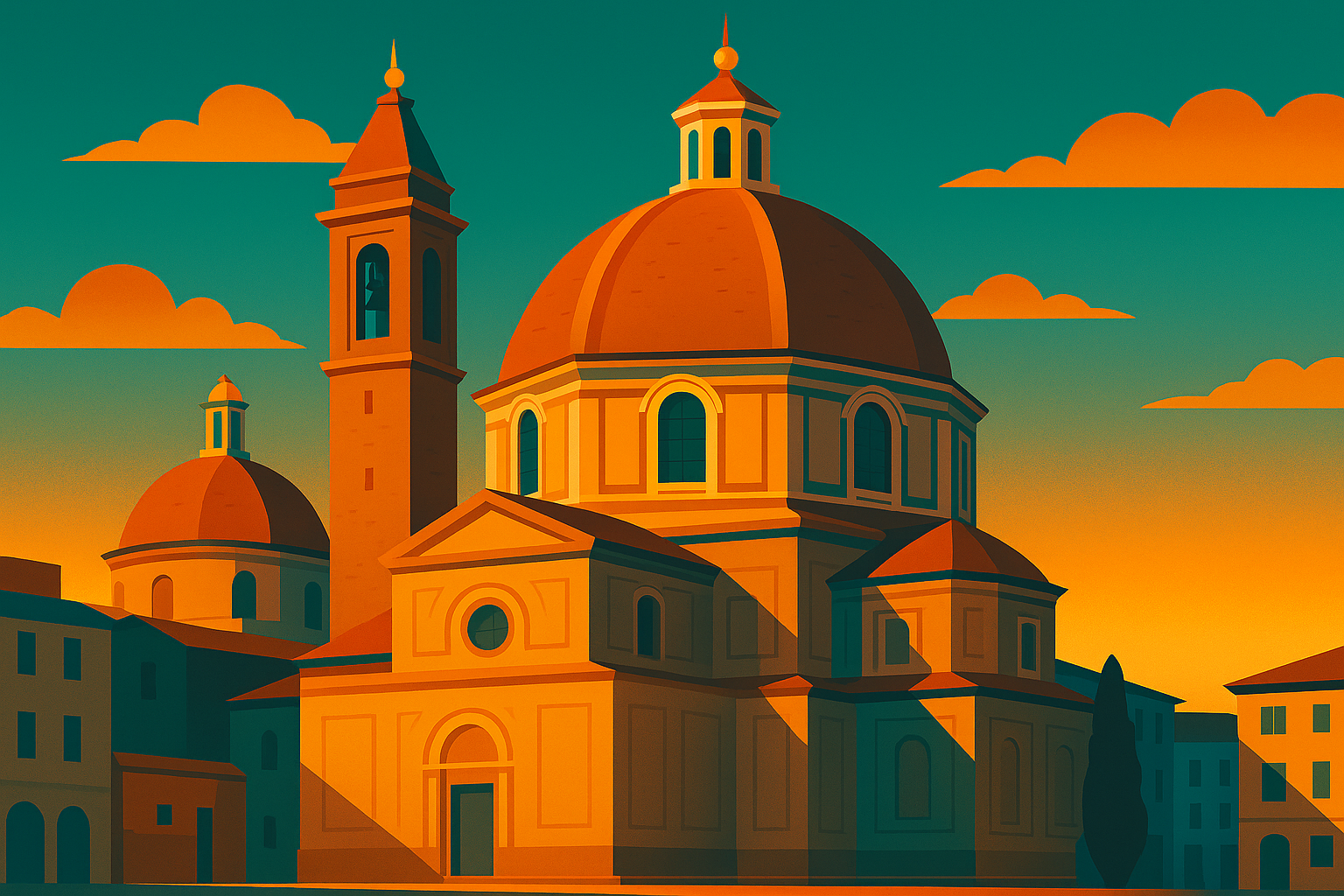
Museum of the Medici Chapels
Experience the magic of Tuscany
Imagine driving through the Chianti hills, discovering medieval villages, and stopping for an aperitivo at sunset. Renting a car is the secret to experiencing Tuscany with true freedom. Book now for the best choice.
🔍 Choose your car for TuscanyThe Medici’s Final Shadow: A Guide to the Power, Pomp, and Genius of the Medici Chapels
Stepping into the Piazza di Madonna degli Aldobrandini is a sensory jolt. You are thrust into the vibrant, sun-baked chaos of the San Lorenzo Market. Vendors shout over piles of leather goods, the air is thick with the competing aromas of curing meats and fragrant bistecca from the Mercato Centrale, and the square thrums with the electric energy of modern Florentine life.
Then, you see it: an unassuming doorway, easily missed, tucked into the back of the massive, unfinished facade of the Basilica di San Lorenzo. Step through it. The noise of the city is instantly vacuumed away. The sunlight vanishes, replaced by the cool, echoing silence of stone. You have just entered the Cappelle Medicee, the Medici Chapels, and the effect is that of stepping from the world of the living into the realm of the dead.
This complex is not merely a museum or a resting place. It is the definitive, multi-generational statement of the Medici dynasty. It is a physical manifestation of their journey from shrewd bankers to Grand Dukes of Tuscany, a 300-year legacy rendered in marble, porphyry, and genius.
A visit here is best understood as a “three-act play” on power and eternity. You begin in the Crypt, the somber, literal resting place of the dynasty. You ascend into the overwhelming Chapel of the Princes, a theater of bombastic wealth and dynastic propaganda. And you conclude in the New Sacristy, a sublime, intellectual meditation on life, death, and time, sculpted by the hand of Michelangelo. Now, with the recent opening of the Stanza Segreta—a hidden room where Michelangelo himself hid from his patrons—a new, intimate layer of human drama has been added to this profound journey.
A Three-Act Play on Power and Eternity
To truly appreciate the Medici Chapels, you must pay attention to the calculated shift in atmosphere between its three main spaces. Each is designed to elicit a specific emotional response, guiding you through the Medici’s conception of life, death, and legacy.
Act I: The Crypt – The Weight of Finality
Your visit begins underground. The atmosphere in the Crypt is cool, subterranean, and austere. This is the place of literal death, the functional burial chamber where the bodies of the Medici Grand Dukes, from Cosimo I to the last of the line, Gian Gastone, are interred. The air is still and heavy with the weight of finality. It is the sober reality upon which all the splendor above is built, a grounding and somber start to the journey.
Act II: The Chapel of the Princes – A Theatre of Dynastic Ambition
As you climb a staircase and emerge into the Chapel of the Princes, the transition is a deliberate shock. You are thrust into a cavernous, octagonal space, an explosion of dark, polished color. The atmosphere here is intentionally oppressive and dazzling. Every surface gleams with polychrome marble and semi-precious stones, from the floor to the soaring dome. This is not a space for quiet prayer; it is a declaration of power. The air feels heavy with porphyry, granite, and the incalculable cost of it all. It is the Medici’s earthly ambition made manifest, a room designed to awe and intimidate.
Act III: The New Sacristy – A Dialogue with Genius
The final act is the resolution. You pass through a simple corridor into a space of absolute, breathtaking contrast. Michelangelo designed the New Sacristy as a perfect cube of ethereal, whitewashed walls and serene, gray pietra serena stone. The light is different here—focused, clear, and intellectual, falling from a high lantern. The atmosphere is no longer about dynastic wealth, but about the human soul. It is contemplative, hushed, and deeply, unforgettably moving. Here, you leave the world of propaganda and enter the mind of a genius.
The Story Behind the Stone: Betrayal, Irony, and Genius
The story of the chapels begins around 1520, driven by the ambition of two of the family’s most powerful figures: Pope Leo X (Giovanni de’ Medici) and his cousin, Cardinal Giulio de’ Medici, who would soon become Pope Clement VII. They envisioned a grand mausoleum to forever cement their family’s legacy, but the project would become defined by irony and intense human drama.
A central, poignant irony lies at the heart of the complex. The sublime New Sacristy, designed by Michelangelo, was originally intended to house the tombs of Florence’s two greatest leaders: Lorenzo the Magnificent and his brother, Giuliano de’ Medici. However, political shifts and the untimely deaths of two “lesser” family members changed the plan. The magnificent, allegorical tombs that now dominate the room were created not for the “Magnificents,” but for two minor, short-lived relatives: Lorenzo, Duke of Urbino, and Giuliano, Duke of Nemours. The two men who truly forged the Medici legend, Lorenzo and Giuliano, lie in a simple, unmarked sarcophagus beneath Michelangelo’s Medici Madonna on the third wall.
This project also contains a powerful human story. Michelangelo had a complex, lifelong relationship with the Medici, who had been his first patrons when he was a teenager in Lorenzo the Magnificent’s sculpture garden. But Michelangelo was a fervent republican at heart. In 1527, when the Florentine people expelled the Medici, he betrayed his patrons and accepted the role of “Governor of Fortifications” for the new Republic, designing its defenses against the Medici army.
When the Medici—backed by their Pope, Clement VII—retook the city in 1530, Michelangelo was a marked man. He vanished, seeking refuge for weeks in a tiny, secret room, the Stanza Segreta, beneath the very chapel he was building for them. It was in this claustrophobic hiding place that he sketched on the walls, ghostly charcoal figures that are now seen as the first seeds of his later masterpieces. This context transforms the “hidden room” from a tourist curiosity into a profound document of fear, betrayal, and inextinguishable genius.
An Architectural Masterpiece in Three Movements
The complex is a unified monument composed of three distinct parts, each with its own purpose and architectural language.
The Crypt: The Foundation of a Dynasty
The functional starting point, the Crypt is a large, vaulted space that serves as the actual burial chamber for 49 members of the Medici dynasty. While simpler than the rooms above, it sets the stage. It is the sober reality of death that anchors the extravagant theater of remembrance. It is here you will find the tombs of nearly every Grand Duke and their families.
The Chapel of the Princes: The Art of Power
This is the monument to dynastic power, a breathtaking display of wealth. Architecturally, it is a massive octagonal hall, 28 meters (92 ft) wide, crowned by a dome that reaches 59 meters (194 ft), making it the second-largest in the Florence skyline, designed to dominate the San Lorenzo neighborhood.
The “dazzling” interior is its most important feature. It is not frescoed, but covered entirely in commesso di pietre dure, or Florentine mosaic. This is an impossibly intricate and expensive art form of inlaying precisely cut semi-precious stones—jasper, lapis lazuli, agate, mother-of-pearl, and porphyry—to create images. The project was so vast and time-consuming that in 1588, Grand Duke Ferdinando I founded the Opificio delle Pietre Dure, a state-run workshop, for the sole purpose of completing it. This workshop exists today as one of the world’s most important conservation institutes. In essence, this chapel created its own art form.
Another telling detail: the six massive sarcophagi that line the walls, dedicated to the Grand Dukes, are cenotaphs. They are all empty. The bodies they supposedly honor are all resting in the simple Crypt below. This room is not a tomb; it is pure, magnificent propaganda.
The New Sacristy: Michelangelo’s Meditation in Marble
This is the monument to genius. As Michelangelo’s first major, unified architectural commission, he deliberately designed it to “compete” with Brunelleschi’s Old Sacristy next door in the main basilica. He used Brunelleschi’s “language”—serene gray pietra serena stone against white plaster—but made it more dynamic, tense, and muscular.
But the architecture is a frame for the sculpture, a profound Neoplatonic meditation on life and death.
- The Tombs: On the right wall is the tomb of Giuliano, Duke of Nemours (representing the “Active Life”). He is flanked by the dynamic allegories of Day (Giorno) and Night (Notte). Day is a powerful, unfinished figure, struggling to emerge from the marble. Night is a picture of exhausted, troubled sleep. On the left wall is the tomb of Lorenzo, Duke of Urbino (representing the “Contemplative Life”). He is flanked by the more languid figures of Dusk (Crepuscolo) and Dawn (Aurora). Dawn awakens not with joy, but with a palpable sense of sorrow and weariness.
- The Symbolism: These four allegories are not just decorative. They are the symbols of Time, which traps, consumes, and destroys all mortal things. They writhe uncomfortably on the sloping lids of the sarcophagi, forever imprisoned by mortality. The two Dukes, however, sit above them, idealized and eternal. They have transcended the prison of Time to contemplate the divine.
- The Third Wall: Their gaze is directed to the third (unfinished) wall, which holds Michelangelo’s tender Medici Madonna and Child. The Madonna is flanked by Saints Cosmas and Damian, the patron saints of the Medici family. This is the focal point of salvation, the spiritual exit from the trap of Time that the entire room describes.
Planning Your Visit: Practical Information
A visit to the Medici Chapels is straightforward, but a little planning goes a long way to ensuring a memorable experience.
Opening Hours and Tickets
The Medici Chapels are open from 8:15 am to 6:50 pm, with the last entry at 6:10 pm.
The most critical piece of planning information is this: the museum is CLOSED on Tuesdays. It is also closed on December 25th and January 1st.
The full admission price is €9.00. A reduced ticket is available for €2.00 for European Union citizens between the ages of 18 and 25.
Do not plan to walk up and buy a ticket, especially between May and October. Always book your ticket in advance online to skip the entire line.
The official online vendor is B-ticket, and the mandatory reservation fee is €3.00. This is, without question, the best €3 you will spend on your trip. For your visit, plan on 60 to 90 minutes. While some guides suggest 45 minutes is enough, this is far too rushed to absorb the emotional power of Michelangelo’s work.
How to Get There
The Medici Chapels are located in the heart of the San Lorenzo district, making them exceptionally easy to reach on foot from anywhere in the historic center.
- From Santa Maria Novella (SMN) Station: The city’s main train station is an easy and well-signposted 8 to 10-minute walk away. Follow the signs for “Mercato Centrale” or “San Lorenzo.”
- From Florence Airport (FLR): The most efficient option is the T2 Vespucci tram line. Take the tram directly from the airport terminal to the “Unità” stop. From there, it is a brief 3 to 5-minute walk.
- By Local Bus: Small electric “bussini” (mini-buses) are useful. Lines C1, C2, and C4 all serve the area, with stops at “Panzani Unità” or “Piazza Di San Lorenzo,” just steps from the museum entrance.
Facilities and Visitor Information
The Medici Chapels are part of the modern Musei del Bargello circuit and are well-equipped.
- Accessibility: The museum has excellent accessibility. The ground floor (Crypt) is accessible via a ramp, an elevator takes visitors to the first floor, and a dedicated platform lift provides access to the New Sacristy, making the entire main circuit accessible to wheelchair users.
- Amenities: Audioguides are available to rent for €6.00 (single) or €10.00 (double). A bookshop and fully accessible restrooms are located along the exit route.
- Restrictions: Large bags, oversized backpacks, and suitcases are not permitted. You will be required to check them at the free on-site lockers. Food and drink are also prohibited.
Insider Tips for the Best Experience
The Best Time to Visit
To experience the New Sacristy as Michelangelo intended—in quiet contemplation—timing is everything. The best possible time to visit is at opening (8:15 am) on a weekday. Wednesdays and Thursdays are typically the quietest, granting you at least an hour of relative peace before major tour groups arrive around 10:00 am. Late afternoons, after 4:00 pm, are also a good option. Avoid weekends and the first Sunday of the month (“Museum Sundays”), when free admission leads to uncomfortable crowds.
The Best Photo Spots (and How to Take Them)
There is often confusion about the photography policy, but the official rule is clear: photography for personal use is allowed. The strict, non-negotiable rules are:
- NO Flash (this is strictly enforced to protect the art).
- NO Tripods or selfie sticks.
- NO Video recording.
For the Chapel of the Princes, the best shot is from the very center of the room. Use a wide-angle lens and aim up to capture the overwhelming scale of the dome. In the New Sacristy, focus on details illuminated by the natural light. Get close to capture the emotional texture of Michelangelo’s sculptures: the weary, unfinished face of Day, the sorrowful turn of Dawn, and the tense form of Night.
The Ultimate Experience: Michelangelo’s Hidden Room
For those who plan ahead, the single most profound experience in Florence is now available: booking a visit to “Michelangelo’s Hidden Room” (Stanza Segreta). This is the tiny, cellar-like room where Michelangelo hid for weeks in 1530, covering the walls in charcoal sketches.
Access is not included in the standard ticket. It is only accessible via a special “combo ticket” that must be booked months in advance, as admissions are strictly limited to small, timed groups. The combo ticket costs €32.00 (€9.00 museum admission + €20.00 hidden room surcharge + €3.00 reservation fee). You must book this only through the official B-ticket website. This is not just a visit to a museum; it is a direct, intimate, and chilling encounter with the mind of a genius at his most vulnerable.
Beyond the Chapels: What to See Nearby
The Medici Chapels are the anchor of a perfect “Medici-themed” day. After your visit, the surrounding neighborhood offers the rest of the story.
- Basilica di San Lorenzo: The adjacent church and official parish of the Medici family. It is a separate ticket and entrance, but essential for understanding the context. It houses masterpieces by Brunelleschi and Donatello.
- Mercato Centrale / San Lorenzo Market: After the somber silence of the tombs, immerse yourself in the chaotic life of Florence. The outdoor market is famous for leather, while the spectacular indoor Mercato Centrale is a world-class food hall—the perfect place for lunch.
- Palazzo Medici Riccardi: A five-minute walk away, this was the primary home of the Medici for a century. This is where Lorenzo the Magnificent hosted a young Michelangelo, completing the narrative circle of the artist and his most important patrons.
- Musei del Bargello: The Medici Chapels are part of this museum group. Your ticket may grant access to the main Museo Nazionale del Bargello—the world’s most important collection of Renaissance sculpture—and Palazzo Davanzati.