
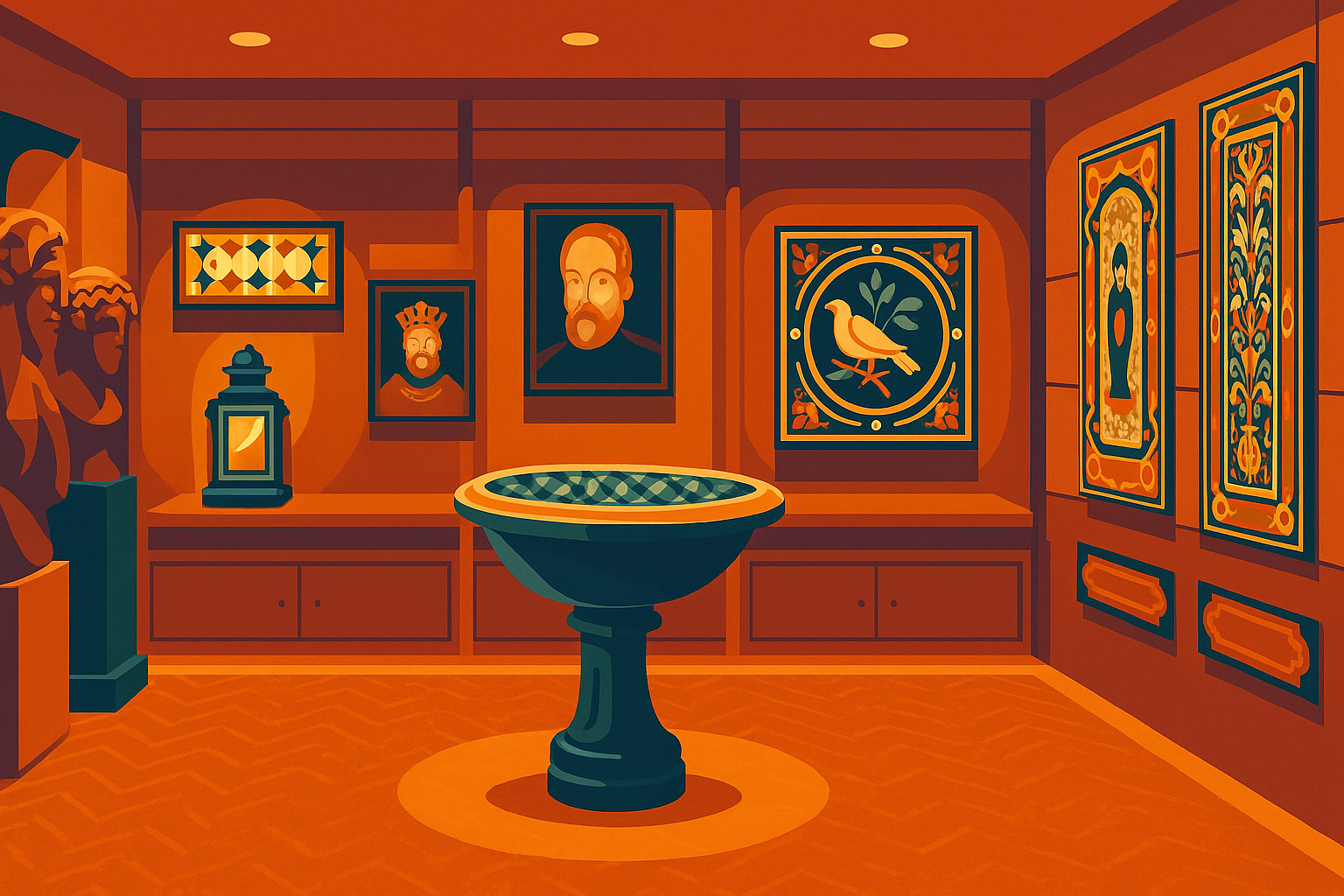
Opificio delle Pietre Dure Museum
Experience the magic of Tuscany
Imagine driving through the Chianti hills, discovering medieval villages, and stopping for an aperitivo at sunset. Renting a car is the secret to experiencing Tuscany with true freedom. Book now for the best choice.
🔍 Choose your car for TuscanyPainting for Eternity: The Medici’s Secret World of the Opificio delle Pietre Dure
In a city of masterpieces locked in a fragile battle with time, Florence holds a secret to eternity. While frescoes fade and marble erodes, the Medici—a dynasty built on the very concepts of permanence and power—sought an art form that could defy decay. Their solution was as brilliant as it was audacious: *pietre dure*, or “hard stones,” a mesmerising technique for creating “paintings of stone” designed to last forever.
This unique Florentine art form is known as commesso fiorentino. It is essential to understand that this is not a mosaic in the traditional sense, which uses small, uniform tiles (*tesserae*). The word *commesso* comes from the Latin for “to join together,” and the technique is a sophisticated evolution of ancient *opus sectile*. Here, artisans used the Earth itself as their palette. They would slice impossibly thin sections of semi-precious stones—lapis lazuli for the sky, Persian jasper for robes, Sienese agate for flesh tones—and cut them to shape with such precision that the seams would vanish. The result was a single, luminous, and virtually indestructible image.
The Museo dell’Opificio delle Pietre Dure is the public face of this grand-ducal obsession. It is the surviving royal workshop, the *Galleria dei Lavori* established by Grand Duke Ferdinando I de’ Medici in 1588. While the Uffizi and Accademia showcase Florence’s monumental public art, this small, scholarly museum offers an intimate look at the obsessive technical genius that powered the Renaissance, transforming geology into genius.
Why Visit? An Antidote to the Crowds
Stepping inside the Opificio is an immediate antidote to the chaos of Florence’s larger museums. The atmosphere is not that of a bustling tourist attraction, but of a quiet, intensely focused library or a master jeweller’s private vault. It is a place for connoisseurs, for those who wish to lean in and look closely. You are surrounded by works of almost supernatural precision, objects that radiate a cool, permanent, and silent beauty.
The symbolism of the art here is twofold. First, there is the clear message of permanence. To create a painting that would not fade or a tabletop that could not be scratched was a powerful metaphor for the Medici’s dynastic ambition. They weren’t just patrons; they were building a legacy as eternal as the stone itself.
Second, and more subtly, the materials are the message. The art of *commesso* was a dazzling demonstration of geopolitical power. The magnificent *campionario* (stone library) on display is a map of 16th and 17th-century Medici global reach. To create these works, the workshop imported Persian lapis lazuli, rare agates from Bohemia, and jaspers from Sicily. This was a deliberate and extravagant statement of international wealth and trade power, proving that the Grand Duke’s influence extended to every corner of the known world, all to bring its most beautiful elements to Florence.
From Medici Ambition to Modern Mastery: A Living History
The history of the Opificio is a tale of two distinct identities: one of Medici creation and one of modern preservation. It was officially founded in 1588 by Grand Duke Ferdinando I de’ Medici, who consolidated the city’s greatest artisans into a single state-run manufactory. This was not merely a workshop; it was an engine of artistic production, vertically integrated to serve the state.
Its first and foremost mission was a project of staggering ambition: the complete, floor-to-ceiling decoration of the Cappella dei Principi (Chapel of the Princes) in the nearby Basilica of San Lorenzo. This monumental mausoleum for the Medici family was to be the Opificio’s magnum opus, a task so vast it would consume the workshop for centuries—the intricate flooring, for example, was only completed in 1962. The museum today contains original designs, test panels, and decorative elements created for this very chapel.
The Opificio’s modern identity was forged in tragedy. When the great flood of 1966 submerged Florence, it devastated the city’s artistic heritage. The technical experts at the Opificio, masters of stone, bronze, and inlay, were called upon to lead a desperate, innovative, and ultimately world-changing restoration effort. This event pivoted the institution’s purpose. The Opificio split into two bodies: the Museo, which preserves the history of the *commesso* technique, and the Istituto, which became one of the most important and advanced art conservation centres in the world. When you visit the museum, you are standing at the origin point of a living, global scientific and artistic authority.
What to See: Unlocking the Secrets of Stone
The workshops moved to their present location on Via Alfani in 1796, but the building you see today is a modern and elegant space, thoughtfully renovated in 1995. The architecture, however, is secondary to the museum’s true unique feature: the mezzanine level.
The Ground Floor: Masterpieces of Impossible Beauty
The ground floor displays the stunning finished works. Here you will find tables, decorative panels, and portraits that defy belief. Look for the remarkable *commesso* panoramic view of the Piazza della Signoria and a fascinating series of works from the early 20th century, which adapt the ancient technique to the flowing, naturalistic forms of the Art-Déco style. These pieces are the glorious end result of a painstaking process.
The Mezzanine: Where the Magic is Revealed
While the ground floor shows you the *what*, the mezzanine tells you the *how*. This is the heart of the museum and should not be missed. It is here that the magic is demystified, allowing you to appreciate the genius behind the beauty. You can explore the entire creation process through:
- The Campionario (Stone Library): This is the artisan’s “palette.” A breathtaking wall displays hundreds of polished samples of semi-precious stones, from deep-green malachite to striped agates and blood-red jaspers, revealing the vast range of natural colours available.
- Historic Workbenches and Tools: The mezzanine features 18th-century workbenches, offering a glimpse into the artisan’s environment. You can see the simple bow-drills, wires, and abrasive pastes used to cut and polish the stone—tools that have remained largely unchanged for centuries.
- Didactic Displays: A series of exhibits expertly explains the *commesso* process from start to finish: from the initial painting, to the creation of a tracing, the selection of stones based on colour and grain, the meticulous cutting, and the final assembly that renders the joints invisible.
Planning Your Visit: Practicalities and Insider Tips
The museum is a sanctuary of quiet and air-conditioned contemplation, making it the perfect escape when Florence’s other attractions are at their most frenetic. It is rarely, if ever, crowded.
Opening Hours and Tickets
The museum operates on a concise morning schedule, ideal for a focused visit before lunch.
- Hours: Monday to Saturday, 8:15 AM to 2:00 PM.
- Last Entry: The ticket office closes promptly at 1:20 PM, so arriving by 1:00 PM at the latest is essential.
- Closures: The museum is closed on all Sundays, national holidays, and on June 24 (Feast of St. John the Baptist, Florence’s patron saint).
- Admission: A full-price ticket is a modest €6.00, with a reduced price of €2.00 for eligible visitors. A €3.00 reservation fee is typically added for online bookings.
An ideal duration for a visit is 60 to 90 minutes, allowing for a thorough exploration of the mezzanine’s technical exhibits before appreciating the masterpieces on the ground floor. For those planning ahead, check the official website for special openings, which often include invaluable, free guided tours conducted by the institute’s own professional staff.
How to Get There
The museum is located at Via degli Alfani, 78, in the heart of the San Marco university district. By far the best way to arrive is on foot. Its location is a strategic asset, just a two-minute walk from the Galleria dell’Accademia and a three-minute walk from the Piazza and Museo di San Marco.
For those using public transport, the area is a major hub for Autolinee Toscane buses:
- Stop: Museo di San Marco: Serves lines 6, 14, 19, 23, and 31.
- Stop: Santissima Annunziata: Serves lines 6, 14, 23, 31, and C1.
Arriving by car is strongly discouraged. The museum is located deep within Florence’s Zona a Traffico Limitato (ZTL), a restricted traffic zone with heavy fines for unauthorized entry. The nearest large public car park is Parterre at Piazza della Libertà, about a 15-minute walk away.
Facilities and Accessibility
As a specialized state institute, facilities are focused and academic. A small, high-quality Bookshop near the entrance offers specialist publications that are difficult to find elsewhere. Audio guides are available and highly recommended to understand the incredible labour hidden in each piece.
Regarding accessibility, the museum is listed as accessible for visitors with motor disabilities. However, access requires a platform lift that, according to multiple sources, is not usable by electric wheelchairs. Visitors using manual wheelchairs can be fully accommodated.
The Perfect Florentine Morning: The San Marco Triangle
The Museo dell’Opificio delle Pietre Dure should not be visited in isolation. Its location makes it the keystone of a perfect thematic half-day itinerary we call the “San Marco Triangle”—a journey through three distinct forms of Florentine genius.
- Galleria dell’Accademia: Begin here (with pre-booked tickets) to experience the macro-genius of the Renaissance: Michelangelo’s *David*. This is the monumental, powerful, and public-facing art of the Florentine Republic.
- Museo dell’Opificio delle Pietre Dure: After a two-minute walk, shift from macro to micro-genius. This museum reveals the obsessive, technical, and private art of the same Medici court that dominated the city.
- Museo di San Marco: A three-minute walk completes the triangle. Here, in the cells of the former convent, you will find the spiritual genius of Fra Angelico’s frescoes.
In one morning, this itinerary provides a profound 360-degree view of the Florentine mind: the monumental, the technical, and the divine.
Capturing the Craft: Best Photo Spots
Photography without flash is permitted, and the best images tell the story of the craft through extreme close-ups.
- The Invisible Seam: The most powerful shot is an extreme close-up of a complex *commesso* work. Focus on a parrot’s feather or the petal of a rose where two different stones meet to capture the total absence of a visible seam.
- The Tools vs. The Art: On the mezzanine, create a compelling photo that contrasts the simple 18th-century workbenches and bow-drills with the sublime, impossibly complex artwork they produced.
- The Palette: A shot of the *campionario*, the “library” wall of polished stone samples, vividly captures the vast natural palette that the artisans had at their disposal.
Before viewing the finished masterpieces on the ground floor, go upstairs to the mezzanine first. By understanding how these “paintings of stone” were made, your visit transforms from a passive viewing of “pretty tables” into a profound appreciation of a nearly-lost, superhuman art form.