
Museum of Palazzo Davanzati (Museum of the Ancient Florentine House)
Experience the magic of Tuscany
Imagine driving through the Chianti hills, discovering medieval villages, and stopping for an aperitivo at sunset. Renting a car is the secret to experiencing Tuscany with true freedom. Book now for the best choice.
🔍 Choose your car for TuscanyThe Florence Time Capsule: A Guide to Palazzo Davanzati, the City’s Best-Kept Secret
In a city defined by overwhelming masterpieces, “museum fatigue” is a real and present danger. We travel to Florence to see the Uffizi Gallery and the Accademia, and we often find ourselves in a magnificent, crowded battle for a glimpse of Botticelli’s Venus or Michelangelo’s David. But what if there was an antidote? A place where the past whispers rather than shouts, where you can connect with history on an intimate, personal level?
Tucked away on the Via Porta Rossa, a narrow medieval street humming with commerce, is an unassuming, rustic facade you might walk past without a second glance. This is the Palazzo Davanzati, officially known as the Museo della Casa Fiorentina Antica (Museum of the Ancient Florentine House). Its purpose is not to display a collection of trophy art, but to offer something far rarer: a stunning, one-of-a-kind example of what domestic life was actually like for the wealthy merchants and bankers who built this city. It is a true time machine, offering an intimate glimpse into a 14th-century home. This is not the quasi-royal propaganda of the Medici; this is the world of the working elite who were the true engine of the Renaissance.
The museum is a “hidden jewel,” loved by locals but seeing far “fewer visits by tourists.” It is almost never busy. This low popularity (Score: 35) is not a reflection of its quality (Cultural Interest Score: 95). Rather, the quiet is a prerequisite for its magic. The lack of crowds is precisely what preserves the intimate atmosphere, the feeling that you are “stepping into their everyday life,” allowing you to connect with the texture of the past in a way that is impossible in the city’s grander, more famous galleries.
Stepping Back in Time: The Unique Allure of Palazzo Davanzati
The experience of Palazzo Davanzati begins with an architectural transition from the public sphere to the private. You leave the bustling street, with its modern sounds and hurried pace, and pass under the austere, imposing pietra forte (sandstone) facade. Immediately, you are enveloped in the cool, quiet elegance of a 14th-century private courtyard. The sounds of the city fade, replaced by a sense of calm and anticipation.
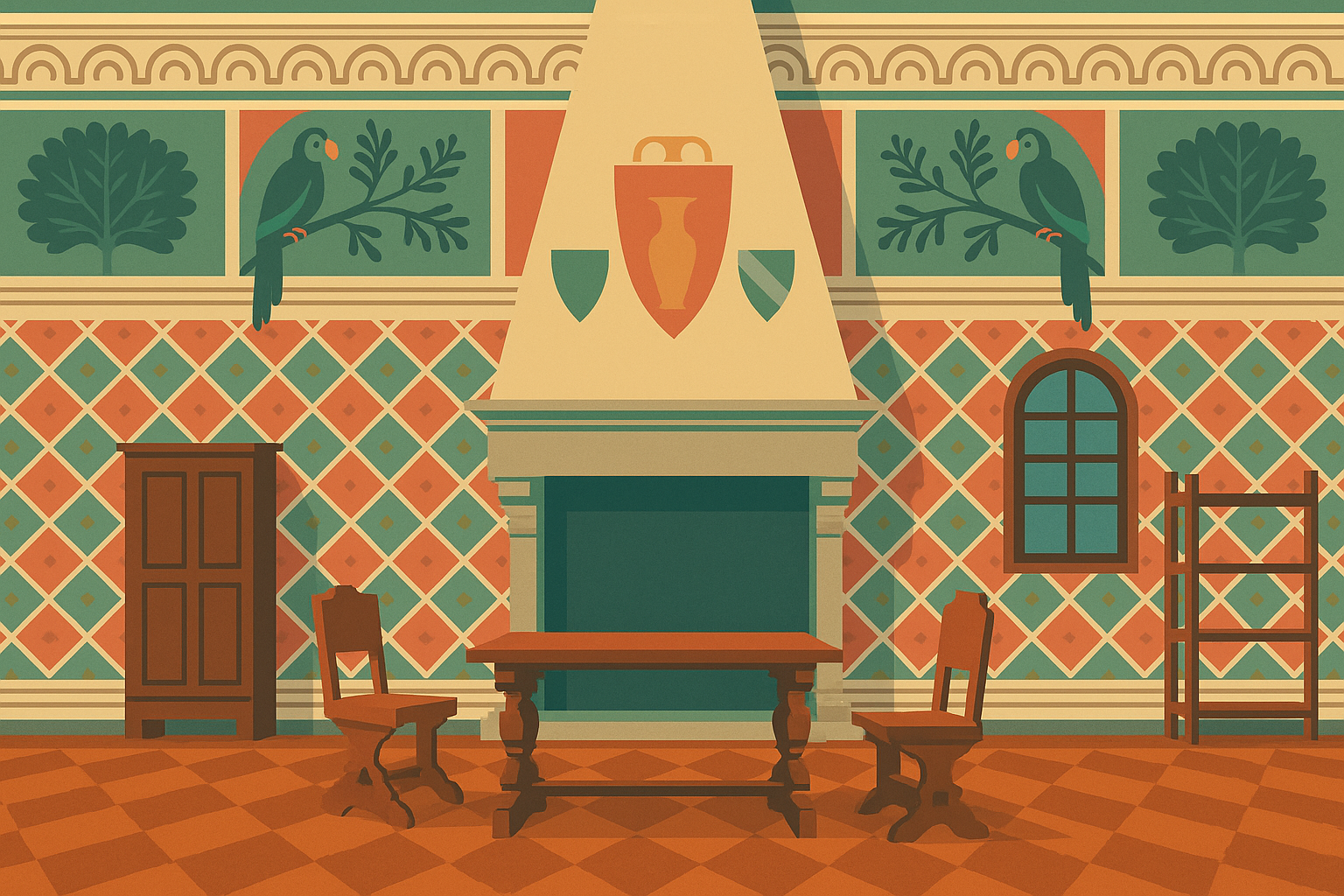
This journey—from the harsh world of commerce to a protected, curated domestic sphere—is the central theme of the palazzo. As you ascend the worn stone staircase, each step echoing with centuries of history, the main salons of the piano nobile reveal the family’s status. The walls are not hung with grand narrative paintings, as one might expect in a later palace, but are covered in elaborate trompe l’oeil frescoes designed to imitate even more expensive and luxurious patterned wall hangings. The two most famous are the Sala dei Pappagalli (Room of the Parrots) and the Sala dei Pavoni (Room of the Peacocks).
These choices are deeply symbolic. In medieval and Renaissance Christian art, the peacock was a powerful symbol of immortality and resurrection, stemming from an ancient belief that its flesh never decayed. The parrot, an exotic and costly bird, was a clear signifier of wealth and global connections, indicating the family’s reach far beyond Florence. In some iconographic traditions, it also represented the “Word of God” or the virgin birth, hinting at the family’s piety. These rooms are a vital document of early domestic art patronage. Before wealthy merchant families like the Davizzi sponsored public chapels or commissioned monumental sculptures, they spent their money at home. The frescoes in their main living spaces demonstrate a life carefully balanced between piety (peacocks for immortality), status (parrots for wealth), and domestic comfort (the illusion of warm, insulating tapestries).
A Story Etched in Stone: History and Reconstruction
The palazzo’s 600-year history is a captivating story of wealth, tragedy, and reinvention, mirroring the very pulse of Florence itself. It was originally built in the mid-14th century, around 1350, for the Davizzi family, who were powerful merchants and bankers belonging to the formidable wool guild. This establishes the building’s “merchant class” DNA from its very foundation, a testament to the economic engine that drove the Renaissance.
In 1578, the palace was purchased by Bernardo Davanzati, another exceptionally wealthy merchant and scholar. The Davanzati family gave the building its enduring name and owned it for nearly three centuries, until 1838. They made their own indelible mark, adding the massive, proud family coat of arms that still dominates the facade and commissioning the elegant 16th-century loggia at the very top, which replaced the original, defensive medieval battlements. The family’s long tenure ended in tragedy with the suicide of Carlo Davanzati, a poignant reminder of the human stories woven into these ancient walls.
After the Davanzati line ended, the palace was split into apartments, fell into severe disrepair, and was threatened with demolition during Florence’s 19th-century “urban renewal.” It was saved in 1904 by a man crucial to its modern identity: Elia Volpi. Volpi was a brilliant antiquarian and restorer, a visionary who saw beyond the decay. He purchased the palace, undertook a dramatic restoration, and opened it to the public in 1910 as the “Museum of the Old Florentine House.”
However, Volpi was also a dealer, not just a preservationist. The museum was his masterpiece, but it was also, crucially, his showroom. He used the stunningly restored interiors to display exquisite furniture and art, which he then sold off at massive, high-profile auctions, including a famous one in New York in 1916. This context is essential for any visitor. The palace itself is authentic, a genuine survivor of the 14th century, but the collection is not original to the Davanzati family. When the Italian state purchased the (mostly empty) building in 1951, it had to “reconstruct” the domestic setting. The museum’s current collection of furniture, maiolica, textiles, and domestic objects was painstakingly assembled from other Florentine galleries and private donations. Today, we are visiting an expertly curated concept of a medieval home—an ideal pioneered by Volpi himself—rather than the untouched, original contents of a single family. This understanding deepens the appreciation for the careful scholarship and dedication behind the current display.
Architectural Marvels: Beyond the Facade
The palazzo’s primary architectural importance is as a rare, surviving example of the transition from the medieval casa-torre (tower-house) to the Renaissance palazzo. It was constructed by unifying several earlier, smaller tower homes, a common practice at the time, reflecting the gradual consolidation of wealth and power.
The facade itself tells this story of social evolution. The ground floor is dominated by three massive, rustic portals. These were originally an open loggia, used for conducting business and engaging with the public street, a direct connection to the bustling commercial world outside. By contrast, the very top of the building features the light, airy 16th-century loggia built by the Davanzati family for private leisure and to catch cool breezes—a feature that replaced the defensive crenellations of a medieval fortress. This shift from defensive necessity to leisurely comfort speaks volumes about the changing priorities of Florence’s elite.
The interior, however, holds the building’s most astonishing secrets: its 14th-century domestic technology, which was decades ahead of its time. The house was designed for a level of comfort that shatters modern myths about medieval life. Imagine the luxury of:
- Internal Well: A central well and shaft connected to a clever pulley system, allowing water to be drawn on every floor, from the ground-floor courtyard to the third-floor kitchen. This eliminated the arduous task of carrying water up multiple flights of stairs, a true innovation.
- Agiamenti (Toilets): Even more remarkably, the palace was built with agiamenti (lavatories or toilets) on each floor. These private bathrooms were an almost unheard-of luxury in 14th-century Europe, signaling incredible wealth and a profound focus on domestic comfort and hygiene.
This architecture is the story. The building’s very structure—evolving from a collection of fortified towers into a unified, comfortable palace with a central courtyard, an open-air loggia, and advanced internal plumbing—is a physical manifestation of Florence’s social history. It charts the merchant class’s mindset shifting from one of medieval defense to one of Renaissance comfort, leisure, and the private enjoyment of wealth.
Planning Your Visit: Hours, Tickets, and Essential Tips
Planning a visit to Palazzo Davanzati requires a bit of strategic timing, as its hours are famously “Florentine” and can be complex. The museum operates on a split schedule, designed to accommodate different visitor flows. It is open Tuesday through Thursday from 8:15 am to 1:50 pm, and on Friday, Saturday, and Sunday from 1:15 pm to 6:50 pm. It is closed every Monday. Always double-check the official website for any last-minute changes, though these hours are generally reliable.
Admission is one of the best values in the city, especially considering the unique experience it offers. A full-price ticket is just €6.00. A reduced ticket for EU citizens aged 18 to 25 is €2.00, and admission is free for everyone under 18, making it an excellent family-friendly option. While you can book online for an additional €3.00 reservation fee, it is generally unnecessary. Given the museum’s reliably low visitor numbers, you can almost always walk in and purchase a ticket at the door with no wait, saving you the booking fee.
Unlocking the Upper Floors: The Heart of the Museum
This is the most important information for any visitor: the standard €6.00 ticket grants you free access to the ground floor courtyard and the main salons on the first floor. But the undisputed treasure of the museum—the part that makes it truly unforgettable—is on the second and third floors. These floors are accessible only via a free, staff-accompanied tour that you must sign up for in person on the day of your visit. This is a non-negotiable aspect of the experience and should be your first priority upon arrival.
The tour takes you to two incredible spaces:
- The Chatelaine’s Bedroom (Camera della Castellana di Vergy): Located on the second floor, this room contains the museum’s most important and intimate fresco cycle. The paintings depict the Chatelaine de Vergy, a popular and scandalous 13th-century French chivalric romance. Running around the top of the walls like a graphic novel, the frescoes tell a tragic “medieval soap opera.” The plot follows the secret love between a knight and the Châtelaine. The Duchess, who is married to the knight’s lord, becomes jealous and tricks the knight into revealing his secret. The Duchess then publicly taunts the Châtelaine with this private knowledge at a courtly ball. The Châtelaine, believing her lover has betrayed her, dies of a broken heart. The knight, discovering her body, kills himself with his own sword. The Duke, upon finding the lovers and learning the truth from a note, exacts his own revenge by killing his treacherous wife, the Duchess. The significance of this fresco is profound. This is not a religious scene. It is a secular, tragic, and intensely romantic story. Having this painted in a private bedroom shows a sophisticated, worldly family that was educated, well-read, and interested in courtly literature from beyond Italy—a sign of an intellectual life that went far beyond just commerce.
- The Kitchen (3rd Floor): Often cited as the visitor’s favorite room, the third-floor kitchen is a perfect, tangible recreation of medieval domestic life. It is filled with household tools that are fascinating in their rustic familiarity. Alongside the massive fireplace and copper cauldrons are looms and spinning wheels, a reminder that textile production (the source of the Davizzi wealth) was also a domestic task. But the most surprising items are the small utensils that shatter modern “dark ages” myths: a functional citrus squeezer, a dough kneader, and even a corkscrew. This room, combined with the agiamenti (toilets) and the ingenious well system, reveals a 14th-century domestic world that was sophisticated, comfortable, and technologically advanced.
Insider Tip: The upper floors are the true highlight. Upon arrival, immediately go to the ticket desk and sign up for the next available staff-accompanied tour. Spots are limited, and this is the only way to see these incredible rooms.
A visit should be budgeted for 90 to 120 minutes. This duration is crucial. It allocates 30-45 minutes for a self-guided exploration of the magnificent courtyard and the main salons on the first floor. More importantly, it builds in the necessary time to wait for and participate in the essential 45- to 60-minute staff-accompanied tour of the upper floors, which is the undeniable highlight of the museum.
Getting There: A Hidden Gem in Plain Sight
The palazzo is perfectly hidden in plain sight at Via Porta Rossa, 13, a narrow, ancient street that runs between the bustling Piazza della Repubblica and the elegant Piazza Santa Trinita. Its central location makes it an easy and pleasant stop on any Florentine itinerary.
From Santa Maria Novella (SMN) Station:
- By Foot (Recommended): This is arguably the best way to arrive. The palazzo is a flat, easy 10- to 15-minute walk from the station. Simply head toward the Piazza del Duomo or Piazza della Repubblica; Via Porta Rossa is one of the main streets in the historic center. Arriving on foot allows you to experience the building as it was meant to be found: as a hidden jewel in the city’s dense medieval fabric, gradually revealing itself amidst the everyday life of Florence.
- By Bus: For those with limited mobility or simply preferring public transport, the small electric bussini (little buses) that navigate the historic center are ideal. The C2 line stops very close by. The most convenient stops are “Vecchietti” or “Orsanmichele,” both of which are just a 4- to 5-minute walk from the museum’s entrance.
- By Taxi: A taxi from the SMN station will be quick (around 8 minutes), but due to the pedestrian-only zones (ZTL) that restrict vehicle access in the historic center, it will have to drop you at the edge of the street, requiring a short walk to the palazzo’s door.
The museum’s location is exceptionally convenient, just a 2-minute walk from the majestic Piazza della Signoria and a 5-minute walk from the iconic Ponte Vecchio, making it easy to integrate into a broader exploration of the city center.
Accessibility and Comfort: Facilities for Every Visitor
For a 14th-century building, the Palazzo Davanzati is remarkably accessible, though it requires some staff interaction to navigate fully (Accessibility Score: 70). The museum has made efforts to accommodate visitors with varying needs. An elevator is available to take visitors to the upper floors, ensuring that the entire experience, including the crucial upper floor tours, is within reach. Accessible restrooms are also available on the ground floor.
However, visitors with mobility challenges should be aware of two key “accessible-with-assistance” features. First, the main entrance has a 12 cm (4.7-inch) rise, which requires staff to position a mobile platform. Second, the passages between the ancient rooms have raised thresholds of up to 6 cm (2.4 inches), which require staff to deploy portable ramps. Staff are reportedly very helpful and accustomed to assisting, but visitors should factor in this extra time and be prepared to ask for help.
Other facilities make the visit comfortable and convenient. A small Bookshop is located at the entrance, offering guides and art publications to deepen your understanding of the palazzo and Florentine history. A Cloakroom with 40 lockers is available on the mezzanine floor (requiring a €1.00 deposit for the key), allowing you to store bags and coats for a more comfortable exploration. For families, a fasciatoio (baby changing table) is located in the ground-floor restrooms. The museum also offers a Tactile Path for visually impaired visitors, allowing them to touch select sculptures and experience the art in a unique way. This experience must be arranged in advance by contacting the museum’s Educational Services.
When to Visit: Timing Your Journey Through Time
At almost any other museum in Florence, “best time to visit” means “how to beat the crowds.” Here, that is not an issue. The museum is a well-known, quiet refuge, rarely overwhelmed by visitors. The real strategy for visiting Palazzo Davanzati is dictated entirely by the mandatory, staff-accompanied tour schedule for the upper floors. Your arrival time must align with these specific tours, which vary depending on the day of the week.
- If visiting on a Tuesday, Wednesday, or Thursday, you must go in the morning. The only accompanied tours run at 9:15 am, 10:15 am, 11:15 am, and 12:15 pm.
- If visiting on a Friday, Saturday, or Sunday, you must go in the afternoon. The tours run at 2:15 pm, 3:15 pm, 4:15 pm, and 5:15 pm.
Insider Tip: To guarantee your spot on the first available tour, arrive 15-20 minutes before the first tour of the day (e.g., at 9:00 am on a Tuesday or 2:00 pm on a Friday). This ensures you can purchase your ticket and immediately sign up, securing your place for an unforgettable experience.
Beyond the Palazzo: A Merchant’s Florence Walking Tour
Instead of just palace-hopping, use Palazzo Davanzati as the centerpiece of a “Merchant’s Florence” walking tour. This itinerary provides a cohesive narrative of the wealth, power, and culture that funded the Renaissance, offering a deeper understanding than simply ticking sites off a list.
- Start at Orsanmichele (5-minute walk): This unique building was the combined church, grain market, and headquarters for Florence’s powerful guilds. Study the exterior statues in their niches—like Donatello’s St. George—which the guilds (including the wool guild) commissioned to flaunt their wealth and piety. This is the public face of merchant power, a grand display of their influence and devotion.
- Visit Palazzo Davanzati (5-minute walk): After seeing their public-facing art and commercial hub, step inside the Davizzi family’s home. Here, you witness the private domestic life that this guild wealth funded: the advanced comforts, the private art, and the family structure that underpinned their success. It’s a direct contrast, showing the intimate side of their prosperity.
- End at the Museo Nazionale del Bargello (10-minute walk): This museum, part of the same Bargello network as Davanzati, holds the city’s greatest collection of Renaissance sculpture. This final stop shows the evolution of merchant patronage, as families and guilds moved from decorating their homes to commissioning world-changing public art like Donatello’s David. It completes the narrative arc, demonstrating how private wealth eventually fueled public artistic masterpieces.
This 3-stop itinerary, all within a 10-minute walk, gives you a complete story of the merchant class that is far more rewarding than simply ticking sites off a list. Other nearby landmarks include the iconic Piazza della Signoria, the romantic Ponte Vecchio, and the serene Basilica di Santa Trinita, all easily incorporated into your walk.
Capturing the Past: Best Photo Spots
First, a note on policy: while photography was strictly forbidden in the past, current visitor reports and guides confirm that non-flash photography for personal use is now permitted and is essential for capturing the museum’s unique details. Embrace this opportunity to document your journey through time.
- The Courtyard: The view looking up the 14th-century stone staircase is the most iconic shot. The “rampant arches,” geometric patterns, and worn, carved capitals create a dramatic composition full of texture and shadow, offering a perfect sense of the building’s age and grandeur.
- Camera della Castellana di Vergy: This is the narrative highlight. Focus your lens on the band of frescoes running along the top of the walls. Capturing the individual story panels of this medieval romance is a must, allowing you to tell the tragic tale through your lens.
- The Kitchen (3rd Floor): This room is a photographer’s favorite. The massive, rustic fireplace, the hanging copper pots and cauldrons, and the arrangement of authentic domestic tools create a textured, lived-in scene that feels incredibly authentic and evocative.
- The Lace Collection: For a unique detail shot, head to the 3rd-floor lace exhibit. The most intricate pieces of lace and embroidery are displayed in shallow, pull-out drawers. Gently opening one and shooting down captures a beautiful, flat-lay image that most visitors miss, highlighting the exquisite craftsmanship of the era.
Conclusion: Your Essential Florentine Antidote
Palazzo Davanzati is the essential antidote to Florentine museum fatigue. It is not a place for grand masterpieces viewed from behind velvet ropes. It is an intimate, tangible, and quiet space that allows for a genuine connection with the past, offering a rare chance to understand the domestic lives of the people who built the Renaissance. It is, without question, one of the most rewarding and overlooked experiences in the city, a true time capsule waiting to be discovered.
Insider Tip: Do not leave without seeing the upper floors. The standard €6 ticket only grants access to the main salons. The 14th-century kitchen and the stunning Bedroom of the Chatelaine di Vergy are on the 2nd and 3rd floors, accessible only via a staff-accompanied tour. These tours are free but must be booked in-person at the museum ticket desk immediately when you arrive. Spots are limited and this is non-negotiable—make it your first priority.