
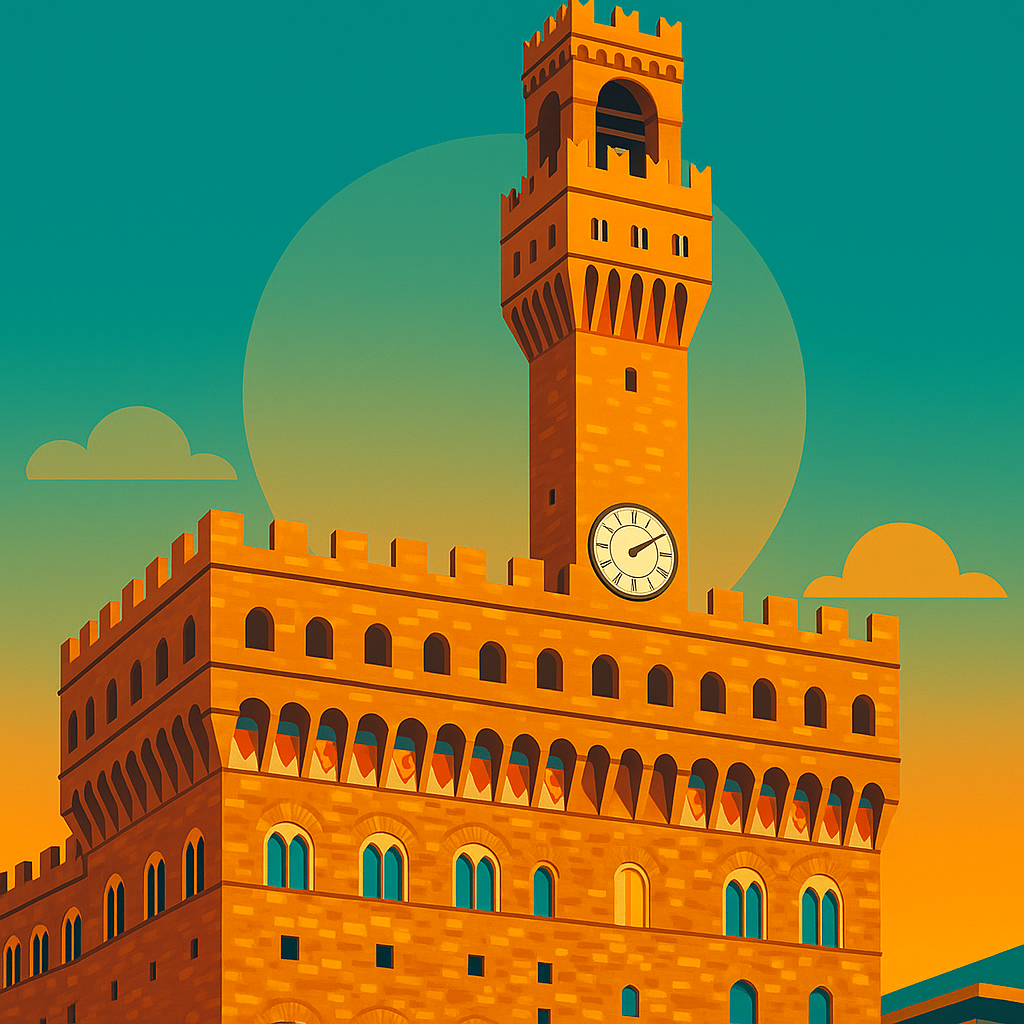
Palazzo Vecchio: Secret Routes Tour
Experience the magic of Tuscany
Imagine driving through the Chianti hills, discovering medieval villages, and stopping for an aperitivo at sunset. Renting a car is the secret to experiencing Tuscany with true freedom. Book now for the best choice.
🔍 Choose your car for TuscanyBeyond the Gilded Halls: Unlocking the Medici Secrets on Palazzo Vecchio’s ‘Percorsi Segreti’ Tour
To stand in the Salone dei Cinquecento (Hall of the Five Hundred) is to be dwarfed by propaganda. It is the overwhelming public face of the Palazzo Vecchio, a vast chamber designed to broadcast the absolute power of Duke Cosimo I de’ Medici. The 18-meter-high coffered ceiling, gilded and painted by Giorgio Vasari, tells a triumphant story of Florentine victories and Medici glory. This room is what 99% of visitors come to see, a masterpiece of Renaissance spectacle.
But for a select few, this hall is merely a starting point. A deeper experience awaits those who seek what lies “Oltre alla visita standard” (Beyond the standard visit): the Percorsi Segreti, or “Secret Itineraries.” This is not just another museum tour. It is a 75-minute guided journey that peels back Vasari’s opulent veneer to reveal the building’s true, hidden mechanisms. It is the palace’s private antithesis, a labyrinth of escape routes, hidden treasuries, and secret laboratories built for a dynasty that understood, better than anyone, the difference between public power and private survival.
A Journey into Paranoia and Privilege
The Percorsi Segreti tour begins by fundamentally shifting the atmosphere. You leave the echoing crowds of the main museum and follow a guide, who often carries a set of heavy, jangling keys, to a small, innocuous-looking door you would otherwise never notice. The transition is immediate and visceral. The air cools, the sounds of the piazza vanish, and the grand, luminous spaces of the Renaissance are replaced by the cramped, functional stone of a medieval fortress.
This is a tour about paranoia, privilege, and access. The symbolism is potent: you are no longer a tourist but a conspirator, granted access to spaces designed to be unseen. The atmosphere is one of claustrophobic intimacy. You will duck into tiny stone-walled rooms, climb winding staircases so narrow you must go single-file, and find yourself in windowless chambers where dukes and princes hid their treasures and their secrets. The tour’s power lies in this tactile, physical connection to the building’s hidden DNA, a world away from the “do not touch” artifacts in the main halls.
A Palace Divided: Why the Secrets Were Necessary
To understand the Percorsi Segreti, one must first understand the building’s profound identity crisis. The Palazzo Vecchio was not built for the Medici. It was erected in 1299 as the Palazzo dei Priori, a rugged, crenelated fortress designed to house the Signoria, the rotating republican government of Florence. It was a symbol of civic, not personal, power.
Everything changed in 1540. In a brilliant political move, Duke Cosimo I de’ Medici moved his official residence from the private Palazzo Medici-Riccardi to this very public, republican symbol. This act transformed the building into the Palazzo Ducale (Ducal Palace) and created an immense architectural problem. How does an autocratic ruler and his family, including his wife Eleonora of Toledo, live, sleep, and protect their wealth in a building designed for public councils and transparency?
The answer was Giorgio Vasari. Cosimo’s brilliant architect was tasked with a dual mandate: on the outside, create magnificent public spaces like the Salone dei Cinquecento to project Medici power; and on the inside, carve out a network of hidden passages, secret studies, and escape routes to ensure the family’s privacy and security. The standard museum visit shows you Vasari’s first achievement. The Percorsi Segreti reveals the second.
Percorsi Segreti vs. Vasari Corridor: A Crucial Distinction
It is essential to clarify what this tour is not. Many visitors confuse the Percorsi Segreti with the much more famous Vasari Corridor. They are two completely different structures with different purposes.
- Percorsi Segreti (Secret Itineraries): This is a network of small, hidden rooms and passages located entirely inside the Palazzo Vecchio. Think of it as the palace’s internal nervous system, designed for private movement and security within its walls.
- Vasari Corridor (Corridoio Vasariano): This is the famous 1km-long, enclosed elevated bridge that connects the Palazzo Vecchio (via the Uffizi Gallery) to the Palazzo Pitti on the other side of the Arno River. It was the palace’s external artery, allowing the Medici to cross the city and the Ponte Vecchio unseen.
This tour explores the former, the intricate and secret world within the palace itself.
A Walk Through Hidden History
The 75-minute tour provides exclusive access to a series of rooms that are masterpieces of architecture, engineering, and narrative. Each space tells a story of a different era and a different ruler’s mindset.
The Duke of Athens’ Escape Route
First, you descend into the medieval past, ascending the Stairway of Gualtieri di Brienne, the Duke of Athens. Built in 1342, this narrow, stone spiral staircase was embedded within the thick fortress wall as a secret escape route, leading directly to a small door on the Via della Ninna. It proved its worth when the duke, a tyrant, used it to flee a popular rebellion in 1343. As you climb its tight spiral, you can feel the desperation and urgency for which it was built.
The Studiolo: An Alchemist’s Sanctuary
The tour then jumps forward 200 years to the Medici dynasty, contrasting two generations through their private chambers. First is the Tesoretto (Little Treasury) of Cosimo I, an elegant writing room for his “rare and precious things,” reflecting a man of tangible wealth and political power.
Directly connected is the tour’s jewel: the Studiolo of Francesco I. This small, dark, barrel-vaulted room is one of the most exquisite examples of Mannerism in the world. It was the private sanctuary of Cosimo’s son, Francesco, a melancholic intellectual who despised politics and preferred the solitary pursuits of science and alchemy. The room has no windows. Its 34 intricate paintings are, in fact, cleverly disguised cabinet doors. The room is organized by the Four Elements (Earth, Air, Fire, Water); behind a painting depicting a foundry (Fire), Francesco kept his forged metals; behind a scene of pearl fishing (Water), he stored shells and marine curiosities. From a hidden peephole, he could also spy on his ministers in the Salone dei Cinquecento, completely unseen.
Above the Hall of Giants
The tour’s stunning finale is an engineering marvel. You are led through a small door and emerge onto a modern catwalk suspended high above the magnificent, gilded ceiling of the Salone dei Cinquecento. Here, you walk among the massive, 16th-century timber trusses designed by Giorgio Vasari. To create the grand hall, Vasari had to raise the original 15th-century roof by 7 meters. He did so with an ingenious double-truss system: one set to hold the new roof, and another, separate set to support the enormous weight of the 42-panel coffered ceiling below. It is here that Dan Brown’s Inferno placed its climax, and from this vantage point, you are literally standing on the hidden structural “bones” of the palace’s greatest treasure, smelling the ancient timber that has held it all together for centuries.
Planning Your Secret Visit: Tickets, Times, and Logistics
The main Palazzo Vecchio museum is open daily from 9:00 to 19:00, with a shorter day on Thursdays when it closes at 14:00.
The Percorsi Segreti tour, however, does not run continuously. It is a special guided tour with limited, timed slots, typically at 10:00, 11:30, 14:30, and 16:00 (with fewer slots on Thursdays). Booking in advance is not just recommended; it is essential, as groups are strictly limited to just 10 participants.
The pricing structure is a crucial detail: the tour is an add-on. You must first purchase a standard museum ticket (full price €12.50) and then add the Percorsi Segreti guided tour (€5.00 for non-residents), for a total official cost of €17.50, plus any pre-sale booking fees.
The tour itself is a dense 75 minutes. After the guide leaves you, you are free to explore the rest of the Palazzo Vecchio at your leisure. Plan for a total of 2 to 2.5 hours to fully experience both the secret tour and the main museum halls.
How to Get to the Palazzo Vecchio
The Palazzo Vecchio dominates the Piazza della Signoria in the absolute heart of Florence. If you are arriving at the main Santa Maria Novella (SMN) train station, it is a pleasant and straightforward 15- to 18-minute walk (about 1.3–1.5 km) through the historic center.
For those preferring public transport, the best option is the small electric bussini. Take the C2 bus from the “Stazione Via Panzani” stop near SMN and get off at “Canto Alla Quarconia,” which is just a short walk from the piazza.
A critical warning for anyone traveling by car: you cannot drive to the Palazzo Vecchio. The entire area is deep inside Florence’s ZTL (Zona Traffico Limitato), a limited traffic zone active most of the day. Cameras automatically photograph license plates at every entry point and issue expensive fines to unauthorized vehicles. The only safe solution for drivers is to pre-book a private parking garage within the ZTL, such as Garage Palazzo Vecchio or Garage del Bargello. Upon arrival, the garage staff will register your license plate with the police for temporary access, saving you from a fine.
Know Before You Go: Accessibility and Facilities
The Palazzo Vecchio is a functioning city hall as well as a museum, and its facilities are good. A free cloakroom is available on the ground floor where you must check large bags, backpacks, and umbrellas. Restrooms and a gift shop are also available.
However, the Percorsi Segreti tour has zero accessibility. This cannot be overstated. The tour is explicitly not accessible for wheelchair users or strollers. Due to the narrow medieval staircases, tight passages, and small rooms, it is strongly not recommended for anyone with mobility impairments, significant claustrophobia, or heart conditions. Comfortable, sturdy shoes are an absolute must.
There is no café inside the museum itself, but the Piazza della Signoria and the surrounding streets are filled with excellent cafés, restaurants, and gelaterias for a break before or after your visit.
Insider Tips for the Perfect Visit
To make the most of this unique experience, timing and perspective are everything. Since the Percorsi Segreti tour requires a timed-entry ticket, your visit time is predetermined. For the best experience, book the first tour of the day at 10:00. This allows you to complete the 75-minute secret tour and then emerge into the main museum halls—especially the Salone dei Cinquecento—just as they are beginning to fill, but before the peak midday crowds arrive. This strategy lets you appreciate both the secret and public spaces in relative calm.
Photography on the tour is challenging. The spaces are dark, cramped, and flash photography is strictly prohibited. The most coveted shot is of the jewel-box-like Studiolo of Francesco I, but be prepared for very low light.
For the definitive, postcard-perfect shot of the Palazzo Vecchio itself, head to the adjacent Uffizi Gallery. Make your way to the second-floor cafeteria, which has a panoramic terrace offering a breathtaking, elevated view of the palace’s tower and facade.
Once you finish the tour, you are perfectly positioned to explore the rest of the Palazzo Vecchio, which is included in your ticket. Don’t miss the main floor of the Salone dei Cinquecento, the stunning Hall of Geographical Maps, and the opulent private apartments of the Medici. Immediately outside, the Loggia dei Lanzi offers an open-air sculpture gallery with masterpieces like Cellini’s “Perseus with the Head of Medusa.” A walk to the Ponte Vecchio completes the narrative, as you can look up and trace the path of the Vasari Corridor you now know is entirely separate from the passages you just explored.
The Percorsi Segreti is, without question, one of the most rewarding experiences in Florence. But its value is directly tied to a visitor’s physical ability and expectations. This is not a comfortable, luxury tour; it is a privileged, adventurous climb. The standard museum ticket shows you the magnificent result of Medici power. The Percorsi Segreti shows you the process—the medieval paranoia, the alchemical genius, and the audacious engineering that made the magic trick possible. You don’t just see the palace; you finally understand its design.