
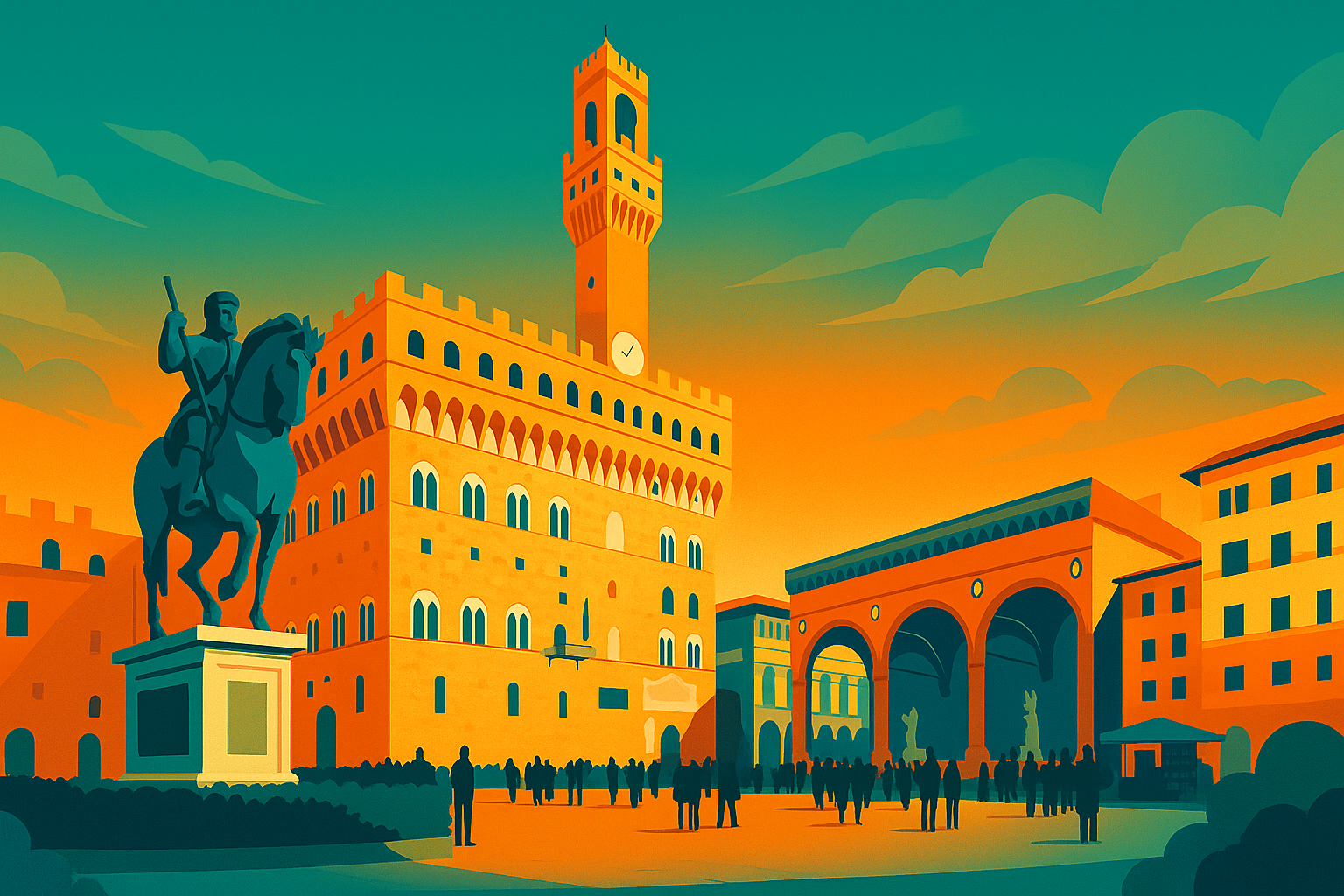
Piazza della Signoria
Experience the magic of Tuscany
Imagine driving through the Chianti hills, discovering medieval villages, and stopping for an aperitivo at sunset. Renting a car is the secret to experiencing Tuscany with true freedom. Book now for the best choice.
🔍 Choose your car for TuscanyThe Heart of the Lion: Power, Propaganda, and Art in Florence’s Piazza della Signoria
For more than 700 years, every triumph and tragedy in Florence’s tumultuous history has echoed off the stones of the Piazza della Signoria. This is not merely a square; it is the city’s political and emotional epicentre, a contested stage where civic pride, brutal power, and divine art have collided for centuries. While many travellers treat it as a grand corridor—a gateway to the adjacent Uffizi Gallery or a waypoint between the Duomo and the Ponte Vecchio—the piazza is, in itself, one of the most important destinations in the world.
It is a unique, L-shaped theatre that doubles as one of the world’s most magnificent open-air sculpture galleries. But unlike a museum, nothing here was placed by accident or for simple aesthetics. Every statue, every fountain, every inch of the surrounding facades is a political statement, a piece of a larger conversation. This is where the Florentine Republic was born, where the Medici dynasty asserted its absolute power, and where the radical friar Savonarola held his “Bonfire of the Vanities” before being burned on the very same spot. To stand here is to stand in the heart of the Renaissance, witnessing a 700-year-old argument about power, etched in marble and bronze.
A Tale of Two Piazzas: The Soul of the City by Day and Night
To truly understand the Piazza della Signoria, you must experience its two distinct personalities. This single space transforms completely with the rising and setting of the sun, offering two profoundly different encounters.
The “Day Piazza” is an overwhelming sensory experience. From roughly 10:00 AM to 5:00 PM, it becomes a bustling, chaotic, and noisy sea of humanity. Tour groups cluster around guides holding colourful flags, visitors jostle for the perfect photo of the David copy, and the air is thick with the frenetic energy of a global tourist destination. It is a place to be seen, a box to be ticked on a whirlwind itinerary. While impressive in its scale, its deeper meaning can be lost in the clamour.
But as the crowds recede and the sun sets, the “Night Piazza” emerges, and its soul returns. The atmosphere becomes magical, hushed, and deeply romantic. The stone facades of the Palazzo Vecchio and the Loggia dei Lanzi glow under soft, strategic illumination. The statues, now dramatic and imposing silhouettes, are often serenaded by the melancholic notes of a lone cellist or violinist performing nearby. This is when the square reverts to its original purpose: the hub of local life. You will see Florentines meeting for an evening aperitivo at one of the historic cafes, sitting on the steps of the Loggia, and reclaiming the space as their own. In the quiet of the night, the square ceases to be a sight and once again becomes the true political and social focus of the city.
To truly feel the piazza’s pulse, you must visit it twice: once to witness its daytime energy, and again to experience its magical transformation after dark.
A Stage Built on Vengeance: The History of the Square
The piazza’s very shape is an act of political revenge. Its distinctive L-shaped form was not designed; it was created by destruction. In the 13th century, Florence was torn apart by the bloody conflict between the Guelphs (supporters of the Pope) and the Ghibellines (supporters of the Holy Roman Emperor). In 1268, the victorious Guelphs razed 36 Ghibelline palaces to the ground. In a final act of damnation, they declared the land “cursed” and passed a law forbidding anything to be built on that spot ever again, creating a permanent, scarred void in the city’s heart.
This “architecture of absence” defined the space for decades. Then, in 1299, the new Republican government—the Signoria—decided to build its seat of power directly on the edge of this void. The result was the Palazzo della Signoria (now known as Palazzo Vecchio), a massive, Romanesque, crenellated fortress-palace designed by Arnolfo di Cambio. Its severe, rustic stone and imposing 95-meter tower were a clear message to all: this was a symbol of civil power, a fortress for the people, built defiantly upon the ruins of its enemies.
This stage was set for one of Florence’s most dramatic moments of religious fanaticism. In 1497, the Dominican friar Girolamo Savonarola, having temporarily ousted the Medici, held his infamous “Bonfire of the Vanities” here. He incited Florentines to burn thousands of “sinful” objects—books, fine dresses, musical instruments, and priceless works of art—in a giant pyre. Just one year later, in 1498, the political winds shifted violently. Savonarola was declared a heretic, and on the exact same spot, he was publicly hanged and burned. A simple circular marble plaque, set in the pavement directly in front of the Fountain of Neptune, marks the precise location of his execution, a subtle but chilling reminder of the square’s brutal past.
The Medici’s Masterclass in Propaganda: Reading the Statues
The true genius of the piazza lies in the “conversation” between its sculptures—a deliberate re-scripting of history by the Medici family as they rose from bankers to absolute rulers. The art here is not decorative; it is a weapon.
The Republic’s Symbols of Defiance
Initially, the Republic placed its own icons of liberty and courage in the square, facing outwards as a warning to would-be tyrants.
- Donatello’s Judith and Holofernes (a copy; the original is inside the Palazzo Vecchio): A powerful sculpture of a woman slaying a despot, placed here to celebrate the expulsion of the Medici in 1494. Its message was unambiguous: tyranny will be defeated.
- Michelangelo’s David (a copy; the original is in the Accademia Gallery): The ultimate symbol of the small Florentine Republic’s defiance against powerful enemies, including the Medici. The young hero, armed only with a sling and his faith, stands ready to take on any giant.
- The Marzocco (a copy; the original is in the Bargello Museum): The proud, fierce lion holding the city’s coat of arms, a long-standing symbol of the Florentine people’s unconquerable spirit.
The Medici’s Bronze and Marble Response
When the Medici returned to power and became Dukes of Tuscany, they didn’t destroy these beloved Republican symbols. Instead, in a brilliant act of political theatre, they co-opted the space, commissioning new works to overwrite the old message with their own narrative of absolute power.
- Cellini’s Perseus with the Head of Medusa (1554): Placed prominently in the Loggia dei Lanzi, this dark and magnificent bronze was the Medici’s first and most brilliant response. It is a political manifesto in metal. Perseus (representing Duke Cosimo I) holds aloft the severed, snake-haired head of Medusa (representing the chaotic, infighting Republic he had conquered). It was a chilling warning to his enemies. In a stroke of artistic arrogance, Cellini’s bronze Perseus holds the head of Medusa—which turns men to stone—directly opposite his rival Michelangelo’s stone David.
- Ammannati’s Fountain of Neptune (1574): This was not just a fountain; it was Cosimo I’s deification. Commissioned to celebrate Florence’s new maritime ambitions, the face of the sea-god Neptune is a direct portrait of Cosimo I himself, asserting his dominion over the city and its fortunes. The Florentines, however, were unimpressed, derisively nicknaming the colossal statue “Il Biancone” (The Big White One).
- Giambologna’s Equestrian Monument of Cosimo I (1595): This statue, placing the Duke on horseback in the very centre of the square like a Roman emperor, was the final word. It cemented his status as an absolute monarch, the undisputed master of the city.
The transformation was completed when the Loggia della Signoria (the “People’s Stage”) was renamed the Loggia dei Lanzi, after the Duke’s personal German mercenary bodyguards (Lanzichenecchi or Lanzi) who were stationed there. The Republic’s open stage had become a ducal guardhouse.
Planning Your Visit: Practical Information
After immersing yourself in the history and art, here’s what you need to know to plan your visit.
Opening Hours and Tickets
The Piazza della Signoria’s greatest feature is its 24/7, free access. You can—and should—walk through it at dawn, at noon, and at midnight. The Loggia dei Lanzi, with its collection of masterpieces, is also free and always open to the public.
The primary ticketed attraction is the Palazzo Vecchio Museum, which serves as both Florence’s active Town Hall and a magnificent museum.
- Opening Hours: Daily from 9:00 AM to 7:00 PM (19:00).
- Thursday Exception: On Thursdays, it has reduced hours, closing early at 2:00 PM (14:00).
- Admission: Full admission for the museum is €12.50.
To plan your time, allow a good 60 to 90 minutes for the piazza itself. This gives you time to walk around the sculptures in the Loggia, find Savonarola’s plaque, and absorb the atmosphere. If you plan to enter the Palazzo Vecchio to see the opulent Salone dei Cinquecento (Hall of the Five Hundred) and climb the tower for its stunning views, you should budget a total of 2.5 to 3 hours for the entire experience.
How to Get There
Florence’s historic centre is famously compact and best explored on foot. The most rewarding way to reach the Piazza della Signoria is by walking. From the city’s main Santa Maria Novella train station, it is a pleasant 15-minute (approximately 1.3 km) stroll that takes you through the heart of the Renaissance city.
If you are using public transport, the small, electric Autolinee Toscane buses are the most direct option. Look for the C2 line and get off at the “Orsanmichele” or “Canto Alla Quarconia” stop, both of which are just a one-to-two-minute walk from the square. Taxis are also plentiful and will cost around €10–€13 from the train station, but given the pedestrianised zones, the walk is often just as fast.
It is strongly advised not to drive. The piazza is located deep within Florence’s ZTL (Zona a Traffico Limitato), or Limited Traffic Zone. Access is strictly controlled by cameras and reserved for residents and authorized vehicles. Unauthorized cars entering the zone will receive a heavy fine.
Facilities and Accessibility
As the city’s civic hub, the piazza is well-served. It is surrounded by restaurants and high-end cafes, most notably the historic Caffe Rivoire, which has been serving coffee and decadent hot chocolate since 1872.
For accessibility, be aware that the piazza itself presents a challenge. The large, uneven cobblestones can be difficult for those with mobility issues or for pushing strollers. However, the main attraction, the Palazzo Vecchio Museum, is accessible. It features a dedicated ramp for wheelchair access located at the side entrance on Via della Ninna, as well as elevators and accessible restrooms inside.
Public restrooms can be scarce and often require payment. A classic Florence hack is to bypass the paid toilets and instead use the clean, free facilities in the department stores just off the piazza, such as Rinascente in Piazza della Repubblica or Coin on Via Calzaiuoli.
When to Go and Where to Point Your Camera
The timing of your visit will completely define your experience. To avoid the intense midday crowds, which can be sweltering in the summer, you must visit at the edges of the day. The two best windows are early morning (before 10:00 AM) and late evening (after 9:00 PM).
In the morning, the “golden hour” light illuminates the marble of the Fountain of Neptune and the bronze of Perseus, and you can explore the Loggia dei Lanzi in relative peace. The evening, however, is when the piazza’s magical atmosphere truly emerges. The crowds thin, the sculptures are beautifully lit, and you can often find live street musicians providing a classical soundtrack. The shoulder seasons of Spring (April-May) and Fall (September-October) offer the most pleasant weather for these evening strolls.
Best Photo Spots
To capture the piazza’s grandeur, move beyond the standard eye-level snapshot.
- The Classic: Take a wide-angle shot from the corner near the Fountain of Neptune, capturing the full height of the Palazzo Vecchio’s tower alongside the David copy. This is best at golden hour or at night when the palace is illuminated.
- The Detail: Get close to the intricate base of Cellini’s Perseus in the Loggia. Focus on the small, exquisitely detailed statues of gods and the artist’s incredible skill.
- The Insider Shot: The best composition is found at the Loggia dei Lanzi. Have your photographer stand outside the arches on the piazza. You stand inside, framed by one of the massive stone arches, with the sculptures rising beside you. This creates a spectacular, high-contrast photo that perfectly captures the scale of the art and the grace of the architecture.
Beyond the Square: What to See Nearby
The Piazza della Signoria is the perfect pivot point for any Florence itinerary, acting as the gateway to the city’s other primary treasures.
- The Uffizi Gallery: The most immediate neighbour. The Loggia dei Lanzi flows seamlessly into the Uffizi’s famous colonnade, which opens directly onto the piazza.
- The Ponte Vecchio: A 5-minute walk south, just past the Uffizi, will take you to Florence’s iconic medieval bridge.
- The Piazza del Duomo: A 5-minute walk north via the bustling shopping street, Via dei Calzaiuoli, connects the city’s political heart (Piazza della Signoria) with its religious heart (the Cathedral).
- The Bargello Museum: Just a short walk east, this former prison is a must-see complement to the piazza. It houses the original sculptures of Donatello’s bronze David and the Marzocco lion, allowing you to compare the authentic masterpieces to the copies you just saw.
A Final Secret
The Piazza della Signoria is not a passive museum. It is the active, beating heart of Florence—a text written in stone and bronze, telling a brutal and brilliant 700-year-old story of civic pride, political theatre, and artistic genius. Do not just walk through it.
Your final must-do is to engage with its most arrogant masterpiece. Go into the Loggia dei Lanzi and find Benvenuto Cellini’s Perseus. Walk around to the back of the statue and look closely at the back of Perseus’s helmet, where his hair curls at the nape of his neck. There, hidden in plain sight, you will find the sculptor’s own hidden self-portrait—a final, defiant signature from the artist who helped the Medici claim this square as their own.