
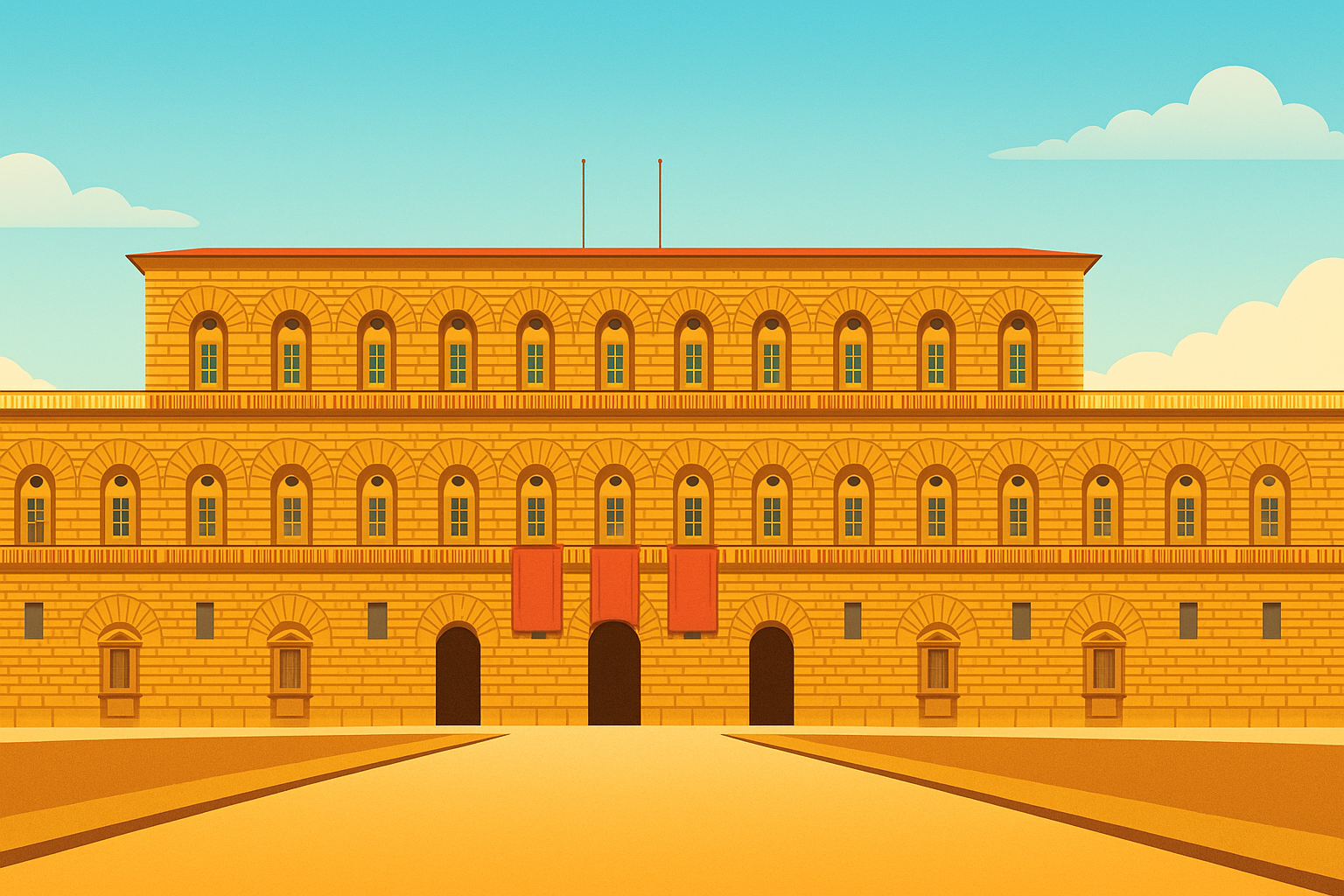
Pitti Palace
Experience the magic of Tuscany
Imagine driving through the Chianti hills, discovering medieval villages, and stopping for an aperitivo at sunset. Renting a car is the secret to experiencing Tuscany with true freedom. Book now for the best choice.
🔍 Choose your car for TuscanyBeyond the Uffizi: Palazzo Pitti, Florence’s Monument to Dynastic Power
Most visits to Florence are a whirlwind of republican ideals and artistic triumphs, a well-trodden path connecting the Duomo, the Palazzo Vecchio, and the Uffizi Gallery. But to truly grasp the city’s complex soul, to understand the story written in its stones beyond the narrative of merchants and artists, you must cross the river.
A short, scenic walk from the Ponte Vecchio, nestled in the bohemian-chic Oltrarno district, lies a building of crushing scale and ambition: the Palazzo Pitti. This is not just another museum; it is the largest museum complex in Florence, a sprawling 32,000-square-meter universe that served as the royal palace and seat of absolute power for three successive dynasties. While the Uffizi (which literally means “offices”) was the administrative heart of the Medici state, the Pitti was their home. It was their throne, their treasury, and the ultimate symbol of their transformation from bankers to Grand Dukes.
To step inside the Pitti is to walk through 400 years of royal life, a journey that takes you from the Medici’s private art hoard and jewel vault to the Habsburg-Lorraine’s 19th-century collections and the intimate bedrooms of the first King of Italy. It is overwhelming, opulent, and utterly essential. This is not the Florence of the guilds; this is the Florence of empires.
The Atmosphere of Absolute Power
The palace’s character is defined by a single, undeniable word: power. Its façade, a relentless, 205-meter-long wall of rugged pietraforte stone, is a masterpiece of architectural intimidation. Forget the graceful humanism of a Florentine church; this is a deliberate echo of ancient Roman fortifications, designed to awe and subdue.
The massive, rough-cut stones—a technique known as rustication—were quarried from the very Boboli hill the palace rests upon, a raw statement of man’s dominion over nature. The design is intentionally severe, almost forbidding, projecting an aura of permanence and invincibility to the city spread out below. It was a clear message to Florentines and rivals alike: the era of republican debate was over.
But this imposing public face conceals a more refined world within. Once you pass through the main entrance, you step into Bartolomeo Ammannati’s magnificent courtyard. Here, the architectural language softens. The rustication becomes more articulated, the arches more elegant, the space more harmonious. This courtyard acts as a symbolic airlock, a masterful transition from the raw, public-facing power of the piazza to the private, cultivated splendor of the grand ducal court. It is the moment you leave the city behind and enter the realm of the rulers.
A Story of Rivalry and Dynasty
The palace’s origin story is the ultimate Florentine irony. It was not built by the Medici, but by their chief rival. In 1458, the astoundingly wealthy and ambitious banker Luca Pitti commissioned the building, driven by a burning desire to outdo his “friend” and competitor, Cosimo de’ Medici. Legend persists that Pitti ordered the windows of his new palace to be larger than the very doorway of the Palazzo Medici, a breathtaking act of hubris.
But Pitti’s ambition was his ruin. Following political misfortunes and the death of his protector, Cosimo de’ Medici, his finances collapsed. He died in 1472, his grand palace a hollow, unfinished monument to his failed rivalry. For decades, the incomplete structure stood as a stark warning against overreach.
Then, in 1549, came the symbolic checkmate. Eleonora di Toledo, the savvy and influential wife of Grand Duke Cosimo I de’ Medici, purchased the palace of her husband’s family’s greatest rival. The act was a definitive statement: the Medici dynasty was absolute. They poured their immense wealth into the building, expanding it and transforming it into their new grand ducal residence, the official symbol of their power over all of Tuscany.
The palace became a physical timeline of the three dynasties that ruled from it. The Medici filled it with priceless art and treasures. When their line died out, the House of Habsburg-Lorraine took over in 1737, adding their own neoclassical and modern collections. Finally, after Italy’s unification, the palace served as the royal residence for King Victor Emmanuel II of the House of Savoy during the brief period when Florence was the nation’s capital (1865-1871). In 1919, his grandson, Victor Emmanuel III, donated the entire complex to the Italian state, turning a private seat of power into a public treasure.
Navigating a Palace of Five Museums
A single Palazzo Pitti ticket grants access to a constellation of five separate museums, which can be overwhelming without a clear plan. The key is to understand that you are not just visiting galleries; you are walking through the layers of history left by its royal occupants.
The Palatine Gallery: A Royal Hoard, Not a Modern Museum
This is the main event, and it is crucial to understand what it is not. It is not a modern museum. If you arrive looking for chronological order, sterile white walls, or neatly spaced, labeled paintings, you will be frustrated.
The Palatine is the Medici’s private collection, left almost exactly as they and their successors hung it: as opulent decoration for their ceremonial state rooms. Paintings are stacked floor-to-ceiling, arranged by size, frame, or color to complement the room’s silk wallpaper, gilded stucco ceilings, and priceless inlaid-stone tables. You are not a museum visitor; you are a guest walking through the duke’s lavish private apartments. The setting—especially the breathtaking “Planet Rooms” frescoed by Pietro da Cortona—is as much the masterpiece as the art itself.
This gallery also boasts the single largest concentration of paintings by Raphael in the world, including his iconic Madonna of the Chair and La Donna Velata. You will also find yourself face-to-face with masterworks by Titian, Caravaggio, Rubens, and Perugino, all jostling for attention in a dazzling display of wealth and taste.
A Palace of Other Treasures
Your ticket also unlocks four other collections that tell the story of royal life from different angles:
- The Royal Apartments: Located on the same floor as the Palatine, these 14 rooms were the private quarters of the House of Savoy. Recently reopened after a five-year restoration, they offer a fascinating (and jarring) contrast of opulent 19th-century royal splendor.
- Treasury of the Grand Dukes (Ground Floor): This is the Medici’s vault. Housed in their former summer apartments, it’s a staggering collection of gems, ivories, silver, rock crystal, and jewels that formed the basis of their immense wealth and political influence.
- Gallery of Modern Art (Second Floor): Reflecting the tastes of the Habsburg-Lorraine dynasty, this collection provides a superb overview of Italian art from the 18th to the early 20th century, including the influential Macchiaioli, often called the “Italian Impressionists.”
- Museum of Costume and Fashion (Second Floor): A journey through 400 years of fashion, this museum showcases the court’s wardrobe, from grand ducal gowns and the funeral clothes of Cosimo I to 20th-century haute couture.
Planning Your Visit: Tickets, Times, and Strategy
A visit to a complex this vast requires a bit of forethought to make the most of your time and energy.
Opening Hours and Tickets
The Palazzo Pitti museum complex is open from Tuesday to Sunday, 8:15 AM to 6:30 PM (18:30). The ticket office closes at 5:30 PM (17:30), and the last admission is at 5:45 PM (17:45). The palace is closed every Monday, as well as on January 1 and December 25.
A single ticket purchased on the day of entry costs €16. However, it is highly recommended to book in advance online. This costs €19 (€16 + a €3 reservation fee) but allows you to bypass the often lengthy ticket queue, saving you precious time.
Your ticket is your key to a universe, but the options can be confusing. The single ‘Palazzo Pitti’ ticket includes all five palace museums but does not include the Boboli Gardens. For the complete experience, be sure to purchase the ‘Combined Pitti + Boboli’ ticket.
How Much Time Do You Need?
Be realistic about your time. While some guides suggest 2-3 hours, this is only enough for a rushed, highlights-only visit to the Palatine Gallery. To properly experience the Palatine and the adjacent Boboli Gardens, budget a minimum of a half-day (3-4 hours). To see the entire complex, including the Treasury and Modern Art galleries, you should set aside a full day.
The Best Time to Go
To avoid the largest crowds, timing is everything. The best seasons to visit are the shoulder seasons: March through May and September through November. The weather is mild, and the crowds are significantly smaller than in the peak summer months. Spring is particularly lovely, as the Boboli Gardens will be in full bloom.
For a daily strategy, arrive for the 8:15 AM opening and head straight to the Palatine Gallery. You will have at least an hour to appreciate the masterpieces in relative quiet before the tour groups descend. Alternatively, visit in the late afternoon (after 3:00 PM), when the large groups have thinned out. Avoid weekends if possible, and especially avoid the first Sunday of the month, when state museums offer free admission and crowds are at their absolute peak.
How to Get to Palazzo Pitti
The palace is located in the Oltrarno, the district “across the Arno” from the historic center. Reaching it is part of the Florentine experience.
- On Foot: This is the most scenic and practical way to arrive. From the Duomo or the Uffizi, it’s a pleasant 15-20 minute walk, taking you directly over the famous Ponte Vecchio. The palace is just a few steps further, and its massive piazza is impossible to miss.
- By Bus: The historic center is well-served by small electric buses. Lines C3, C4, and 11 all stop directly at the “Pitti” stop, just in front of the palace.
- By Train: If arriving from outside the city, you will land at Florence’s main station, Santa Maria Novella (SMN). From the station, the palace is a 20-minute walk through the city center. Alternatively, you can take a taxi (approx. 10-15 minutes) or catch bus 11 from the “Stazione Scalette” stop, which will take you to the “Pitti” stop.
- By Car: Driving to the palace is strongly discouraged. The entire area is a Zona a Traffico Limitato (ZTL), or Limited Traffic Zone, reserved for residents. Unauthorized cars will be heavily fined. If you must drive, you will need to park in a commercial garage outside the ZTL, such as Garage Lungarno or the Porta Romana parking lot, and walk from there.
Practicalities and Accessibility
For such a historic building, the palace is well-equipped with modern visitor services. A free (and mandatory) cloakroom is located on the ground floor for umbrellas, large bags, and backpacks. Audio guides are available for rent, offering detailed commentary on the collections. There are multiple bookshops and a cafeteria in the main courtyard for a coffee or snack.
A note on accessibility: The palace has elevators to access the upper floors and offers free wheelchair loans. However, visitors with mobility issues should be aware that the main piazza has a significant 20% slope leading to the entrance. Furthermore, the adjacent Boboli Gardens are vast, steep, and hilly, which can be very challenging.
Beyond the Palace: Exploring the Oltrarno
One of the greatest mistakes is to visit the Pitti in isolation. The palace is the royal anchor of the Oltrarno, Florence’s most authentic and artistic neighborhood. After your visit, spend the rest of your day exploring this side of the river.
Start with lunch in Piazza Santo Spirito, the neighborhood’s beating heart. This lively, tree-lined square is filled with locals and cafes, offering a perfect, non-touristy spot to relax and recharge. From there, seek out the Brancacci Chapel in the Church of Santa Maria del Carmine. Here, you will find the revolutionary frescoes by Masaccio that essentially kickstarted the Renaissance. Seeing this in the same day as the high-Renaissance masters in the Pitti is a powerful art-historical bookend.
Finally, wander the streets of the Oltrarno, which are still home to the city’s traditional artisan workshops (botteghe). From bookbinders to shoemakers and jewelers, this is where you can see the living craft that made the Medici’s treasures possible.
Capturing the Moment: Best Photo Spots
First, a critical warning: photography and video, even without flash, are strictly prohibited inside all the palace galleries, including the Palatine. You will be asked to check your camera in the cloakroom. Photography is, however, permitted in the Boboli Gardens, which is where the best shots are.
- The Façade: Stand in the center of the piazza and shoot low to capture the imposing scale of the rusticated stone wall.
- Ammannati’s Courtyard: From the center of the courtyard, look up to capture the magnificent, layered architecture and the sky framed by Renaissance arches.
- The Grotto: The fantastical, Mannerist Grotto of Buontalenti near the garden entrance makes for a unique, otherworldly photo.
- The Money Shot: This is the best panoramic view of Florence. Climb to the top of the Boboli Gardens, near the Porcelain Museum and the Kaffeehaus. From this vantage point, you can capture a stunning vista looking back over the palace, the Tuscan hills, and Brunelleschi’s Duomo in the distance.
A Final Word of Advice
The Uffizi Gallery shows you Florence’s mind; the Palazzo Pitti shows you its power. Do not make the mistake of treating this monumental complex as an optional extra. It is the essential counter-narrative, a visceral experience of the absolute monarchy that shaped the city as profoundly as the republic ever did.
One final, practical tip: you will walk for miles. The palace floors are stone, and the 11-acre Boboli Gardens are steep. The single most important item you can bring is a pair of comfortable shoes. Your feet will thank you.