
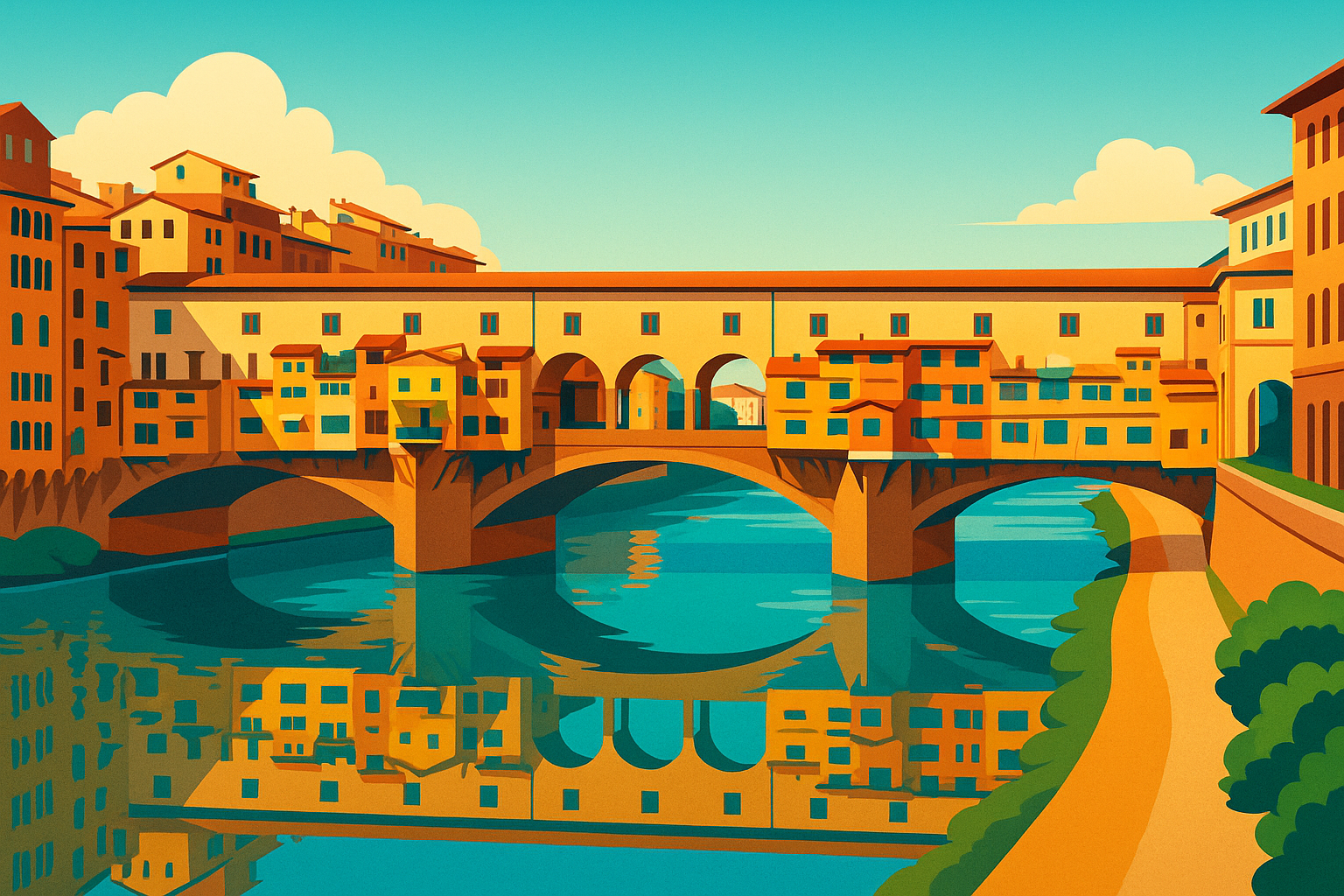
Ponte Vecchio
Experience the magic of Tuscany
Imagine driving through the Chianti hills, discovering medieval villages, and stopping for an aperitivo at sunset. Renting a car is the secret to experiencing Tuscany with true freedom. Book now for the best choice.
🔍 Choose your car for TuscanyGold, Ghosts, and Glory: The Ponte Vecchio’s 700-Year Reinvention
To walk the Ponte Vecchio is to walk through two cities at once. On the ground, you are in a bustling, modern-day marketplace, a river of tourists flowing between glittering 21st-century jewelry displays. But just overhead, hidden in plain sight, a second, secret path exists: the Corridoio Vasariano, or Vasari Corridor, an elevated tunnel built for paranoid dukes to glide, ghost-like, above the rabble.
This is the central paradox of Florence’s “Old Bridge.” It is both a medieval public thoroughfare and an icon of exclusive luxury; a 14th-century engineering marvel and a survivor of 20th-century warfare; a living museum and a frantic commercial hotspot. For centuries, its most exclusive feature—that “secret” corridor—was the stuff of legends and limited tours. But after an eight-year, €10-million restoration, the Vasari Corridor has officially reopened in late 2024, completely reimagined for the public. The bridge has, once again, reinvented itself. Understanding its layered history, from its foul-smelling medieval origins to its modern-day glamour, is the key to truly experiencing this unparalleled monument.
The Soul of the Bridge: Atmosphere and Symbolism
Visiting the Ponte Vecchio is an experience of profound contrasts, entirely dependent on the hour of your visit. Arrive at 2:00 PM on a Tuesday, and you will find less of a bridge and more of a slow-moving crush of humanity. The air is thick with the sounds of a dozen languages and the blinding glare of shop windows reflecting the Tuscan sun. This is the bridge as a commercial entity, a “hotspot” so popular it can feel overwhelming, a place to endure rather than enjoy.
But return at 7:00 AM, before the shops creak open, or stroll its ancient stones at 10:00 PM, long after they have closed. The atmosphere is transformed. The iconic wooden shutters of the shops, often described as “treasure chests” when closed, are bolted shut, restoring the bridge’s rugged, medieval silhouette. The only sounds are the steady rush of the Arno below and the echo of your own footsteps, joining those of locals using the bridge for its original, simple purpose: to cross the river.
In these quiet hours, you can feel its true symbolism. The Ponte Vecchio is not just a structure; it is a testament to Florentine resilience. It is the city’s oldest and only bridge to survive the Nazi retreat in 1944, a catastrophic 1966 flood that nearly tore it from its foundations, and even a 1993 Mafia bomb that damaged the Vasari Corridor. In the quiet, you can feel its history—a survivor standing firm while the city flows around and beneath it.
From Blood and Guts to Gold and Glitter: A History
The bridge’s glamorous identity is a relatively recent invention. For most of its life, it was defined by grit, disaster, and an unforgettable smell. While a bridge has likely stood here since Roman times, connecting the ancient settlement of Florentia to the Via Cassia Nova, the structure we know today was born from catastrophe.
A Bridge Built from Disaster
On November 4, 1333, a cataclysmic flood swept through Florence, a wall of water that “destroyed it almost completely.” The city, undeterred, rebuilt it, completing the current bridge by 1345. This new version was a marvel of medieval engineering, but its purpose was grimily practical. In 1442, city authorities obliged all butchers, tanners, and fishmongers to move their shops onto the bridge. This was not an honor; it was a medieval waste-management solution. It isolated the “foul-smelling and polluting waste” from the city center and allowed merchants to dump blood and offal directly into the Arno below.
This squalor defined the bridge for over a century, until a paranoid duke demanded a makeover. In 1565, Grand Duke Cosimo I de’ Medici wanted a private, secure passageway from his government office (Palazzo Vecchio) to his new home (Palazzo Pitti) on the other side of the river. He commissioned Giorgio Vasari to build the “Vasari Corridor” in just five months. This kilometer-long tunnel ran from the Uffizi, over the shops of the Ponte Vecchio, and into the Oltrarno district.
This created a problem. The Grand Duke, walking in his elevated private passage, could not “tolerate the unpleasant odors” rising from the butcher shops below. In 1593, his successor, Ferdinand I, issued a decree: all “base” trades were to be expelled, replaced by the only trades deemed noble enough for the location: goldsmiths and jewelers. In a single moment, the bridge’s identity was forever changed, transformed by royal decree from a bloody, smelly market into the icon of glittering luxury we see today.
The Survivor of the Arno
This was not the bridge’s last brush with history. On the night of August 3-4, 1944, retreating Nazi forces enacted Operation Feuerzauber, detonating mines to destroy all of Florence’s bridges and slow the Allied advance. All were destroyed, except one. Why the Ponte Vecchio was spared is a debate that reveals the bridge’s mythic status.
- The Official Story: A plaque on the bridge honors Gerhard Wolf, the German consul in Florence. A devoted art lover, he is said to have used his “decisive role” and diplomatic influence to persuade his superiors to save the bridge.
- The Military Story: Others point to a direct order, perhaps from Hitler himself, who had been charmed by the bridge on a 1938 visit. A more pragmatic theory suggests Field Commander Kesselring, already facing Hitler’s “fury” for not destroying Rome’s bridges, made a military compromise: spare the culturally priceless bridge, but demolish the ancient medieval buildings on both ends to render it impassable. This is precisely what happened.
- The Local Legend: A beloved, more recent story, published in 2016, credits a local hero named “Burgasso.” A disabled shop assistant, he was underestimated by soldiers and allowed to roam freely. Legend says he found the mines and “cut the wires” himself.
The truth is likely a combination of all three—a confluence of high command, diplomatic courage, and local bravery that secured the bridge’s survival for future generations.
Architectural Marvels, Hidden in Plain Sight
The 1345 bridge is an architectural masterpiece, a direct response to the flood that destroyed its predecessor. Instead of the typical, narrow Roman semi-circular arches, the design (attributed to Taddeo Gaddi or Neri di Fioravante) employed three revolutionary “closed-spandrel segmental arches.” These wide, flattened arches—the central one spanning an impressive 30 meters (98 feet)—were stronger and allowed a far greater volume of water and debris to pass underneath, an innovation born from bitter experience.
The bridge’s most famous features are the sporti, the “suspended” shops that seem to cling precariously to the sides, hanging out over the river on wooden braces. This was a clever medieval method of maximizing valuable shop space on a narrow footprint. While the jewelry shops dominate, two features reward the curious visitor.
What to Look For
- The Sundial: Look up. On the roof of a shop in the central piazza, you can spot an ancient 14th-century marble sundial. Next to it, a plaque, now almost illegible, reportedly commemorates the 1333 flood and the 1345 reconstruction—a direct physical link to the bridge’s origin story.
- The Cellini Bust: The central piazza is marked by a 1901 bronze bust of the 16th-century goldsmith Benvenuto Cellini. This bust’s railing was, for years, the infamous site of “love locks.” This tradition is decisively over. The city removed 5,500 locks in 2006 and now enforces a hefty €160 fine for attaching new ones.
The Reborn Vasari Corridor
The bridge’s greatest architectural feature, however, has been hidden for eight years. The Vasari Corridor, which runs over the shops on the eastern side, has reopened as of December 2024. The old self-portrait gallery is gone, replaced by a curated historical walk featuring 300 ancient Greek and Roman inscriptions, 16th-century frescoes, and moving memorials to the 1993 Mafia bombing and the 1944 Nazi destruction. It is now, for the first time, fully wheelchair accessible. A combined ticket for the Uffizi and Corridor costs approximately €43–€47 and must be booked well in advance.
Your Visit: A Practical Guide
This is the most critical logistical point for any visitor: the bridge is a public street, while the shops are private businesses.
Opening Hours and Duration
The Ponte Vecchio itself is a public thoroughfare, accessible 24 hours a day, 7 days a week, with no admission fee. You can and should walk across it at sunrise or midnight. The shops, however, generally follow typical Italian retail hours: approximately 10:00 AM to 7:00 PM, though many may close for a long lunch (riposo) and hours vary by season.
For a visit, 30 to 60 minutes is more than enough time. This allows for a stroll from one side to the other, time to browse a few shop windows, a pause at the central piazza for the river view, and, of course, the requisite photos.
How to Get There
The Ponte Vecchio sits in the heart of Florence’s historic center, a Zona a Traffico Limitato (ZTL), or restricted traffic zone, where non-resident vehicles are prohibited. The only way to reach the bridge is on foot.
It is an easy and delightful 15-minute walk from the city’s main train station, Santa Maria Novella (SMN). From the station, you can wind your way through the central market area, past the Duomo, through Piazza della Signoria, and straight on to the bridge. For visitors with mobility concerns, the small, electric Autolinee Toscane (ATAF) buses (lines C1, C3, and C4) navigate the narrow streets of the centro storico and have stops near the bridge’s approaches.
Facilities and Safety
It is essential to set expectations: the Ponte Vecchio is a 14th-century monument, not a 21st-century shopping mall. Facilities are extremely limited.
There are no public restrooms on or near the bridge. Finding a bathroom in this part of Florence is notoriously difficult. You will need to patronize a nearby bar (cafe) or gelateria to use their facilities. The “services” available on the bridge are the shops themselves: dozens of high-end jewelers, a few art dealers, and souvenir sellers.
A critical warning: because of the extreme crowds, the bridge is a well-known hotspot for professional pickpockets. Secure your valuables, wear bags cross-body, and be aware of your surroundings at all times.
When to Go for the Best Experience
The best time to visit the Ponte Vecchio is, unequivocally, not during the day. Between 10:00 AM and 7:00 PM, the bridge is less a place to be seen and more a crowd to be survived.
For a truly magical and romantic atmosphere, plan your visit for the early morning (before 9:00 AM) or the late evening (after 8:00 PM). At dawn, the “golden hour” light is spectacular, and you will share the bridge with only a few joggers and delivery carts. In the late evening, the lights from the shops reflect on the Arno, the wooden shutters are closed, and the path is clear. In these quiet moments, you can finally appreciate the history and architecture you came to see.
Beyond the Bridge: Exploring the Oltrarno
The Ponte Vecchio is not a standalone destination; it is the grand gateway to one of Florence’s most authentic neighborhoods: the Oltrarno, which literally means “the other side of the Arno.” Your visit is incomplete if you don’t cross the bridge and explore this district.
The most famous destinations here are the monumental Palazzo Pitti, the Medici’s former residence, and its sprawling, magnificent Boboli Gardens. Further up the hill, a 20-minute walk will take you to Piazzale Michelangelo, which offers the definitive panoramic snapshot of the entire city.
But for a true insider experience, your first stop should be a hidden gem just 50 feet from the bridge’s southern exit: the Church of Santa Felicita. It is one of the oldest churches in Florence, but it holds two secrets. First, it contains the “Deposition,” a breathtaking, vividly colored masterpiece by the Mannerist painter Pontormo. Second, look up at the internal facade: you will see a large, grated window. This is part of the Vasari Corridor, which cuts directly through the church. The Medici family would stand behind this screen to attend mass, completely hidden from the public below. It is a tangible, free-to-visit piece of the bridge’s aristocratic history.
Capturing the Perfect Photo
The single most important piece of advice for capturing the Ponte Vecchio is to get off the bridge. The worst photos are taken on it, amidst the crowds.
- Ponte Santa Trinita: This is the iconic shot. Walk to the next bridge west (downriver). From its center, you have the perfect, unobstructed, full-length view of the Ponte Vecchio, its arches, and its sporti reflected in the water. This is the definitive spot for sunset photography.
- Piazzale Michelangelo: This hilltop plaza provides the famous panoramic view of all of Florence. From here, you can see how the bridge fits into the entire city skyline, with the Duomo and Palazzo Vecchio in the background.
- The Uffizi Gallery: The windows in the western wing of the Uffizi, near the museum’s cafe, offer a beautiful, high-angle view looking down on the bridge and the Vasari Corridor as it makes its crossing.
A Final Word of Advice
The Ponte Vecchio is a living monument, a place of constant, seven-century-long reinvention. It has evolved from a Roman crossing to a medieval waste-disposal system, to an aristocratic symbol, and now to a global icon of luxury. The most exciting evolution in a generation is the reopening of the Vasari Corridor. It is a must-do, but you must plan for its new, rigid logistics.
The Vasari Corridor’s new route is one-way only, from the Uffizi to the Boboli Gardens. Do not check a bag at the Uffizi cloakroom, as you will exit a 15-minute walk away and will not be allowed to return.