
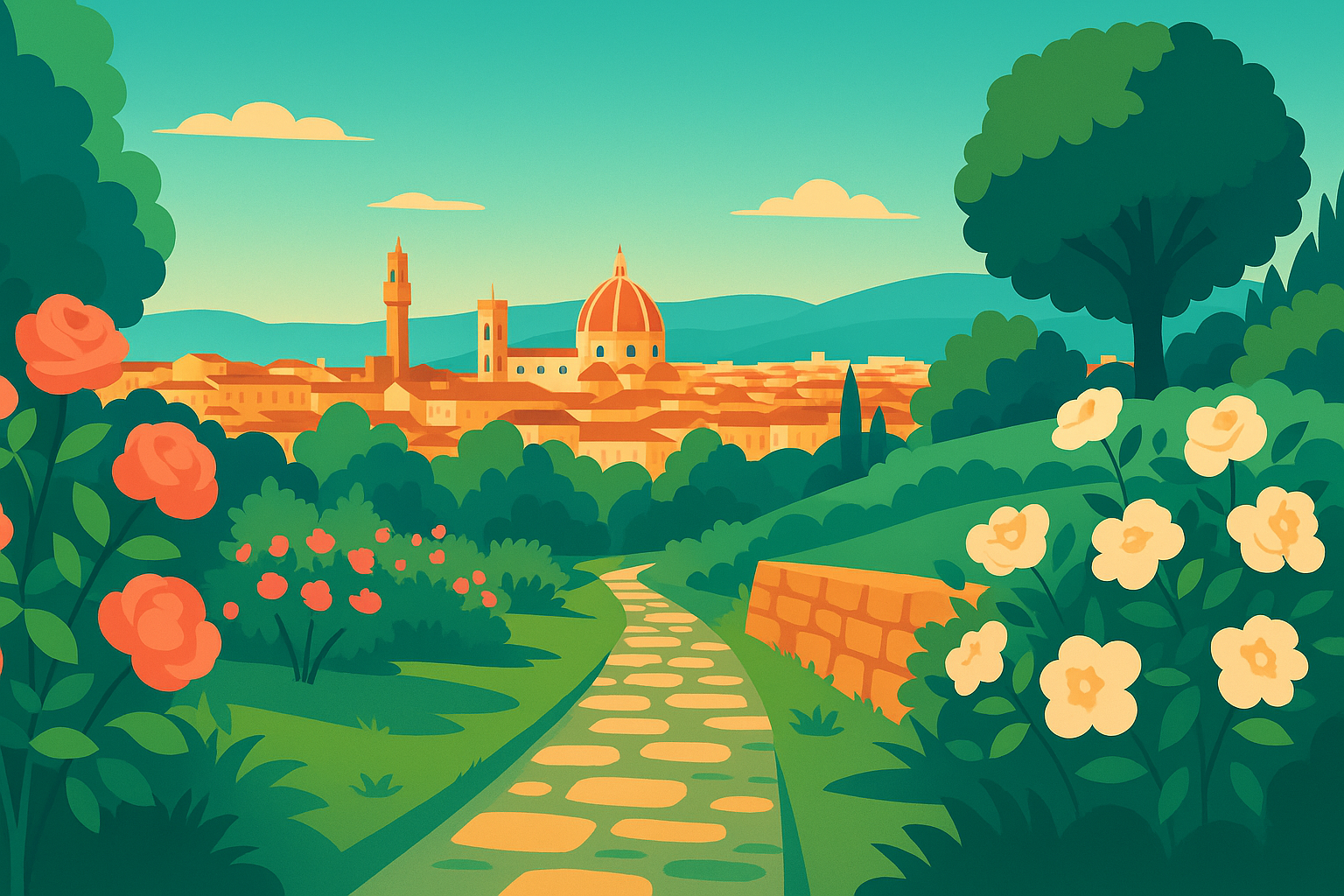
Rose Garden
Experience the magic of Tuscany
Imagine driving through the Chianti hills, discovering medieval villages, and stopping for an aperitivo at sunset. Renting a car is the secret to experiencing Tuscany with true freedom. Book now for the best choice.
🔍 Choose your car for TuscanyThe Secret Balcony of Florence: An Insider’s Guide to the Giardino delle Rose
Every traveler to Florence knows the magnetic pull of Piazzale Michelangelo. They arrive by bus or taxi, push through the crowds, and stand at the wide balustrade to capture the definitive postcard view of the city. But just meters below this crowded epicenter, hidden in plain sight, lies a more intimate, fragrant, and art-filled alternative: the Giardino delle Rose.
This terraced green oasis, sloping gently down the hill of Monte alle Croci, offers a perspective of the city that is arguably more magical than the one from the Piazzale above. Here, the extraordinary panoramic view of Brunelleschi’s dome and the Palazzo Vecchio is framed by the soft petals of ancient roses, the silver leaves of olive trees, and the whimsical lines of modern bronze sculptures.
It is an oasis of calm, a world away from the chaos of the tour groups jostling for a selfie. This is where Florentines come to read a book on the grass, where couples share a quiet moment at sunset, and where savvy travelers discover a place to pause and truly absorb the city’s staggering beauty. Best of all, unlike the city’s other grand gardens, this one is completely, wonderfully free.
A Symphony of Senses: The Atmosphere of the Garden
The garden’s primary function is not botanical, but emotional. It is a place designed for pausa—a deliberate, contemplative break from the museum queues and bustling streets. As you wander its terraced paths, the sounds of the city below are muffled, replaced by the breeze rustling through olive leaves and the delicate scent of over 400 varieties of roses.
This profound tranquility is curated by a trio of symbolic elements that blend seamlessly. First is the 19th-century romanticism of its original design. Architect Giuseppe Poggi created a bucolic natural setting of winding paths, low stone walls, and sloping lawns that invite you to linger, a sharp and welcome contrast to the rigid, formal geometry of Florence’s famous Renaissance gardens.
Second is the meditative quality of a real Japanese Shorai oasis, a gift from Florence’s twin city, Kyōto. This karesansui (dry rock garden) is a space of pure contemplation, a quiet corner that uses only stone and gravel to evoke landscapes of the mind. It is a sign of friendship and peace that encourages every visitor to slow their pace and their thoughts.
Finally, the atmosphere is defined by the gentle, surrealist art of Jean-Michel Folon. His bronze figures are scattered throughout the park, not as monuments on pedestals, but as companions on your journey. They sit on benches, sleep in the grass, and gaze at the sky, creating an environment of dream and suggestion that beautifully merges art, nature, and humanity.
From Capital Ambition to Public Oasis: A Brief History
To truly understand the Giardino delle Rose, one must understand the pivotal year of 1865. This is not a Medici garden born of Renaissance power; it is a monument to 19th-century Italian ambition. That year, Florence was declared the new capital of a newly unified Italy, taking the prestigious title from Turin.
This new status demanded a grand transformation. The city commissioned its most prominent architect, Giuseppe Poggi, to execute a massive urban renewal plan, or Risanamento. Poggi’s vision was to create a modern European capital, complete with the grand boulevards (the viali) that now encircle the old city center. His most scenographical project was the development of the hills on the Oltrarno side of the river. He designed the sweeping Viale dei Colli, a scenic promenade that would culminate in a magnificent panoramic terrace: the Piazzale Michelangelo.
Just below this new piazza, on a one-hectare terraced plot that had been a farm, he designed the Giardino delle Rose. The design was based on a fashionable French model, emulating the public parks of Paris. It was a political and cultural statement: Florence was no longer just a Renaissance relic but a modern, sophisticated capital. Though completed in 1865, the garden was first opened to the public in 1895 for the city’s “Arts and Flowers Festival,” cementing its public and floral vocation from the very beginning.
What to See: The Garden’s Three Unique Souls
The garden’s identity is a unique triptych, blending botany, Japanese philosophy, and modern art into a single, harmonious experience.
The Botanical Collection
While some sources mistakenly claim 1,000 rose varieties, the truth is more nuanced and just as impressive. The garden contains approximately 1,000 to 1,200 total botanical varieties, including a lovely collection of lemon trees. The heart of this collection is its namesake: 350 to 400 distinct varieties of roses. Most impressively, this includes a significant collection of “ancient roses,” with some specimens dating back to 1550. This makes the garden a living museum of horticulture, preserving species that predate modern cultivation and offering a fragrant link to centuries past.
The Japanese Shorai Oasis
Donated in 1998 by the city of Kyōto and the Kōdai-Ji Zen temple, this tranquil space was designed by architect Yasuo Kitayama. It is a classic karesansui (dry garden), using only rocks, gravel, and sand to evoke a natural landscape and invite quiet meditation. It offers a moment of pure minimalism and peace amidst the vibrant colors of the roses and the sprawling cityscape below.
The Folon Sculptures
The third and most transformative feature is the permanent exhibition of twelve bronze sculptures by the Belgian artist Jean-Michel Folon. Folon, who passed away in 2005, had a deep love for Florence and dreamed of leaving his work in a Tuscan garden. In 2011, his widow, Paola Folon, generously donated the collection to the city. This single addition was the catalyst that changed the garden forever. Previously, the garden was only open to the public in May and June for the rose bloom; the sculptures provided a compelling, year-round reason to visit, prompting the city to open the gates permanently for all to enjoy.
Planning Your Visit: Practical Information
One of the garden’s most appealing features is its accessibility. It’s a world-class experience that costs nothing to enter.
Opening Hours & Admission
Admission to the Giardino delle Rose is completely free. This stands in wonderful contrast to the city’s other major gardens, such as the Boboli and Bardini, which require paid tickets.
The garden opens reliably every day of the year at 09:00 (9:00 AM) and closes at sunset. However, “sunset” is a seasonal variable, and the gates are locked promptly. It is essential to know the specific closing time for your visit, which varies significantly by month:
- May – September: 9:00 AM – 8:00 PM (20:00)
- April: 9:00 AM – 7:00 PM (19:00)
- March & October: 9:00 AM – 6:00 PM (18:00)
- November – February: 9:00 AM – 5:00 PM (17:00)
We recommend allotting 60 to 90 minutes for a comfortable visit. This provides enough time to explore all the terraces, interact with the sculptures, and take ample photographs. However, for those looking to truly embrace the garden’s spirit—by bringing a book, enjoying a picnic, or simply watching the light change over the city—a full afternoon is easily and joyfully spent.
How to Get to the Giardino delle Rose
There are two primary ways to reach the garden, each offering a distinct experience.
By Bus (The Easy Way): This is the most straightforward option, ideal for those with limited time or mobility. From the city center (near the Santa Maria Novella station or Piazza San Marco), take bus line 12 or 13. Both lines travel up the hill and stop directly at Piazzale Michelangelo. From the Piazzale, face the city view, and you will find the garden’s upper entrance (Viale Giuseppe Poggi) a short, pleasant walk downhill to your left.
On Foot (The Scenic Way): This is the local’s route and by far the most rewarding. The journey begins in the charming, artisan-filled Oltrarno neighborhood of San Niccolò. From the Porta San Miniato, you begin your ascent. The climb is steep, following the stone steps of the Scalea del Monte alle Croci. As you climb, the city reveals itself in glimpses, building anticipation. The garden’s main entrance will appear on your left, offering a perfect place to rest and savor the panorama you just earned.
Facilities and Accessibility
The Giardino delle Rose is well-equipped for a comfortable visit. Unlike many public parks, it features public restrooms, which are available for a small €1 fee. There is also a small café on one of the upper terraces, the perfect spot to grab an espresso or an Aperol Spritz to enjoy with the view.
Crucially, picnics are permitted and are a central part of the garden’s culture. You will see many locals and students lying on the grass with a panino or a small spread. This makes the garden one of the best budget-friendly lunch spots in all of Florence.
In terms of accessibility, the garden is officially listed as “partially accessible.” While the main pathways are paved and manageable for strollers, it is fundamentally a terraced, hillside space with steep inclines and some steps. Visitors with mobility impairments should use the upper Viale Poggi entrance and remain on the top levels, which still offer magnificent views and access to the café.
When to Go: Finding Your Perfect Moment
The “best” time to visit the garden depends entirely on your priority.
For peak floral beauty, the answer is unequivocal: May and June. During these two months, the 400 varieties of roses are in a riotous, fragrant bloom, transforming the hillside into a tapestry of color. Late April is also an excellent time to catch the first blossoms.
However, thanks to the permanent Folon sculptures and the Japanese oasis, the garden is a wonderful destination year-round. For atmosphere and photography, the time of day is key. An early morning visit, just after the 9:00 AM opening, offers cool air, the strongest rose fragrance, and a chance to experience the park in near-solitude. Conversely, the late afternoon “golden hour” leading up to sunset provides the most magical light, illuminating the city’s terracotta roofs and stone facades in a warm, ethereal glow.
Beyond the Roses: Exploring the Oltrarno Heights
The Giardino delle Rose is the perfect anchor for exploring a cluster of major attractions on the hill of Monte alle Croci. We recommend connecting your visit into a logical half-day walking tour.
- Start at the Giardino delle Rose. Give yourself at least an hour to soak it all in.
- Visit the Giardino dell’Iris. If you are visiting during its brief opening season (typically late April to late May), the adjacent Iris Garden is a must-see. It’s dedicated to Florence’s signature flower and is located just to the east of Piazzale Michelangelo.
- Climb to Piazzale Michelangelo. After the garden, continue the short walk uphill to the Piazzale itself. While crowded, it is an essential stop for the classic, unobstructed, wide-angle photograph of the city.
- Ascend to the Basilica di San Miniato al Monte. This is the true crown of the hill. Continue walking past the Piazzale, up the final grand staircase, to this 11th-century masterpiece. It is one of the finest examples of Romanesque architecture in Tuscany, and its interior, cemetery, and the view from its terrace are of inestimable cultural and historic value.
Capturing the Magic: Best Photo Spots
The garden is a photographer’s dream. Go beyond the general panorama and seek out these specific, iconic shots:
- Partir (The Suitcase): This is the most famous sculpture. Don’t just photograph the artwork; use the open bronze suitcase as a clever frame for the Duomo and Palazzo Vecchio in the distance.
- Je me souviens (I Remember): Find the sculpture of the man reading on a bench. The artist left the other half of the bench empty, inviting visitors to sit next to him. It’s the perfect, contemplative self-portrait.
- Chat (The Cat): The large, sleepy bronze cat is a local favorite. Reclining on the grass next to it, with the roses and city behind, is a classic, whimsical shot.
- The Rose Foreground: In May or June, walk down to the lower terraces and shoot back up at the city, using the heavy blooms of the ancient roses to create a rich, colorful foreground that tells the garden’s full story.
A Final Word
The Giardino delle Rose is far more than a simple park. It is a historical statement, a living botanical museum, and an open-air art gallery, all offered to the public for free. It encapsulates the best of Florence: beauty that is both natural and man-made, a deep connection to history, and an atmosphere that prizes contemplation over commerce.
Insider’s Tip: Many travelers make the mistake of treating Piazzale Michelangelo as their destination. Treat it as a waypoint. The superior experience is to earn the view by walking up from San Niccolò, pausing for an hour in the Giardino delle Rose, and then continuing past the crowded Piazzale to the silent, ancient beauty of San Miniato al Monte. That is the perfect Florentine afternoon.