
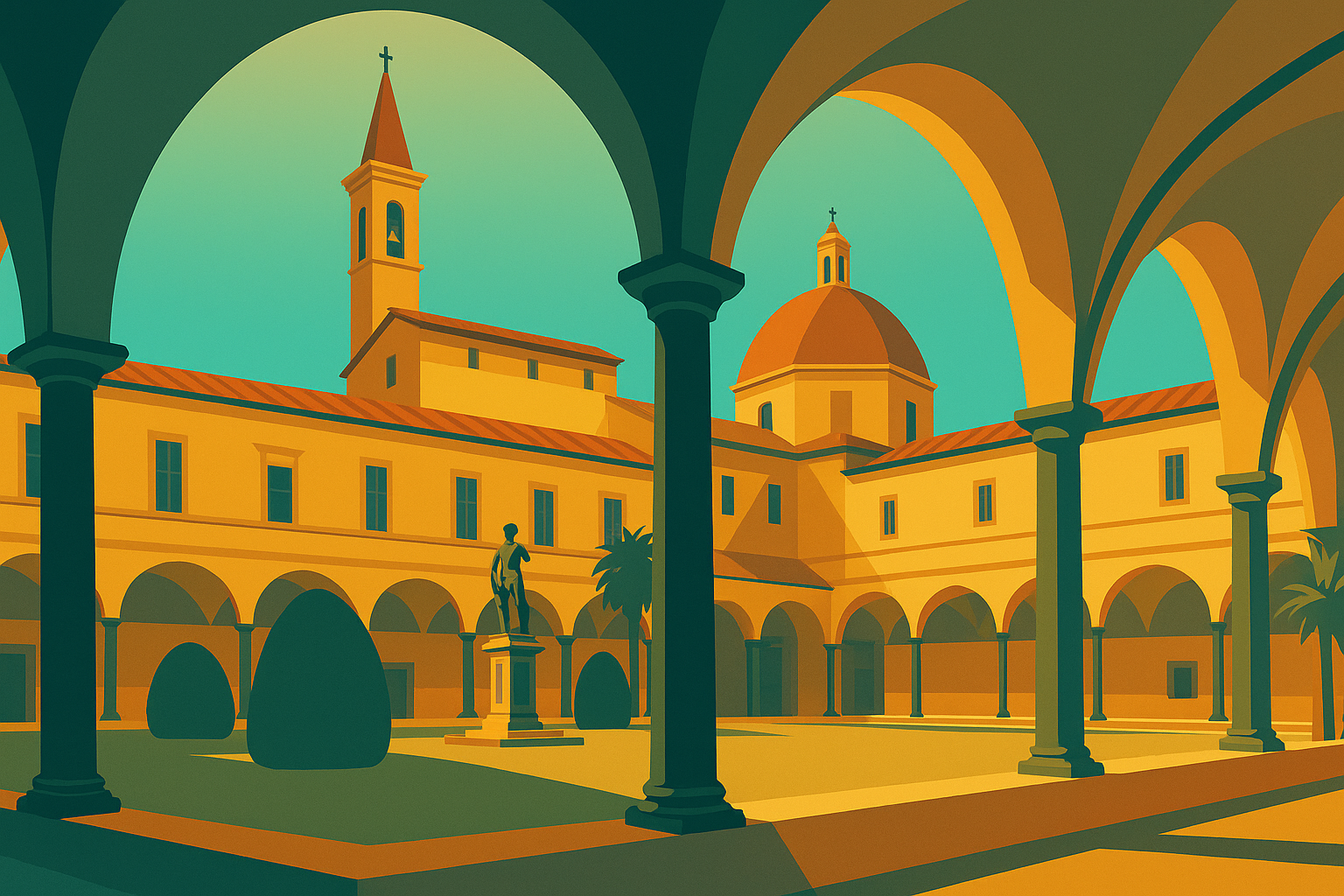
San Marco Museum
Experience the magic of Tuscany
Imagine driving through the Chianti hills, discovering medieval villages, and stopping for an aperitivo at sunset. Renting a car is the secret to experiencing Tuscany with true freedom. Book now for the best choice.
🔍 Choose your car for TuscanyWhere Angels Paint and Prophets Preach: A Journey into Florence’s Museo di San Marco
In a city defined by blockbuster museums, where visitors queue for hours to see masterpieces gathered from across the continent, the Museo di San Marco is a profound exception. It is not, in the traditional sense, a museum at all. It is an act of preservation, a 15th-century Dominican convent where the art has never moved, because it was painted directly onto the walls for a specific, sacred purpose. To walk through these cloisters is to experience Renaissance art as it was intended: not as a “work” to be viewed, but as a functional, spiritual tool.
This is a “painted prayer,” a physical and spiritual time capsule that offers a quiet, contemplative refuge from the crowds at the nearby Uffizi and Accademia. The story of this extraordinary space is told by the three men whose ghosts still linger in its halls. First, the patron, Cosimo il Vecchio de’ Medici, who poured his immense fortune into rebuilding the convent as both a monument to his power and a desperate plea for his soul. Second, the artist, Fra Angelico, the “Angelic Friar,” a Dominican monk who translated complex theology into transcendent light and colour. And third, the prophet, Fra Girolamo Savonarola, the convent’s later, fiery prior, who rejected the very humanism that built his home and met a brutal end. This is a journey into the “two convents” of San Marco: the silent, humanist masterpiece of Angelico and the fiery, apocalyptic stage of Savonarola.
An Ascent into Light and Silence: What to See at San Marco
The genius of San Marco lies in the architecture of Michelozzo, who created a space perfectly suited to its Dominican function: sober, elegant, and harmonious, designed to encourage a calm, contemplative life. Your visit is structured by his design, a journey that moves from the public world to the intensely private inner life of the monks.
The Ground Floor: Public Art and Sacred Life
You enter through the serene Sant’Antonino Cloister, a perfectly proportioned space whose graceful arches immediately set a tone of sacred silence. This is the heart of the convent’s communal life, and from here you can access several key rooms.
The Sala dell’Ospizio (Pilgrim’s Hospice) is where the convent once sheltered travelling pilgrims. Today, it houses the world’s largest collection of Fra Angelico’s panel paintings. This is where you see his “public-facing” work, created for altars and chapels. Stand before the magnificent Deposition from the Cross and the Tabernacle of the Linaioli to appreciate the brilliant colour, complex compositions, and lavish detail he employed for a wider audience.
Nearby is the Small Refectory, the dining hall for convent guests. Here, one entire wall is covered by a stunning, detailed Last Supper by Domenico Ghirlandaio. His mastery is in the realistic details that bring the scene to life. Look for the cat sitting patiently, the peacock in the window (a symbol of immortality), and the virtuoso rendering of the transparent water carafes, through which you can see the apostles’ hands.
The Spiritual Gateway: Fra Angelico’s Annunciation
The journey from the ground-floor cloister to the first-floor dormitories is a literal and symbolic ascent. As you climb the stairs, you are met by a single fresco that defines the entire complex: Fra Angelico’s Annunciation (c. 1440–1445).
This is not a grandiose, gold-leafed altarpiece. It is quiet, pale, and profoundly humble. The scene is set within a simple loggia, whose graceful arches and slender columns directly mirror the architecture of the very convent you are standing in. This deliberate choice grounds the divine event in the monks’ daily reality. The angel Gabriel and the Virgin Mary are depicted with a gentle, silent reverence, their forms rendered in soft peach tones and luminous ultramarine. The focus is not on drama, but on Mary’s humble acceptance—her “yes” to God.
This fresco is a masterpiece of spiritual engineering. It was placed precisely at this landing to intercept every monk on his way to his private cell. It was a command, a spiritual checkpoint, reminding him to emulate Mary’s humility and purity of heart before beginning his own contemplation. Lest this function be misunderstood, an inscription runs along the bottom, speaking directly to the friar: Virginis Intacte Cvm Veneris Ante Figvram Preterevndo Cave Ne Sileatvr Ave. This translates to: “When you come before the image of the Ever-Virgin, take care that you do not neglect to say an Ave.”
The First Floor: The Monks’ Cells and the Library of Humanism
Past the Annunciation, you enter the heart of the experience: the Monks’ Cells. Here you walk down a long, silent corridor, peering into 44 spartan rooms. Each features a small, sparse fresco by Angelico or his workshop, depicting a scene from the life of Christ. These were not “art” in our sense. They were aids to contemplation and meditation. Their spare, simple style was intentional; they were meant to be finished in the mind of the monk who prayed before them for hours on end.
Finally, at the end of the dormitory, you enter the architectural crown jewel: the Biblioteca di Michelozzo (Michelozzo Library). This 45-meter-long hall was revolutionary. Michelozzo designed a “basilica for books,” a light-filled, airy space divided into three naves by a double row of slender, “thin ionic columns.” It is a physical manifesto of Renaissance Humanism, designed as a “workshop for the mind.” Critically, it was one of the first libraries in Europe to be “open to everybody who wish to study,” housing the legendary manuscripts of the Medici, Pico della Mirandola, and Poliziano.
The Two Souls of San Marco: Medici Power and Savonarola’s Fire
To understand San Marco is to understand the two powerful, opposing forces of the 15th century that it housed. The building tells a story of two different priors, two different visions of Florence, and two different worlds.
Cosimo de’ Medici: Penance and Power
The first world was that of the early Renaissance, a world of enlightened piety and humanist power, embodied by Cosimo de’ Medici. The site was an older, ruined convent given to the Observant Dominicans. In 1437, Cosimo il Vecchio commissioned his favourite architect, Michelozzo, to rebuild the entire complex. This was no simple act of charity. As the head of the Medici bank, Cosimo was burdened by the mortal sin of usury (charging interest on loans). His funding of San Marco was a “lavish expense” that, by official decree of Pope Eugenius IV, served as expiation for his sins.
Simultaneously, the project was a “preeminent public expression of Medici piety, patronage and political power.” By funding this major convent, Cosimo created a Medici stronghold in the heart of the city. He even had his own personal double cell built in the dormitory (Nos. 38–39), a private space for both prayer and politics, where he could retreat from the world like a friar.
Girolamo Savonarola: The Apocalyptic Prophet
A half-century later, the convent’s character changed completely under its most famous prior: Fra Girolamo Savonarola. A charismatic, apocalyptic preacher, Savonarola made San Marco his headquarters from 1489. He launched furious sermons against the corruption of the papacy, the “pagan” Humanism of the Renaissance, and the worldly luxury of the Medici.
He took control of the city and famously organized the “Bonfire of the Vanities” in 1497, convincing Florentines to burn their art, “heretical” books, and luxurious items in a massive pyre in the Piazza della Signoria. Savonarola’s rule was short-lived. He was excommunicated by the Pope, and in 1498, an angry mob stormed the convent of San Marco to arrest him. He was tortured and, in a final, brutal irony, was hanged and burned on the exact spot where he had held his bonfire. A visit today is a physical walk through this narrative. You can stand in the quiet, contemplative cell of Cosimo de’ Medici and, just a few doors down, stand in the stark cell of Savonarola, which still contains his desk, his simple chair, and relics of his fiery, tragic life.
Planning Your Visit: Hours, Tickets, and Practical Tips
Planning a visit to San Marco requires precision. Unlike the Uffizi, it is not an all-day museum. Its hours are famously and frustratingly limited.
Opening Hours and Tickets
The museum operates on a complex schedule. It is generally open from Tuesday to Saturday, 8:30 am – 1:50 pm (13:50). It also opens on the 1st and 3rd Sunday and the 2nd and 4th Monday of each month, during the same hours. It is closed on the 1st and 3rd Monday, and the 2nd, 4th, and 5th Sunday of the month, as well as on January 1, May 1, and December 25.
Last admission is critical: the ticket office closes at 1:20 pm (13:20), and staff begin clearing the museum by 1:40 pm (13:40). Do not arrive after 12:30 pm if you want a meaningful visit.
Current admission prices are:
- Full Ticket: € 8,00
- Reduced Ticket: € 2,00 (for EU citizens aged 18–24)
- Reservation Fee: € 3,00 (recommended during high season)
Be aware of a significant upcoming change: starting from September 26, 2025, the full ticket will cost € 11,00.
Though some guides suggest 45 minutes, this is far too short. To properly experience the ground-floor cloister, the panel paintings, Ghirlandaio’s Last Supper, and to then thoughtfully walk the entire first-floor dormitory, you must allocate 90 to 120 minutes.
Facilities and Accessibility
The museum’s facilities are functional. A free cloakroom is available near the entrance where you must check large bags, backpacks, and umbrellas. A high-quality bookshop is located on the ground floor, inside the Small Refectory. The museum does not have its own audio guide, so we recommend bringing a good guidebook or using this article to understand the art’s specific context.
Accessibility is a crucial, nuanced point. The museum is wheelchair accessible via a movable platform at the entrance and a platform lift to the first floor. However, please note this critical distinction: unlike the Uffizi and Accademia, San Marco is NOT free for disabled visitors. This is an important exception to the rule for other Italian state museums and can catch many travellers by surprise.
How to Get to the Museo di San Marco
The Museo di San Marco is located on Piazza San Marco, a large, busy square that serves as a major transportation hub. It is very easy to reach.
- On Foot (Recommended): This is the best way to approach the museum. It is ideally situated in the historic centre, just a 10-minute walk north of the Duomo and less than 100 meters from the Galleria dell’Accademia.
- From Santa Maria Novella (SMN) Train Station: A pleasant 20- to 25-minute walk takes you through the San Lorenzo market area. Alternatively, numerous Autolinee Toscane buses (including lines C1, 6, 14, 17, 23, and 32) stop directly at “San Marco Piazza” in under 10 minutes.
- By Tram: The T2 tram line, which runs from the Florence airport, has a dedicated “San Marco” stop, making it extremely convenient for those coming from that direction.
Do not attempt to drive to the museum. It is located deep inside the ZTL (Zona a Traffico Limitato), which is restricted to authorized vehicles.
When to Go: The Secret to Experiencing San Marco
For a quality visit, this is non-negotiable: arrive at 8:15 am, right when it opens. The entire power of San Marco is its contemplative, monastic atmosphere, which is completely shattered by 10:00 am as tour groups arrive. For the first hour, you can walk the cloisters and cell corridors in near-total silence, experiencing the space exactly as the friars did. The soft, angled morning light is also perfect for viewing the frescoes, especially the Annunciation at the top of the stairs. Finally, with a hard-stop closure at 1:50 pm, arriving late creates a stressful, rushed visit.
Treat your visit like a morning ritual. Arrive at 8:15 am. The museum is a place of profound silence, and for the first hour, you will have the cloisters and cells almost entirely to yourself.
Capturing the Convent: Best Photo Spots
Photography is permitted, but no flash is allowed. The cells and corridors are dim, so a camera that performs well in low light is ideal.
- The Annunciation: Stand at the top of the dormitory stairs. Use the arch of the corridor to perfectly frame the painting, emphasizing its role as a “gateway.”
- The Michelozzo Library: Stand at the far end and shoot down the central aisle to capture the vanishing point. The power of the shot is the rhythmic repetition of the columns and the soft light flooding in from the side windows.
- The Sant’Antonino Cloister: Stand in the covered walkway and shoot through one of the arches to frame the central garden and bell tower, creating a powerful sense of depth and tranquility.
- The Cells: Don’t just shoot the fresco; capture the context. Frame your shot with the cell’s dark doorway, showing the small, spartan room with its single, powerful fresco inside.
- Ghirlandaio’s Last Supper: In the Small Refectory, you can get a wide, unobstructed shot of the entire wall, capturing the vibrant colours and intricate details.
Beyond the Cloister: Nearby Attractions
San Marco is the anchor of its own distinct cultural neighbourhood. You can easily build a perfect half-day itinerary around it.
- Galleria dell’Accademia: The home of Michelangelo’s David is less than a two-minute walk away. We recommend a “silence and spectacle” itinerary: visit San Marco at 8:15 am for quiet contemplation, then use a pre-booked 10:00 am ticket for the Accademia.
- Palazzo Medici Riccardi: A 5-minute walk south, this was the Medici family’s private palace. Visiting it after San Marco (the convent they funded) provides a complete view of their public penance and private power.
- The Church of San Marco: The museum is the convent, but the adjacent church (free to visit) is part of the same complex. Step inside to see the tomb of the great Renaissance philosopher Pico della Mirandola.
A Final Word of Advice: The Two Faces of Fra Angelico
In a city that can lead to overwhelming “museum fatigue,” San Marco is an antidote. It is not a place to “do” but a place to be. It is one of the few places on earth where you can stand in a small, 600-year-old room and see the exact same painting that a Dominican friar, or a Medici prince, saw from that very spot.
Here is a final tip to structure your visit: your experience has two parts. When you enter, first see the “public” art in the Pilgrim’s Hospice on the ground floor. Here you will find Fra Angelico’s brilliant, colourful, and complex panel paintings. Then, go upstairs to the dormitory. You will be immediately struck by the contrast. You will see how, for the private cell frescoes, Angelico withheld that colour and complexity, reducing each scene to its absolute spiritual essence for the private meditation of his brothers. Understanding this difference—between the art Angelico made for the world and the art he made for God—is the true genius of San Marco.