
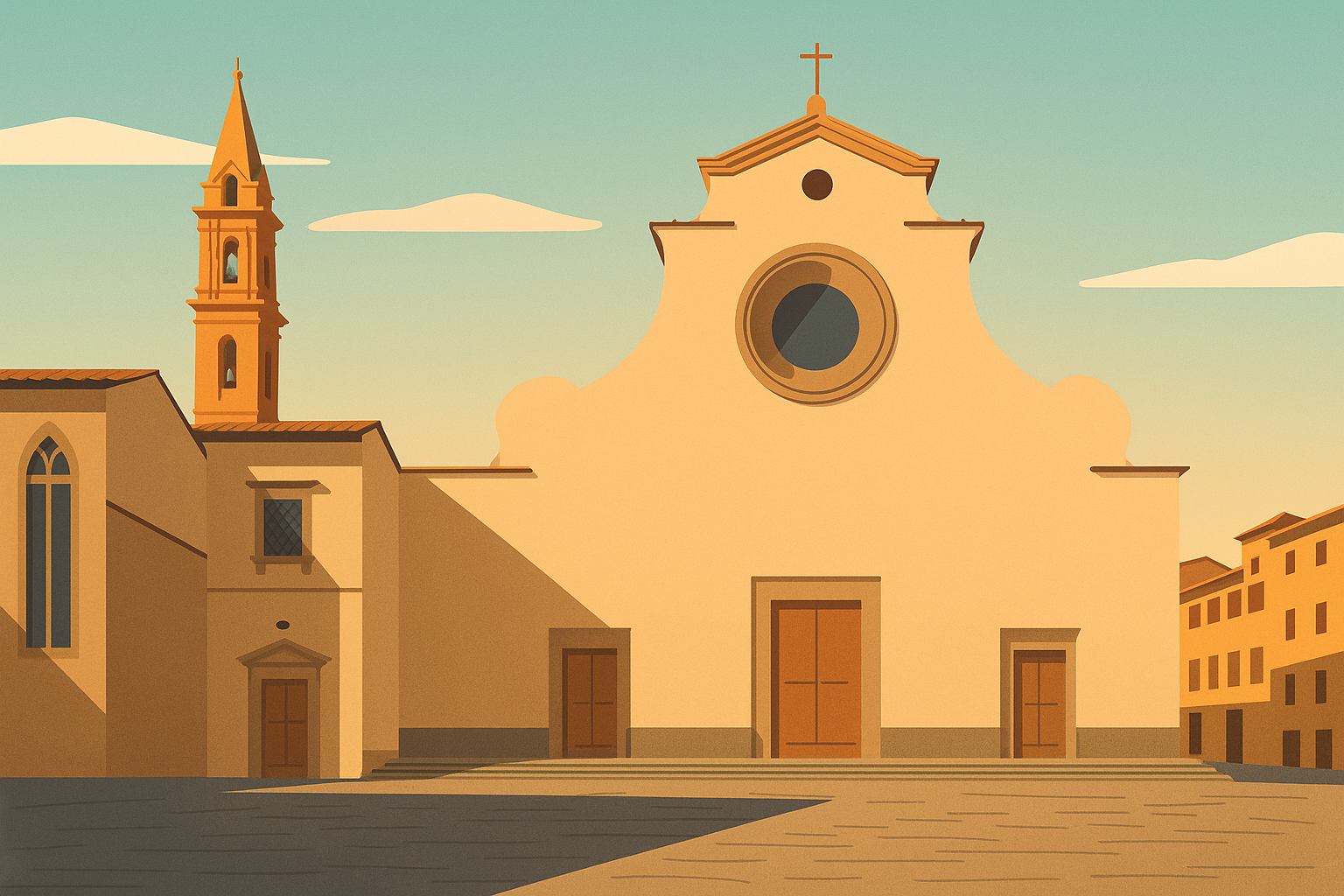
Basilica of Santo Spirito
Experience the magic of Tuscany
Imagine driving through the Chianti hills, discovering medieval villages, and stopping for an aperitivo at sunset. Renting a car is the secret to experiencing Tuscany with true freedom. Book now for the best choice.
🔍 Choose your car for TuscanyFlorence’s Soul: A Guide to Santo Spirito, Museo Novecento, and the City’s Hidden Heart
Florence, a city steeped in history and art, often presents its visitors with delightful puzzles. One such intriguing query, “Museo Novecento: Basilica di Santo Spirito,” links two profoundly important, yet entirely separate, institutions. The Museo Novecento, a vibrant museum dedicated to 20th-century art, stands proudly in the grand Piazza Santa Maria Novella, a bustling hub near the city’s main train station. Across the Arno, anchoring the bohemian Piazza Santo Spirito in the heart of the “other” Florence, lies the Basilica di Santo Spirito, a masterpiece of Renaissance purity.
These two sites are not physically related, nor do they share a direct artistic lineage. So, why the confusion? The answer, as we will discover, reveals one of the best-kept secrets for navigating Florence’s rich cultural landscape. Both the Museo Novecento and a distinct, lesser-known museum located within the Santo Spirito complex—the Fondazione Salvatore Romano—are managed by the same municipal system, the Musei Civici Fiorentini. A visitor planning their trip might easily see them listed together on official portals, creating a logical, yet ultimately incorrect, association. This guide will untangle this fascinating puzzle, providing you with a key to unlock three distinct Florentine experiences: the modern pulse of the Museo Novecento, the serene Renaissance purity of the Basilica di Santo Spirito, and the medieval secrets held within the Fondazione Salvatore Romano.
The Heartbeat of Florence: Piazza Santa Maria Novella vs. Piazza Santo Spirito
To truly understand these sites, one must first immerse themselves in the atmospheres of their respective piazzas, which represent two opposing poles of the Florentine experience. Piazza Santa Maria Novella is a place of formal grandeur and monumental beauty. Flanked by the stunning polychrome façade of its namesake basilica, it acts as a majestic gateway to the city—a place of arrival, orientation, and high tourism. The air here often hums with the chatter of international visitors, the distant rumble of trains, and the sense of a city proudly displaying its most iconic face. It is beautiful, impressive, and serves as an official, almost regal, introduction to the Renaissance city.
Piazza Santo Spirito, however, is something else entirely. This is not a gateway; it is a destination, a place to linger and absorb. Described affectionately as the “living room” of the Oltrarno and the “authentic soul” of Florence, this square is fiercely local, vibrant, and deeply rooted in daily life. By day, it hosts a lively daily market where residents buy fresh fruit, vegetables, and local produce, the scent of ripe tomatoes mingling with the murmur of Florentine dialect. As evening descends, its wide steps fill with students and locals, enjoying an aperitivo from the surrounding bars, their laughter echoing softly against the ancient stones. The piazza breathes with an unhurried, genuine rhythm, inviting you to simply be.
The Basilica’s role in this vibrant square is both symbolic and profound. Its famous façade is often described as “naked”—a vast, plain, unfinished plastered surface. While some architectural purists might deem this an “architectural failure,” its simplicity is, in fact, its greatest social success. Unlike the roped-off, monumental churches elsewhere in Florence, Santo Spirito’s plainness makes it an approachable, non-intimidating backdrop. Its wide, inviting steps are not a barrier but an open invitation, seamlessly becoming the piazza’s default public seating. This unique architectural choice enables the authentic, unscripted life of the square, rather than dominating or intimidating it. It’s a church that truly belongs to its people, a silent witness to generations of Florentine life.
Echoes of History: Fire, Flood, and Artistic Rebirth
The stories of these sites are woven with threads of dramatic events—fire, flood, and subsequent rebirths—each shaping their identity and significance. The tale of Santo Spirito begins in 1250, when Augustinian friars established a convent on this very site. It quickly blossomed into a major intellectual center, attracting and hosting luminaries of the age, including literary giants like Petrarch and Boccaccio. By 1434, the convent’s importance was such that the city commissioned the visionary Filippo Brunelleschi to design a new, magnificent church, a testament to the burgeoning Renaissance spirit.
However, the old church, a venerable structure, remained. The pivotal event that cleared the path for Brunelleschi’s grand vision occurred in 1471. During a sacra rappresentazione (a sacred play) staged within the church to honor a visiting duke, a fire broke out. The flames, theatrically intended to represent the “Descent of the Holy Spirit,” became terrifyingly literal, burning the old church and much of the convent to the ground. This disaster, though devastating, was also a profound creative opportunity, clearing the way for Brunelleschi’s new, modern vision to be fully realized, rising from the ashes.
Centuries later, a different kind of disaster gave birth to the Museo Novecento. The catastrophic 1966 flood of the Arno devastated Florence, damaging or destroying countless masterpieces of art and architecture. In response to this immense loss, the esteemed art historian Carlo Ludovico Ragghianti conceived of a remarkable idea: he invited artists to donate modern works to the city, to “compensate, with modern art, the damage that the flood had caused.” The museum, which finally opened its doors in 2014, is the beautiful fulfillment of that vision—an act of cultural healing, a powerful statement that 20th-century art could stand proudly beside the Renaissance and help mend a wounded city, offering new perspectives and a renewed sense of hope.
Architectural Wonders and Hidden Treasures
The initial query, though born of a slight confusion, brilliantly, if accidentally, touches upon three of Florence’s most unique artistic sites, each with its own compelling story and distinct architectural character.
Brunelleschi’s Final Manifesto: The Basilica di Santo Spirito
The Basilica di Santo Spirito stands as a preeminent example of early Renaissance architecture, representing the final, purest vision of Filippo Brunelleschi. Though he died in 1446, shortly after work began, his devoted followers executed his plans with a remarkable fidelity, creating a breathtaking experience for anyone who steps inside. The plain, almost austere façade acts as a deliberate veil, a stark contrast to the wonders within. Stepping across the threshold, the visitor is immediately transported into a world of perfect, rational geometry and serene harmony. The vast space is defined by a repeating rhythm of graceful arches, supported on 35 elegant Corinthian columns crafted from dark grey pietra serena (serene stone). This dark, cool stone contrasts beautifully with the pristine white plaster walls, creating a “slim and harmonious perspective” that effortlessly draws the eye forward, guiding your gaze towards the altar. Brunelleschi’s genius is particularly evident in his modular plan: 38 (or 40, depending on the count) identical semicircular chapels line the entire perimeter of the church, including the transept and apse, creating an unprecedented unity and flow of design that feels both grand and intimately human.
Michelangelo’s Secret: The Crucifix of Santo Spirito
The Basilica’s most famous single artwork is not immediately visible in the free nave but is hidden within the complex, a true treasure waiting to be discovered. In 1492, following the death of his influential patron Lorenzo de’ Medici, a young, then 17-year-old Michelangelo found refuge and support at the Santo Spirito convent. In an extraordinary exchange, the prior of the convent granted the budding artist a rare and illicit opportunity: to perform anatomical studies, dissecting corpses from the convent hospital. This clandestine access gave Michelangelo an unparalleled, firsthand understanding of the human body, a knowledge that would profoundly shape his future masterpieces.
As a “thank you” gift for this invaluable experience, he carved a life-sized wooden Crucifix for the prior. The work is stunning for its quiet, anatomical perfection and profound realism. The body of Christ is depicted as frail, delicate, and strikingly lifelike—a direct result of his secret studies. This remarkable work was “lost” for centuries, moved from the high altar and largely forgotten. It was dramatically rediscovered in a convent corridor in 1962 and is now the centerpiece of the “Augustinian Itinerary,” suspended majestically in the octagonal Sacristy (itself a masterpiece by Giuliano da Sangallo) for a truly immersive 360-degree view.
A Medieval Time Capsule: Fondazione Salvatore Romano
This is the “other museum” at Santo Spirito, the one that is part of the Musei Civici Fiorentini system and often causes the initial confusion. It is housed in the magnificent 14th-century Cenacolo (Refectory) of the original convent—a grand Gothic hall with an impressive timber-beam roof that miraculously survived the devastating 1471 fire. The room itself is an exhibit, a testament to medieval craftsmanship. Its entire back wall is covered by a monumental fresco (c. 1360-1366) by Andrea Orcagna and his workshop, depicting a grand Crucifixion above a fragmentary, but still powerful, Last Supper. Layered within this ancient, medieval space is the dense, personal collection of the antiquarian Salvatore Romano, who generously donated it to the city in 1946. It is a fascinating array of sculptures and fragments spanning from the Roman era to the 16th century, including significant works by masters like Tino di Camaino and Donatello. The museum is a true time capsule: Romano’s donation contract stipulated that the arrangement of his collection never be changed, and he is even buried there, in an early Christian sarcophagus from his own collection, forever intertwined with his treasures.
Modern Echoes: Museo Novecento
Finally, we return to the other museum from the initial query, the Museo Novecento. This modern art museum is located in the elegant 15th-century Spedale di San Paolo dei Convalescenti (also known as the Leopoldine) in Piazza Santa Maria Novella. Its collection tells the compelling story of 20th-century Italian art, anchored by the remarkable 241-work Alberto Della Ragione Collection. This collection is a “who’s who” of Italian modernism, featuring masterpieces by iconic artists such as Giorgio De Chirico, Filippo De Pisis, Gino Severini, Giorgio Morandi, Renato Guttuso, and Lucio Fontana. It is important to note that some online sources incorrectly confuse this museum with its namesake in Milan; the Florence museum does not feature a large spiral ramp or panoramic views of the Duomo. Its experience is more intimate and contemplative: a powerful dialogue between the vibrant expressions of modern art and the rational, harmonious 15th-century architecture of the former hospital that houses it.
Navigating Your Visit: Hours, Tickets, and Insider Strategies
Navigating this “three-entity” puzzle requires a clear plan, as the hours and ticketing systems for each component are completely separate. Understanding these distinctions is key to a smooth and enriching visit.
- Basilica di Santo Spirito (The Main Church)
- Admission: Free. The main nave and chapels are open to all.
- Hours: Open daily 10:00–13:00 and 15:00–18:00. On Sundays and holidays, it opens slightly later at 11:30.
- CLOSURE: Closed every Wednesday. Plan accordingly.
- Duration: Allow 30–45 minutes to appreciate the architecture and atmosphere.
- “Percorso Agostiniano” (Michelangelo Crucifix & Sacristy)
- Admission: €2.00. This small fee grants access to Michelangelo’s Crucifix and the beautiful Sacristy.
- Tickets: Paid in cash directly at the entrance to the itinerary, which is located inside the church, to the left of the main entrance. No online tickets are authorized for this specific part of the complex.
- Hours: Same as the Basilica (Closed Wednesdays).
- Duration: Adds 15–30 minutes to your visit, bringing your total time at Santo Spirito to 60–90 minutes.
- Fondazione Salvatore Romano (The “Cenacolo” Museum)
- Admission: €10.00. This is a cumulative ticket that also includes entry to the Brancacci Chapel, making a combined visit the most logical and economical approach. A standalone €5.00 ticket may exist, but it is not the primary or most recommended offering.
- Tickets: Purchased from the Musei Civici Fiorentini online portal or directly at the Brancacci Chapel ticket office.
- Hours: This is the most critical detail for planning. The museum has extremely limited hours, currently listed as open only on Saturday, Sunday, and Monday. (Sat/Mon: 10:00–17:00; Sun: 13:00–17:00).
- Duration: Allow 45–60 minutes to explore this unique collection and the Orcagna fresco.
- Museo Novecento (Piazza Santa Maria Novella)
- Admission: €4.50.
- Hours: Generous hours, typically 11:00–20:00. Always check the official site for the current closure day, which is often Thursday.
- Duration: Plan for 60–90 minutes to fully appreciate the collection.
The most common mistake visitors make is buying an expensive “skip-the-line” ticket for Santo Spirito online. The Basilica’s main nave is free, and the only fee—the €2.00 for the Michelangelo Crucifix—is paid in cash or at the desk at the Sacristy door. No online portal is authorized by the Augustinian Order for this specific ticket. Anyone selling you an expensive “ticket” to the Basilica is selling you something you do not need.
Getting There: Bridging Florence’s Two Souls
The two main locations, Piazza Santa Maria Novella and Piazza Santo Spirito, are situated on opposite sides of Florence’s historic center, each offering a distinct journey.
To Museo Novecento (Piazza Santa Maria Novella):
This is arguably the easiest location to find. The museum is located at Piazza Santa Maria Novella 10, directly adjacent to the famed Basilica of Santa Maria Novella. It is a convenient 5-minute, well-signed walk from the Firenze Santa Maria Novella (SMN) train station, making it highly accessible upon arrival in the city.
To Basilica di Santo Spirito (Oltrarno):
The Basilica is nestled in the vibrant heart of the Oltrarno district, across the Arno River.
- On Foot: This is by far the most scenic and recommended route. It is a pleasant 10-15 minute walk from iconic landmarks like the Ponte Vecchio or the Palazzo Pitti. Simply cross any of the central bridges (Ponte Santa Trinita offers particularly lovely views) and allow yourself to wander into the neighborhood’s charming, winding streets, soaking in the authentic atmosphere.
- By Bus: From the SMN Station area, the best option is to take one of the small electric buses (run by Autolinee Toscane), which are perfect for navigating the narrow streets of the historic center. Lines C3, C4, or 11 all have stops conveniently located near the piazza. The “Santo Spirito” stop is just a 3-minute walk from the Basilica itself.
Enhancing Your Experience: Facilities and Practicalities
Understanding the practical services available at each site can significantly enhance your visit.
Basilica di Santo Spirito:
The Basilica is notable for its excellent accessibility, a thoughtful consideration for all visitors. It is fully accessible for people in wheelchairs, with a dedicated ramp located on the right-hand side of the church at Via del Presto San Martino. An official audio guide is available, not as a rented device, but as a convenient downloadable application for your smartphone (on the “Rambl” platform). This allows you to use your own device and headphones. Be aware that photography is strictly not permitted inside the sacred space of the Basilica, a rule that is diligently enforced out of respect for the Augustinian Order and the sanctity of the site.
Museo Novecento:
As a modern museum, the Museo Novecento is well-equipped with contemporary facilities. It features a well-stocked bookshop where you can find publications on 20th-century Italian art and stylish souvenirs. The museum also boasts the elegant Cortese Caffè 900, which is a popular spot in its own right, offering a pleasant break for coffee or a light meal.
Fondazione Salvatore Romano:
Facilities at the Fondazione Salvatore Romano are more limited, as it is a small, protected historic space. It is managed by the Musei Civici system, so while it may not have extensive amenities on-site, it benefits from the broader support of the municipal museum network.
When to Wander: Timing Your Florentine Journey
The “best time” to visit these sites depends entirely on what you wish to experience, whether it’s deep artistic immersion, vibrant local atmosphere, or bustling markets.
- For the Art (Basilica & Fondazione): Plan your visit for a Saturday or Monday morning. This is the only way to guarantee the Fondazione Salvatore Romano will be open, allowing you to combine it with the Brancacci Chapel. Arrive at 10:00, visit the Fondazione and the nearby Brancacci Chapel (on the same cumulative ticket), and then visit the Basilica di Santo Spirito in the afternoon when it re-opens at 15:00. Avoid Wednesdays, when the Basilica is closed entirely.
- For the Atmosphere (Piazza Santo Spirito): Visit in the late afternoon and stay for the evening. As the sun begins to set, the piazza truly “comes alive.” Locals and students gather on the church steps, creating a lively, convivial scene, and the surrounding bars and restaurants (like Volume or Pitta M’Ingoli) fill up for aperitivo, offering a taste of authentic Florentine nightlife.
- For the Markets: The piazza is a destination for market lovers. The daily food market is a local staple, offering fresh produce and a glimpse into everyday Florentine life. The second Sunday of the month hosts a large, high-quality antique and artisan market, perfect for unique finds. The third Sunday of the month is dedicated to “La Fierucola,” a beloved organic food and small-craft market, celebrating local producers and traditional crafts.
Beyond the Walls: Nearby Attractions and Complementary Visits
The Oltrarno is a dense and incredibly rewarding district, brimming with artistic treasures and vibrant life. The most essential complementary visit, especially if you’ve secured the cumulative ticket, is the Brancacci Chapel, located in the nearby Church of Santa Maria del Carmine. This chapel, with its revolutionary frescoes by Masaccio and Masolino, is widely considered the place where the Renaissance truly began, a pivotal moment in art history. Since its ticket is combined with the Fondazione Salvatore Romano, visiting them together is the most intelligent and economical way to see two of Florence’s greatest—and often overlooked—treasures.
From Piazza Santo Spirito, you are also just a few blocks from the monumental Palazzo Pitti and the sprawling, beautifully manicured Boboli Gardens. A perfect Oltrarno day could seamlessly combine the profound art of the Brancacci Chapel and Fondazione Romano, the serene architecture of Santo Spirito, and the grandeur of the Pitti Palace, offering a comprehensive and deeply enriching Florentine experience.
Capturing the Moment: Best Photo Spots
While the beauty of Florence often inspires a desire to capture every moment, it’s important to respect local rules and the sanctity of certain spaces.
Inside the Basilica di Santo Spirito: This is a critical insider tip: photography is strictly not permitted inside the Basilica. Put your camera away and respect the sacredness of the space and the rules of the Augustinian Order. Take this opportunity to simply absorb the atmosphere and the architectural genius with your own eyes.
In Piazza Santo Spirito: This is where you’ll get your most iconic and evocative shots, capturing the true spirit of the Oltrarno.
- The Façade: The classic photo is often taken from one of the charming cafés lining the square, such as Bar Ricchi. This vantage point beautifully frames the “naked” façade of the Basilica, contrasting its simplicity with the lively square in front of it, often bustling with people and market stalls.
- The Steps: Sit on the wide, inviting church steps with a panino from a local shop and take a photo looking out at the piazza’s central fountain and the vibrant local life unfolding before you. This captures the essence of the piazza as Florence’s “living room.”
- From Above: For a truly unique vantage point and a spectacular bird’s-eye view, consider booking a drink at the rooftop terrace of the Palazzo Guadagni Hotel, located right on the square. It offers an unparalleled perspective of the Basilica’s façade and the entire piazza, especially as the evening lights begin to twinkle.
Your Florentine Compass: A Final Word
Ultimately, the initial confusion embedded in the query “Museo Novecento: Basilica di Santo Spirito” reveals a central choice every traveler to Florence must make: between the monumental, checklist-driven city (symbolized by the grandeur of Santa Maria Novella) and the authentic, lived-in, “other” Florence (symbolized by the intimate charm of Santo Spirito). By understanding these three distinct sites—the modern art of Museo Novecento, the Renaissance purity of Santo Spirito, and the medieval secrets of Fondazione Salvatore Romano—their separate stories, and their unique ticketing systems, you are now empowered to curate your own perfect Florentine experience, one that delves deeper than the surface and truly connects with the soul of the city.