
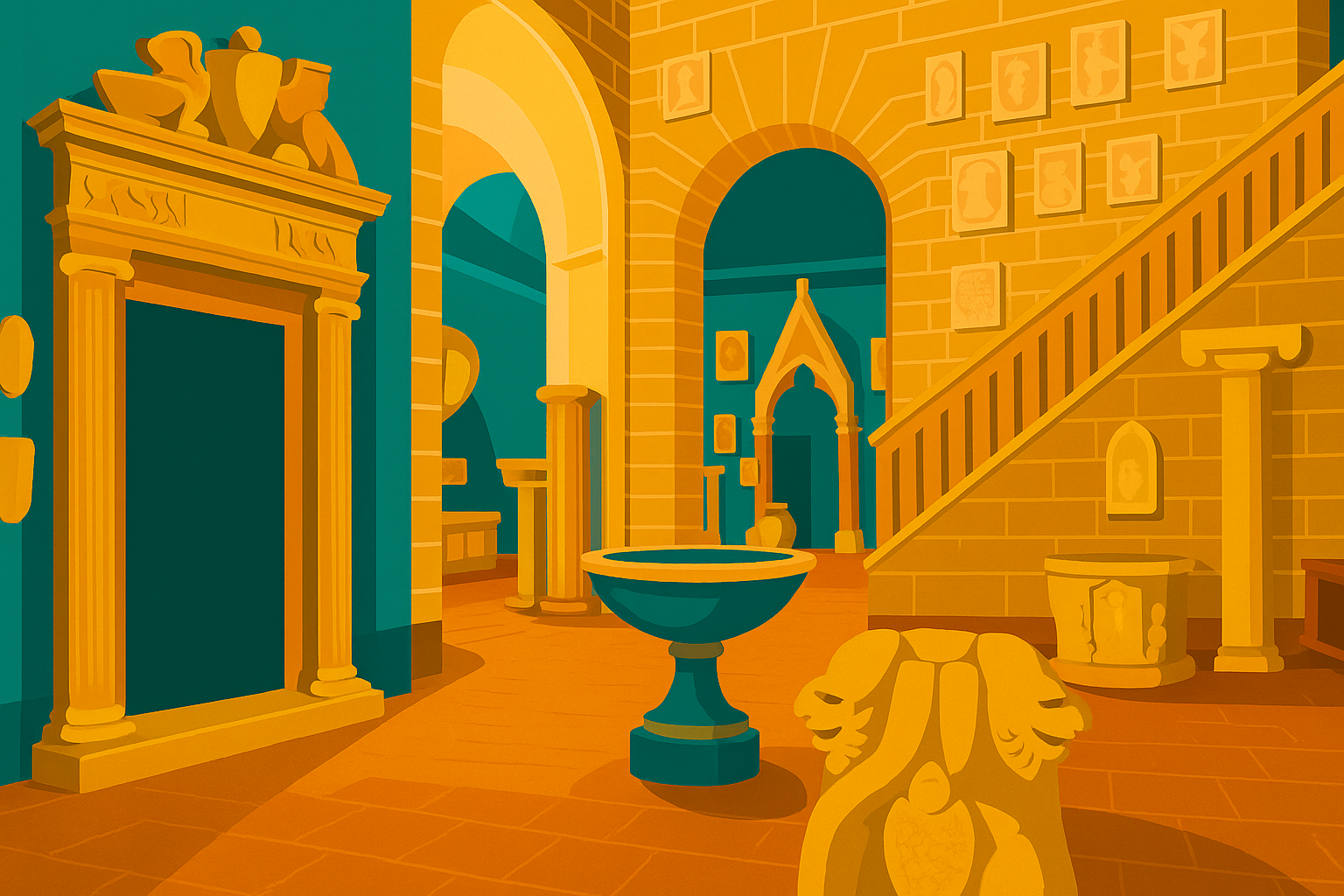
Stefano Bardini Museum
Experience the magic of Tuscany
Imagine driving through the Chianti hills, discovering medieval villages, and stopping for an aperitivo at sunset. Renting a car is the secret to experiencing Tuscany with true freedom. Book now for the best choice.
🔍 Choose your car for TuscanyIn a city defined by the monumental legacies of the Medici and the Renaissance masters, there exists a different kind of sanctuary. Tucked away in the artisan-rich Oltrarno district, far from the thrumming crowds of the Uffizi, the Museo Stefano Bardini is not a gallery of state power or religious devotion. It is something far more personal and audacious: the perfectly preserved showroom and creative mind of a man known in his time as “the Prince of Antiquarians.”
To step inside the palazzo at Via dei Renai, 37, is to enter the world of Stefano Bardini (1836–1922), a legendary 19th-century connoisseur who built an empire by amassing, restoring, and selling Europe’s artistic heritage. This is not a museum where history is presented in quiet, chronological order. It is a theatrical stage, a carefully curated environment where Roman sarcophagi converse with medieval armour and Renaissance sculptures pop against a backdrop of intense, revolutionary blue.
Bequeathed to the city in 1922, this collection of over 3,600 works remains one of Florence’s most cherished secrets. Despite its high Cultural Interest Score of 90, its low Popularity Score of 40 makes it an oasis of peace. For the discerning traveller, it offers a rare chance for solitude and an intimate immersion into the world of 19th-century art dealing, a world that shaped the very collections we see in museums across the globe today.
The Allure of the Antiquarian’s Showroom
The first thing that strikes you upon entering the Museo Bardini is not a specific sculpture or painting, but a colour. The walls are bathed in a deep, dramatic, and immersive hue known internationally as “Bardini Blue.” This is no mere decorative choice; it is a masterstroke of museological history and commercial psychology. Bardini, a brilliant restorer and savvy dealer, understood that presentation was everything. He chose this intense cobalt, possibly inspired by the rich glazes of the Della Robbia terracottas he so admired, to make his objects sing.
Against this stunning, theatrical backdrop, the white marble of Renaissance reliefs, the gleam of polished bronze, and the vibrant colours of polychrome wood are thrown into sharp relief. Every detail seems to visually “pop,” allowing the artistry to command your full attention. This innovative aesthetic was so successful that it was widely imitated, most famously by the American collector Isabella Stewart Gardner, who went to great lengths to secure the exact recipe for her own museum in Boston.
This atmosphere of curated opulence is reinforced by the deliberate arrangement of the collection. Bardini rejected the rigid, academic displays of institutional museums. Instead, he staged his objects to create evocative “scenes,” designed to capture the imagination of his wealthy international clientele. A 16th-century Tuscan ceiling might loom over a Roman sarcophagus; decorative *cassoni* (painted chests) are placed near suits of medieval armour. This intentional eclecticism was a powerful statement: art should be appreciated not just for its historical context, but for its sheer power to transform and elevate a space. The result is the intoxicating feeling of stepping into a sophisticated collector’s private vault, where time is organized by aesthetic harmony rather than historical sequence.
A Palace Built from History: The Story of Stefano Bardini
The museum’s story is inseparable from the life of its creator. Stefano Bardini began his career as a painter but soon discovered his true calling in the restoration and sale of art. He was perfectly positioned to capitalize on two major shifts transforming Florence in the latter half of the 19th century: a booming international demand for Italian Renaissance heritage and the city’s massive urban renewal project, the *Risanamento*.
The Prince of Antiquarians and a Changing Florence
As large parts of Florence’s medieval core were demolished to make way for modern boulevards, Bardini became a master of salvage. He acquired entire architectural features—original doors, carved architraves, stone fireplaces, and magnificent coffered ceilings—before they were lost to the wrecking ball. In this sense, his collection is a powerful, tangible record of a Florence that has since disappeared, a library of the city’s architectural soul.
His genius lay in presenting these salvaged fragments and decorative arts within the evocative, Neo-Renaissance setting of his palace. He purchased the 13th-century church and convent of San Gregorio alla Pace in 1881 and spent decades transforming it into his ultimate commercial showcase. By elevating items like *cassoni* and *spalliere* (painted furniture panels) in this grand environment, he revolutionized how antique wares were exhibited, making them intensely desirable to collectors across Europe and America.
Highlights of the Collection
While the collection is vast and eclectic, several masterpieces demand special attention. Here you will find the famed original bronze statue of Il Porcellino by Pietro Tacca, thankfully removed from the Mercato Nuovo to protect it from the elements. Other highlights include Antonio del Pollaiolo’s dramatic 15th-century painting, *St. Michael Archangel Defeating the Dragon*, and early sculptural marvels like *Charity* by Tino di Camaino and the *Madonna dei Cordai*, attributed to Donatello. The sheer breadth of objects—from Roman antiquities and Islamic rugs to Renaissance maiolica and antique musical instruments—is a direct reflection of Bardini’s intensely personal and eclectic taste.
The Building as an Artifact
Ultimately, the most spectacular artifact in the Museo Bardini may be the palazzo itself. This is not simply an old building housing a collection; it is a curated environment built *from* historical components. Bardini meticulously incorporated his salvaged architectural fragments into the structure. The windows illuminating the first floor, for example, were repurposed from the altars of a demolished church in Pistoia. The magnificent coffered wooden ceilings, dating from the 15th to the 17th centuries, are not reproductions; they are genuine masterpieces from Tuscan and Venetian palaces, installed to bestow an immediate sense of Renaissance grandeur. This synthesis of disparate historical fragments makes the building a unique composite artifact, a testament to Bardini’s vision as both a savvy restorer and an artistic showman.
Planning Your Visit: Practical Information
A visit to the Museo Bardini requires a little planning, as its schedule reflects its status as a specialized civic museum focused on preservation and visitor experience.
Opening Hours and Tickets
The museum is accessible on just four days of the week: Friday, Saturday, Sunday, and Monday, from 11:00 to 17:00. It is reliably closed on Tuesdays, Wednesdays, and Thursdays, as well as on major holidays like New Year’s Day and Christmas. Be sure to plan your trip accordingly.
Admission offers excellent value.
- Full Price Ticket: €7.00
- Reduced Price: Available for young adults (18–25) and university students.
- Free Admission: For visitors under 18 and those with disabilities.
The museum is also included in the Firenze Card, making it an easy addition to a wider itinerary. To truly absorb the atmosphere and appreciate the details, plan for a visit of 90 to 120 minutes. Note that the last admittance is strictly one hour before closing time.
How to Get There
The museum is ideally located in the Oltrarno district on the south bank of the Arno, at coordinates 43.7651° N, 11.2584° E. It feels wonderfully removed from the main tourist crush while remaining easy to reach.
- By Foot: From the city centre near Piazza della Signoria, it’s a pleasant 10 to 15-minute walk. The most scenic route is across the Ponte alle Grazie, which leads you almost directly to Piazza de’ Mozzi, where the museum stands.
- By Public Transport: The area is well-served by Florence’s compact electric buses. Lines C1, C3, and C4 are the most relevant, with the Mozzi stop located just a minute’s walk from the entrance. From the main train station, Firenze Santa Maria Novella (SMN), it is about a 17-minute walk or a short bus ride.
Facilities and Accessibility
In keeping with its character as a historic showroom, the museum forgoes large commercial facilities. You will not find a café or an extensive gift shop, a choice that helps preserve its tranquil and intimate atmosphere.
Crucially, the museum is exceptionally accessible, with an Accessibility Score of 95. Elevators and ramps are installed along the main exhibition routes, ensuring visitors with limited mobility can access nearly all areas of the collection. Accessible restrooms are also available.
Insider’s Guide to the Museo Bardini
To make the most of your visit, keep a few insider tips in mind. This is a place that rewards curiosity and a slower pace.
The Best Time for a Quiet Visit
The museum’s greatest advantage is its lack of crowds. Any day it’s open will feel peaceful compared to Florence’s major galleries. However, for maximum solitude, aim to arrive immediately after the 11:00 opening on a weekday (Friday or Monday). The early morning light beautifully illuminates the textures of the artifacts and the rich Bardini Blue walls before even small groups of visitors arrive.
For a truly unique perspective, watch for the occasional special evening openings organized by the Civic Museums. Seeing the collection under dramatic, controlled lighting is an unforgettable experience.
The Oltrarno Collector’s Route: What to See Nearby
The museum’s location makes it the perfect starting point for exploring the Oltrarno. The essential complement to your visit is the adjacent Giardino Bardini. The museum ticket often includes access to these magnificent gardens, which slope up the hill towards Forte Belvedere and offer some of the most breathtaking panoramic views of Florence.
Here is a strategic itinerary that uses the complex as an elegant and crowd-free shortcut:
- Visit the Museo Bardini first.
- Enter the adjacent Giardino Bardini and ascend the beautiful Baroque staircase through the terraced gardens.
- From the upper exit of the Bardini Gardens, you will find yourself near Forte Belvedere and, crucially, just across a small street from the often-overlooked rear entrance to the vast Boboli Gardens.
This tactic allows you to enter the Boboli Gardens while completely avoiding the long queues typically found at the main Palazzo Pitti entrance. For a full “Collector’s Route,” you can then explore the Palazzo Pitti and the nearby Museo Horne, another intimate house museum dedicated to Renaissance art.
Capturing the Perfect Shot: Photo Spots
The Museo Bardini is a photographer’s dream, offering dramatic contrasts and rich textures.
- The Bardini Blue Walls: This is the most iconic shot. Frame a white marble bust or a piece of Della Robbia ceramic against the rich blue background for a powerful, high-contrast image.
- The Coffered Ceilings: Don’t forget to look up! The collection of original 15th to 17th-century wooden ceilings offers incredible opportunities for detailed, textured overhead shots.
- The Courtyard: The central *cortile* provides classic Italian architectural elements and a wonderful sense of scale, especially when framing some of the monumental pieces housed there.
- The Panorama: The ultimate panoramic shot of Florence isn’t in the museum itself, but from The Belvedere viewpoint in the Giardino Bardini. From here, you can capture that postcard-perfect vista of the Duomo and Palazzo Vecchio.
The Final Secret: Uncovering “Hitler’s Carpet”
The Museo Bardini is more than a collection of beautiful objects; it is a place where history, both distant and startlingly recent, resides. Before you conclude your visit, there is one final object you must find—one that bridges 15th-century Persia with the darkest moments of 20th-century Europe.
Ascend the main stairwell and look for the massive, elaborate Persian Hunting Carpet (Inventory 2198) mounted on the front wall. In local lore, this magnificent textile is known as “Hitler’s Carpet.” It is reputed to have been laid out at Florence’s main train station to welcome Adolf Hitler on his official visit on May 9, 1938. Legend holds that it was damaged by his military spurs as he disembarked. If you look closely, you can discern a visible cut, now carefully stitched, a physical scar on this luxurious antique. This object transforms from a beautiful furnishing into a powerful, tangible touchstone of modern history—a compelling reminder that even the most secluded collections can be marked by the sweep of global events.