
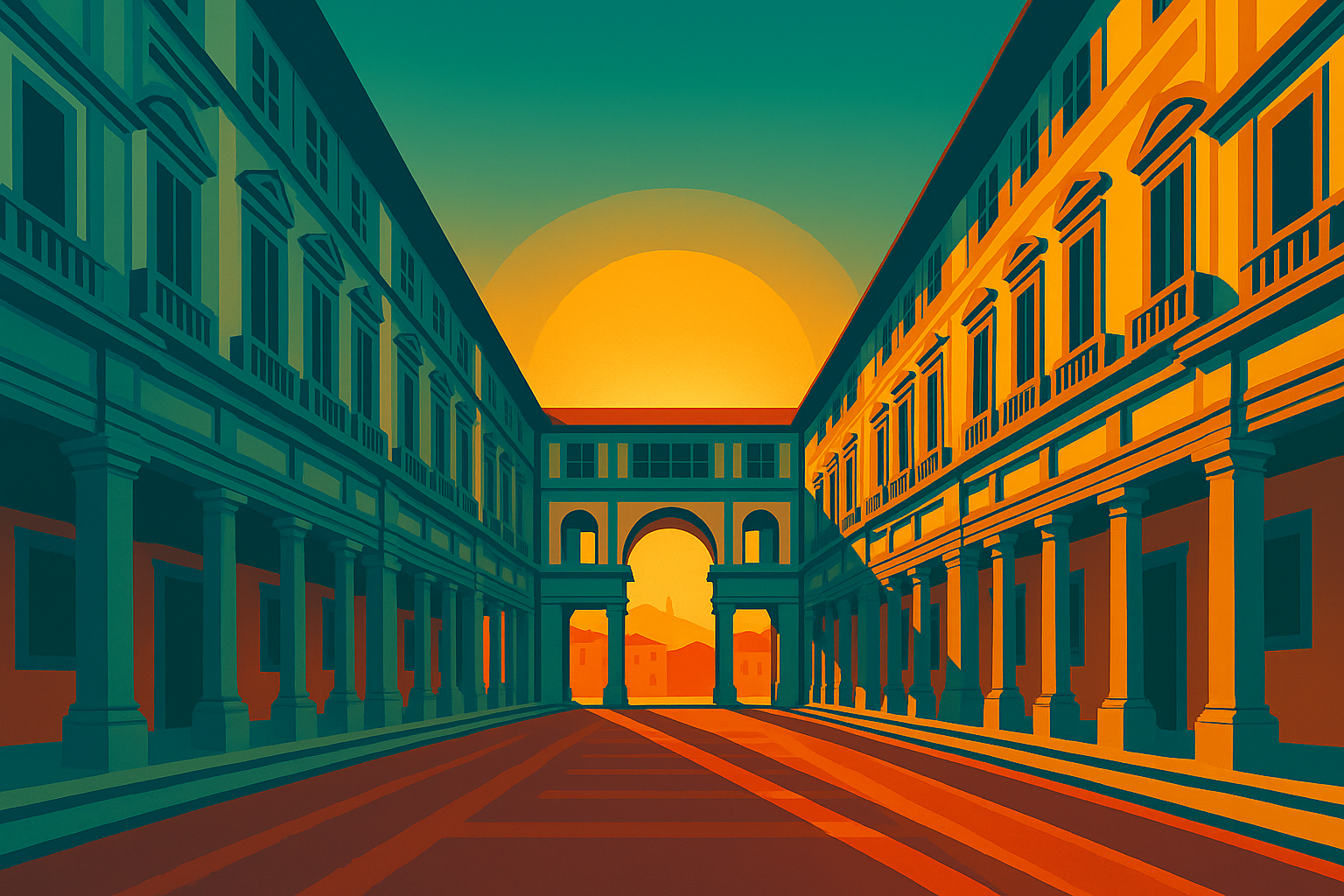
Uffizi Gallery
Experience the magic of Tuscany
Imagine driving through the Chianti hills, discovering medieval villages, and stopping for an aperitivo at sunset. Renting a car is the secret to experiencing Tuscany with true freedom. Book now for the best choice.
🔍 Choose your car for TuscanyThe Uffizi Gallery: A Journey Through the Heart of the Renaissance
To step into the Galleria degli Uffizi is to walk directly into the heart of the Western world’s imagination. The sound of your footsteps echoing on the grey pietra serena stone floors, the silent procession of Roman sculptures lining the corridors, the soft light pouring in from the courtyard—every element combines to create an atmosphere of profound historical weight. This is not merely a museum; it is arguably the world’s first modern museum, a place that has defined our very concept of what a gallery should be.
Yet, the Uffizi was never intended to be a museum. To understand its power, and to navigate its halls wisely, you must first understand its original purpose. It was commissioned in 1560 not for art, but for power. Cosimo I de’ Medici, the first Grand Duke of Tuscany, wanted a single, magnificent building to house the Florentine magistrates—the uffizi, or “offices”. The grand, U-shaped structure was a physical manifestation of his new, centralized government, an imposing symbol of Medici authority.
This dual identity—as a 16th-century power centre and a priceless collection of art—is what makes a visit so extraordinary. It is also what makes it, frankly, overwhelming. The Uffizi is home to the greatest collection of Renaissance paintings on Earth, and the entire world knows it. This guide is designed to help you navigate both the masterpieces and the modern-day logistical challenges, providing a strategic plan to avoid the crowds and experience the Uffizi as it was meant to be seen: as a stunning, chronological journey through the birth of humanism.
The Uffizi’s Dual Soul: From Power to Painting
The atmosphere of the Uffizi is dictated by its architecture. Giorgio Vasari, the architect, designed the two long, parallel wings to function as a kind of theatrical stage, an extension of the adjacent Piazza della Signoria, the city’s political epicentre. As you walk the U-shaped corridors, you are walking through a 16th-century statement of absolute power.
A Symbol of Absolute Power
The symbolism is layered and deliberate. The corridors themselves are lined with an invaluable collection of ancient Greek and Roman sculptures, meticulously collected by the Medici. This was no accident. By surrounding their “offices” with the art of antiquity, the Medici were visually linking their new dynasty to the golden age of Imperial Rome, positioning themselves as its rightful heirs.
Look up. The ceilings of the long corridors are covered in intricate grotesque frescoes, painted in the 1580s. These elaborate, whimsical designs were directly inspired by the decorations found in the recently excavated ruins of ancient Rome, such as Nero’s Golden House. The frescoes are a deliberate and brilliant piece of political branding, created to exalt “the glory of Tuscany and the House of Medici”. Every step you take is beneath a ceiling designed to reinforce their cultural and political dominance.
The Birth of a Museum
The Uffizi’s transformation from a political building to a public museum is one of the most important stories in art history, unfolding in three distinct acts.
Act I: The Commission (1560)
The story begins with Cosimo I de’ Medici. Having consolidated power and declared himself Grand Duke of Tuscany, he needed to centralize the state. He commissioned his trusted architect and, as some call him, history’s first “spin-doctor,” Giorgio Vasari, to build the uffizi. The location was everything: it physically connected the Palazzo della Signoria (the seat of government) to the Arno River, creating a new, modern, and imposing centre of state administration.
Act II: The Transition (1581)
Cosimo’s son, Francesco I de’ Medici, was less a politician and more a reclusive collector obsessed with art and alchemy. He decided to use the top-floor loggia of the “offices” to house his family’s spectacular, and rapidly growing, private art collection. This culminated in the 1584 completion of the Tribuna. This unique octagonal room was the original heart of the gallery, a “wonder room” that showcased the Medici’s most priceless jewels and paintings. It became an obligatory, legendary stop for wealthy nobles on their “Grand Tour” of Europe.
The Pact That Saved the Renaissance
Act III: The Pact (1737–1743)
This is the single most important event in the museum’s history. The Medici dynasty, after centuries of rule, died out. The last heiress, Anna Maria Luisa de’ Medici, was left to decide the fate of an art collection that was, by law, her private property.
In an act of unprecedented vision, she signed the Patto di famiglia (Family Pact) in 1737. This legal document bequeathed the entire Medici collection—from the Uffizi, the Pitti Palace, and all their villas—to the new rulers (the House of Habsburg-Lorraine) and, by extension, to the city of Florence itself. Crucially, the pact included a legal clause, an “unprecedented stipulation”, that forbade any of the artworks from ever leaving Florence.
This single document is the only reason the Uffizi’s collection exists today. It transformed a private dynastic treasure into a permanent public heritage, forever securing Florence’s identity as the cradle of the Renaissance. In 1769, the new Grand Duke officially opened the gallery to the public, establishing it as one of the world’s first modern museums.
Navigating the Masterpieces: A Practical Guide
A visit to the Uffizi demands a plan. Without one, you risk spending more time in queues and crowded rooms than in quiet contemplation of the art. Here’s how to approach your visit strategically.
Opening Hours and Ideal Duration
The Uffizi Gallery is open from Tuesday to Sunday, 8:15 AM to 6:30 PM (18:30). The ticket office closes at 5:30 PM (17:30), and visitors are asked to head to the exits around 6:30 PM. The museum is closed every Monday, and on January 1 and December 25.
Plan to spend a minimum of 3 to 4 hours inside. The collection is so dense with masterpieces that “museum fatigue” is a real and present danger. A focused 3-hour visit is enough to see the essential highlights without feeling completely overwhelmed.
The Ticketing Strategy: How to Beat the Queues
Let us be clear: standing in the general admission line is a “traumatic ordeal” that can consume two to three hours of your precious vacation time. Booking your tickets in advance is not optional; it is mandatory.
The primary source of confusion for travellers is the number of third-party websites and “fake” resellers selling tickets at inflated prices. Book only through the official ticketing portal: b-ticket.com.
The pricing structure can also be confusing. Here is a clear breakdown:
- Standard Full Ticket: The base price is €25.00.
- The Real Price: When you book in advance (which you must), a €4.00 mandatory reservation fee is added. Therefore, the realistic, non-negotiable price for a pre-booked ticket is €29.00.
Here are the best ticket options for smart travellers:
- “Early Morning” Ticket: This is the best deal the Uffizi offers. For entry before 8:55 AM, the base price is reduced to €19.00 (plus the €4.00 reservation fee). This is your golden ticket to seeing the masterpieces in relative peace.
- Passepartout 5 Days: For €38.00, this pass gives you one timed entry to the Uffizi, plus one entry each to the Pitti Palace and the Boboli Gardens, valid over five consecutive days. If you plan to visit these other essential Medici sites, this pass offers excellent value.
- Uffizi + Vasari Corridor Ticket: A combined ticket that includes timed entry to both the Uffizi and the newly reopened Vasari Corridor.
The Best Time for a Peaceful Visit
Your experience of the Uffizi will be defined by one thing: the crowds. At peak times, craning to see over rows of heads just to glimpse Botticelli’s Venus is the norm. A smart strategy is essential.
- Best Season: The “low season” from November to January is, by far, the most pleasant time to visit, with significantly fewer crowds.
- Best Day: Weekdays (Tuesday–Friday) are noticeably less crowded than weekends.
- The Free Day Trap: Avoid the first Sunday of the month. Admission is free, and as a result, the museum is “literally packed”. The experience is so compromised that many local guides refuse to work on this day.
There are two “golden windows” for visiting:
- First Entry (8:15 AM): This is your best option. Purchase the “Early Morning” ticket. You will get about half an hour with very few people. Use this time to go directly to the Botticelli rooms (10–14) and see the masterpieces in peace.
- Late Afternoon (after 4:00 PM): The large tour groups have departed for the day. The galleries begin to empty as closing time approaches, and the light in the corridors is often beautiful and soft.
The Building Itself: Architecture and Secrets
While the art inside is the main draw, the Uffizi building is a masterpiece in its own right, full of stories and hidden perspectives.
The Vasari Corridor: A Prince’s Private Highway
The Uffizi’s most famous and unique architectural feature is, without question, the Vasari Corridor (Corridoio Vasariano). This “secret” passageway is the ultimate expression of Medici power.
In 1565, just five years after work on the Uffizi began, Giorgio Vasari built this enclosed, elevated pathway in an astonishing five months. At 750 meters long, it was a private highway that allowed the Medici family to walk “undisturbed and without running risks to their safety” from their seat of government (Palazzo Vecchio), through the Uffizi, over the shops of the Ponte Vecchio, and to their new, grand private residence, the Palazzo Pitti, on the other side of the Arno. While common people walked the muddy streets and crowded bridge below, the Duke and his family walked above them, unseen. It is a stunning, physical symbol of the separation between the ruler and the ruled.
After a major, multi-year restoration, the Vasari Corridor reopened to the public in late 2024. A visit is now a separate, premium-ticketed experience that runs one-way, from an entrance in the Uffizi, across the Ponte Vecchio, and exits into the Boboli Gardens.
Don’t Miss: The Best Photo Opportunities
While you are there to see the art, the building itself offers some of Florence’s most iconic photographic opportunities. Remember that for personal use, photography is allowed, but with strict rules: NO flash, NO selfie sticks, and NO tripods.
- The “Postcard Shot” of Ponte Vecchio: On the second floor, at the far end of the U-shaped corridor (the short hallway connecting the East and West wings), there is a large window. This offers the single best aerial view of the Ponte Vecchio and the Arno River.
- The “Architectural Shot” of Palazzo Vecchio: Head to the cafeteria terrace. This spot provides a unique, elevated, and intimate view of the Palazzo Vecchio’s tower and the Duomo’s dome, framed by the Uffizi’s own roofline.
Your Visit: Practicalities and Insider Tips
A smooth visit is a well-planned visit. Here are the essential details to make your experience seamless.
How to Get to the Uffizi
The Uffizi is located at Piazzale degli Uffizi, 6, in the very heart of historic Florence, steps from the Piazza della Signoria and the Arno River.
- On Foot (Highly Recommended): The historic centre of Florence is compact and best explored on foot. From the main Santa Maria Novella (SMN) train station, the Uffizi is a beautiful 15 to 20-minute walk. Simply follow the signs for the Duomo, then walk down the main pedestrian street, Via dei Calzaiuoli, to the Piazza della Signoria. The Uffizi is the grand, U-shaped building extending from the piazza’s corner.
- By Public Transport: If you are coming from farther out or have mobility concerns, the small electric ATAF buses are your best option. Lines C1 and C3 navigate the historic centre and have stops near the Piazza della Signoria, a very short walk from the museum entrance.
- Important: Do Not Drive: The Uffizi is located deep inside Florence’s Zona a Traffico Limitato (ZTL), or Limited Traffic Zone. Driving into this zone without a special permit will trigger automatic cameras and result in a very expensive fine being mailed to your home, often months later.
Facilities and Services
The Uffizi is well-equipped with modern visitor services, though they can be strained during peak hours.
- The Mandatory Cloakroom: A free cloakroom is available on the ground floor. You are required to check all backpacks, large bags, and umbrellas. To save time and avoid a second line, travel light. Bring only a small purse or shoulder bag that you can carry with you.
- Accessibility: The Uffizi is highly accessible for visitors with mobility challenges. Lifts and accessible toilets are available. Most importantly, persons with a certified disability and one accompanying family member are entitled to free, priority admission. You do not need to book in advance; simply present your certification at the reception desk.
- Bookshops and Cafeteria: There are several bookshops, but the most strategic facility is the cafeteria, located on the second floor at the end of the main galleries. While the coffee is standard, its panoramic terrace is one of the museum’s best-kept secrets. It offers a priceless opportunity to rest your feet and enjoy a stunning, close-up view of the Palazzo Vecchio’s tower and the Duomo.
An Insider’s Secret to Beating Museum Fatigue
Your visit will be overwhelming. Accept this. Do not try to see everything. Instead, use the museum’s cafeteria as a strategic mid-point.
After you’ve seen the Botticelli, Leonardo, and Michelangelo rooms, stop. Go to the terrace. Have a cappuccino, look out at the Palazzo Vecchio, and let your mind reset for 20 minutes.
This break is the key to conquering “museum fatigue” and having the energy to truly appreciate the masterpieces by Titian and Caravaggio on the way out.
Beyond the Uffizi: Connecting the Medici Dots
The Uffizi is not an isolated attraction; it is the anchor of Florence’s entire political and cultural centre. A visit here is perfectly complemented by seeing the surrounding sites, which tell the rest of the Medici story.
- Piazza della Signoria: You are standing in it. This L-shaped square is Florence’s historic heart, an open-air sculpture gallery, and the site of centuries of political drama.
- Loggia dei Lanzi: Adjacent to the Uffizi, this 14th-century arched pavilion functions as a free, 24/7 sculpture museum, housing masterpieces like Cellini’s bronze Perseus with the Head of Medusa.
- Palazzo Vecchio: The towering, fortress-like town hall. This was the Medici’s first palace and the “office” that the Uffizi was built to serve.
- Ponte Vecchio: The iconic bridge, lined with jewellers, is just steps from the Uffizi courtyard. The Vasari Corridor runs directly over it.
- Palazzo Pitti and Boboli Gardens: Located across the river, this was the destination of the Vasari Corridor. The Pitti was the Medici’s vast, opulent private residence. Using the Passepartout 5 Days ticket to see the Uffizi on day one and the Pitti/Boboli on day two is the perfect way to trace the full arc of Medici power.
A visit to the Uffizi is a pilgrimage. It is not a casual afternoon; it is a dense, chronological, and often overwhelming encounter with the very foundations of Western art. It demands patience and, above all, a plan. The reward for this preparation is not just checking masterpieces off a list, but witnessing, room by room, the birth of humanism and the profound, enduring power of beauty.