
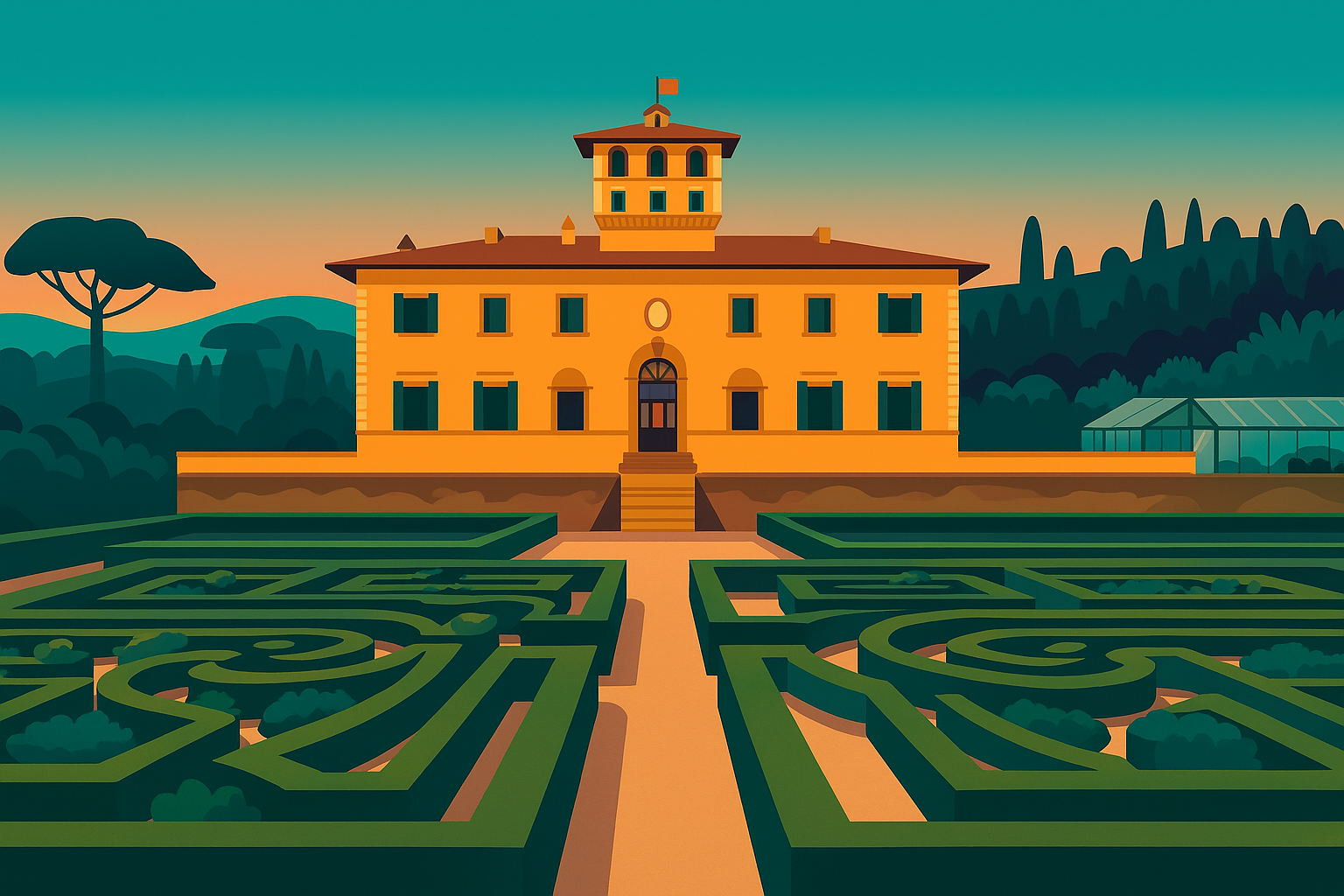
Medici Villa della Petraia and Garden of the Medici Villa di Castello
Experience the magic of Tuscany
Imagine driving through the Chianti hills, discovering medieval villages, and stopping for an aperitivo at sunset. Renting a car is the secret to experiencing Tuscany with true freedom. Book now for the best choice.
🔍 Choose your car for TuscanyThe Medici Alpha and Omega: A Guide to the Twin Villas of Castello and La Petraia
From the highest terrace of the Villa La Petraia, Florence is not a city; it is a map laid at your feet. The view from this belvedere is a deliberate act of possession, a visual mastering of a territory that the Medici dynasty commanded for three centuries. While the Uffizi Gallery and the Pitti Palace, located in the city’s heart, showcase the spectacular results of Medici power, the origin story of that power—its philosophical and political foundations—is told right here, on these quiet, cypress-studded hills.
In the Florentine suburb of Castello, two magnificent villas form a single, essential narrative. This is a combined UNESCO World Heritage site that most visitors, pressed for time and unaware of its significance, unfortunately miss. They are the Villa di Castello, the “Alpha,” and the Villa La Petraia, the “Omega.” To visit one without the other is to read only half the story.
Castello is the philosophical origin. Its garden is not merely a garden; it is a political manifesto carved into the landscape, the original prototype of the 16th-century Italian garden that would serve as the blueprint for the more famous Boboli. La Petraia, just a short walk away, is the grand residential palace. It is the “Omega,” the dynasty’s triumphant celebration of its own history, where monumental frescoes proclaim its achievements, and where subsequent rulers, from the House of Lorraine to the first King of Italy, layered their own legacies.
This guide treats them as they were intended: a single, seamless half-day journey. We will decode the symbolism of the gardens, provide the crucial, updated logistics for the new paid admission (the “free entry” era is over), and explain how to navigate the physical and art-historical path that binds these two extraordinary sites.
The Medici Mindset: From Philosophy to Propaganda
To walk from Castello to La Petraia is to walk from political theory to dynastic propaganda, and the atmosphere of each is distinctly different. It’s a journey from the mind of a young, ambitious duke to the confident legacy of an established dynasty.
The Giardino di Villa di Castello is contemplative, green, and rigorously structured. It feels less like a park and more like an outdoor university, a space designed for thought and reflection. When the 19-year-old Cosimo I de’ Medici commissioned this garden in 1537, he was a new, insecure ruler. He couldn’t just build a pleasure garden; he needed to legitimize his rule. He ordered his architect, Niccolò Tribolo, to create a complex allegory of “good government” (*buongoverno*).
The garden’s perfect harmony and geometric order were a metaphor for the new, stable order Cosimo promised to bring to Tuscany. Its elaborate fountains and revolutionary hydraulic systems symbolized the Medici taming both nature (the rivers of Florence) and their political enemies. This was the very space for which Botticelli’s *Primavera* and *The Birth of Venus* were originally commissioned decades earlier, a deliberate act by the family to link Cosimo’s new “Golden Age” to the classical ideals of Venus, the matron of Florence.
Villa La Petraia, by contrast, exudes a layered and confident grandeur. It feels like a home, albeit a magnificent royal one. The atmosphere is not one of subtle allegory but of magnificent, direct celebration. The heart of the villa is its central courtyard, where the *Fasti Medicei* (Medici Splendors), a massive 17th-century fresco cycle by Volterrano, abandons all subtlety. It is a glorious, direct proclamation of the family’s achievements, commissioned long after their power was secured. This Renaissance courtyard was then spectacularly transformed in the 19th century by the House of Savoy, which covered it with a soaring iron-and-glass roof, creating a light-filled grand ballroom—a unique space where 17th-century Baroque art meets 19th-century industrial engineering.
A Walk Through History: From Fortress to Palace
Both sites began their lives as medieval fortified structures, their strategic positions on the hills overlooking Florence prized for defense long before they were valued for their views. La Petraia was a “palace” first owned by the Brunelleschi family and later by their rivals, the Strozzi. Its imposing central tower, still the villa’s dominant feature, is the most visible remnant of this turreted, castle-like past. Castello was similarly a 14th-century complex, nicknamed “Il Vivaio” (The Nursery) for the large water basins on its land.
The Medici transformation began in the 15th century when the junior branch of the family acquired Castello in 1477. This is where the young Lorenzo di Pierfrancesco was educated by the great humanist philosopher Marsilio Ficino and where he commissioned Botticelli’s mythological masterpieces. The property passed to Grand Duke Cosimo I in 1537, who immediately began its symbolic redesign into the political garden we see today.
Cosimo I acquired La Petraia in 1544 and later gave it to his son, Cardinal Ferdinando I de’ Medici, in 1568. When Ferdinando became Grand Duke, he launched a massive restoration, transforming the “stony” (*petraia*) fortress into the elegant model of a Tuscan country villa.
The key to understanding the villas’ current state lies in what happened after the Medici. When the dynasty died out in the 18th century, the properties passed to the House of Habsburg-Lorraine. In 1788, Grand Duke Peter Leopold of Lorraine made a decision that fundamentally altered both sites: he ordered the “Great Art Migration.” He dismantled Castello’s symbolic program by moving its most important sculptures. The original bronze *Hercules and Antaeus* by Ammannati and, most famously, Giambologna’s iconic *Venus/Florence*, were transferred from Castello’s garden to the interior of La Petraia for preservation. This act demoted Castello to a simple (though beautiful) garden and elevated La Petraia to the status of a primary treasure house.
Later, after the Unification of Italy, La Petraia became a favorite residence of King Vittorio Emanuele II and his morganatic wife, “La Bela Rosin.” It was they who installed the ballroom roof and filled the apartments with the rich Savoyard furniture seen today, making the villa a museum of both Medici and royal 19th-century taste.
What to See: The Unmissable Highlights
Villa di Castello: The Garden as a Manifesto
A critical point for visitors: the Villa di Castello itself is closed to the general public. Since 1966, it has housed the prestigious Accademia della Crusca, the official guardian of the Italian language. Therefore, the Giardino (Garden) is the sole attraction, and it is magnificent.
- The Citrus Collection: This is the garden’s undisputed crown jewel. It is an “exceptional collection” of between 500 and 1,000 enormous potted citrus trees, many of which are direct descendants of the original Medici varieties. Some of these gnarled, sculptural specimens are over 300 years old. In winter, they are stored in the historic *limonaie* (lemon houses) that flank the upper terrace.
- The Grotto of the Animals (Grotta degli Animali): This fantastical, man-made cave, designed by Tribolo and Vasari, was a marvel of hydraulic engineering. It was designed with spectacular water features and populated with sculptures of animals to represent Cosimo’s dominion over a peaceful, harmonious world. After a long restoration, it has recently reopened to the public, offering a glimpse into Renaissance wonder.
- The Fountains: The garden still features the monumental Fountain of Appenino (also called January) by Ammannati. In the center stands a 20th-century copy of the *Hercules and Antaeus* fountain; the priceless original is now safely indoors at La Petraia.
- The Secret Garden (Ortaccio): Within this medicinal herb garden is the *Stufa dei Mugherini*, a special greenhouse built to protect the rare and intensely fragrant Indian jasmine (“mugherino”) from Goa, a plant the Medici prized above almost all others.
Villa La Petraia: The Palace as a Celebration
Here, both the villa and the garden are the main event, and gaining access to the interior is essential to completing the story.
- The Courtyard/Ballroom: The villa’s heart is the 16th-century arcaded courtyard, transformed in the 1860s by the Savoy into a breathtaking ballroom. The 19th-century glass and iron roof floods the space with light, illuminating the priceless frescoes within and creating an unforgettable architectural fusion.
- The Fresco Cycles: This is what you come to see inside. Two magnificent, competing cycles cover the walls. The first, by Cosimo Daddi (16th C.), was commissioned by Cristina of Lorraine and depicts the Deeds of Goffredo di Buglione (Godfrey of Bouillon) at the siege of Jerusalem—a savvy political move linking her French ancestry to the legendary crusaders. The second, more famous cycle is the 17th-century Fasti Medicei (Medici Splendors) by Volterrano. These are masterpieces of Florentine Baroque painting, a glorious and propagandistic testament to Medici power.
- The Terraced Gardens: La Petraia boasts its own perfect example of the Italian formal garden. It is arranged on three distinct terraces that exploit the hill’s steep slope, offering the famous panoramic view over Florence that so defined the villa’s purpose.
- The Original Sculptures: In rooms just off the courtyard, you can see the masterpieces moved from Castello. Here, protected from the elements, are Giambologna’s iconic bronze Venus/Florence and Ammannati’s powerful bronze group Hercules and Antaeus. Seeing them up close is a privilege.
Planning Your Visit: The New Rules and Logistics
This is the most critical update for any visitor. For decades, these villas were famously a “free” attraction. This policy has changed. As of 2024, to fund the conservation of these UNESCO sites, a new paid ticketing system is in effect.
Opening Hours and the New Paid Admission
- New Prices: A full-price ticket for Villa La Petraia (villa + garden) costs €8.00. A ticket for the Giardino di Villa di Castello also costs €8.00.
- Recommended Ticket: The best-value option is the Cumulative Ticket, which costs just €10.00 and grants one-time admission to both Villa La Petraia and the Castello Garden.
Both sites are closed on Mondays, January 1st, and December 25th.
Gardens (Both sites): Open Tuesday–Sunday, with seasonal hours.
- April–September: 8:30 AM – 6:30 PM (last entry 5:30 PM)
- October & March: 8:30 AM – 5:30 PM (last entry 4:30 PM)
- November–February: 8:30 AM – 4:30 PM (last entry 3:30 PM)
The Mandatory “Visita Accompagnata” at La Petraia
A non-negotiable rule for visiting the Villa La Petraia Interior is that you cannot wander freely. Access is only via an “accompanied visit” (*visita accompagnata*). These start at fixed times, approximately 9:30, 10:30, 11:30, 12:30, 14:00, 15:00, 16:00, with a 17:00 tour in summer. You must plan your day around these slots. Be aware that the tours are often only in Italian.
For a complete visit to both sites, plan for a half-day (4–5 hours). This allows ample time to explore both gardens and provides a buffer to align your arrival at La Petraia with the next available interior tour.
How to Get There (and the Uphill Walk)
The villas are located in the Castello neighborhood, approximately 5–8 kilometers northwest of the Florence city center.
- By Bus (Most Common): From the Santa Maria Novella (SMN) train station area, take bus line 2 or 28. The ride takes about 20–30 minutes. Aim for bus stops “Sestese 03” or “Sestese 5”.
- The Walk: Be Prepared. From the main road (Via Sestese), it is a 15-to-20-minute, steeply uphill walk to the villa entrances. This is not a casual stroll and requires comfortable shoes.
- By Train: A local *treno regionale* from SMN to Firenze Castello station is an option. From the station, it is a 15–20 minute walk to the villas.
- By Taxi: A taxi from the city center is the easiest and fastest method, and the only one that avoids the strenuous uphill walk.
The two properties are “almost a compact whole” and are only about 500 meters apart. It is an easy 10–15 minute walk along Via di Castello to get from one to the other.
Essential Know-Before-You-Go
It is essential to manage expectations. These are state-run historical museums, not private tourist attractions, and services are minimal.
- Facilities: Restrooms are available on-site. However, there is no major café, restaurant, or cloakroom. It is highly advisable to bring your own bottle of water, especially in summer.
- Information: On-site signage is limited, and English-language information can be sparse. The official unified website does mention an audioguide, which would be an invaluable companion if available.
- Accessibility: This is a significant challenge. The 16th-century terraced garden design is inherently inaccessible for those with mobility issues. The villas were built on steep hills to achieve their famous views, a design that necessitates many stairs.
- A Critical Clarification: Do not confuse the State Museum “Villa Medicea La Petraia” with the private luxury hotel “Villa La Petraia” located in Panzano in Chianti. The museum does not have a swimming pool, private chef, or guest rooms. They are entirely unrelated.
When to Go for the Full Medici Experience
Late spring (April, May, and June) is unequivocally the best time to visit. The reason is the citrus. This is the moment when the entire spectacular collection of 500+ ancient potted citrus trees is moved from its winter shelter in the *limonaie* and arranged on the outdoor terraces of the Castello garden. The air is filled with the sight and scent of these historic “bizzarrie” (citrus oddities).
Weekday mornings are ideal. The crowds are “non-existent” compared to the pandemonium of the Uffizi, allowing you to experience the gardens in peaceful solitude before joining one of the first villa tours at La Petraia.
Capturing the Villas: Best Photo Spots
The best photographs capture the distinct personality of each site.
At Villa La Petraia, three shots are iconic:
- The Panorama: The definitive view. From the highest terrace, frame the geometric box-hedges of the garden with the city of Florence and Brunelleschi’s distant Duomo in the background.
- The Ballroom: Stand in the center of the courtyard and shoot upwards, capturing the unique juxtaposition of the 17th-century *Fasti Medicei* frescoes with the 19th-century iron-and-glass Savoyard roof.
- Giambologna’s Venus: The beautifully lit bronze *Venus-Fiorenza* sculpture, now standing safely indoors, is a masterpiece of Renaissance sculpture.
At the Giardino di Castello, focus on the garden’s structure:
- The Citrus Aisles: The long, geometric perspectives created by the hundreds of enormous, ancient potted lemon and citrus trees are breathtaking, especially in late spring.
- The Grotto: The fantastical, mossy interior of the Grotta degli Animali, with its unique menagerie of sculpted animals, offers a strange and beautiful image of Renaissance ingenuity.
Beyond the Villas: Exploring the Medici Trail
Visiting Castello and La Petraia places you in the heart of the “Medici Trail.” For those with a deep academic or linguistic interest, the Accademia della Crusca (at Villa di Castello) does offer visits by reservation. This is a truly unique, off-path experience for specialists. Email meetlacrusca@crusca.fi.it for information.
If you have a car, consider a further trip to the Villa Medici di Poggio a Caiano, considered the “architectural pinnacle” of the villas, or the Parco di Pratolino (Villa Demidoff), famous for Giambologna’s colossal sculpture, the Appennine Colossus.
A Final Word of Advice
In a single, uncrowded half-day, you can trace the entire arc of the Medici story—from the raw political ambition of Cosimo I’s allegorical garden to the dynastic splendor of Ferdinando’s frescoed palace and the 19th-century domestic life of a King of Italy. You have walked from the prototype to the palace, from the Alpha to the Omega.
To truly appreciate the *Fasti Medicei* frescoes in the ballroom, you must ‘be your own guide.’ The mandatory tours are often only in Italian, so your own knowledge is what will transform the visit.
Read this article, or a good art history book, before you enter. Understanding the stories depicted on the walls—the battles, the marriages, the political triumphs—is what will turn a simple walkthrough into a profound cultural experience, allowing you to see the villas not just as beautiful buildings, but as the living embodiment of a dynasty’s soul.